OMNeT++
OMNeT++ is a modular C++ simulation library and framework used mainly to build network simulators.
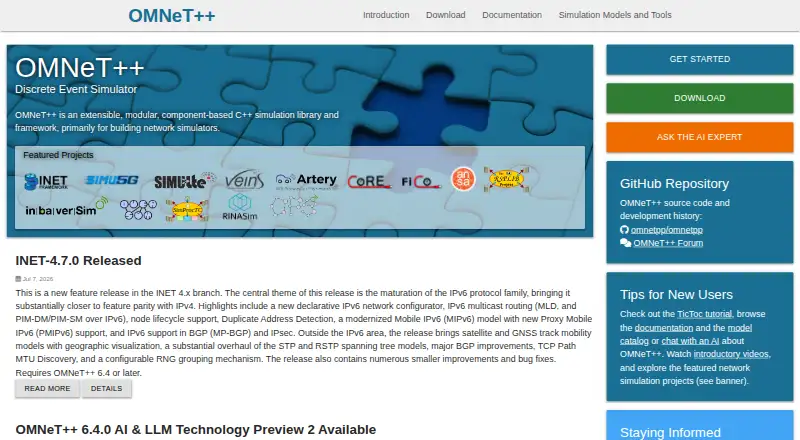
What OMNeT++ is
OMNeT++ is a modular C++ simulation library and framework used mainly to build network simulators. Its discrete-event models use communicating C++ modules, with structure described in the NED language. Simulations can run in Qtenv, a graphical environment, or Cmdenv, a command-line interface. The IDE Analysis Tool uses Pandas and Matplotlib to analyze and plot results; R and Matlab can also process them. Extensions cover real-time simulation, network emulation, database integration, and SystemC integration, while the INET model library includes Internet stack models and other protocols and components. Downloads are offered for Linux, Windows, and macOS, plus a core archive and container images. The project recommends opp_env for installation and WSL for its recommended Windows route. The Academic Public License permits noncommercial teaching and research; commercial use requires a separate license, with pricing on request. The project is used in scientific and industrial settings and states that it has no telemetry or account system.
Good
- Modular C++ framework for discrete-event simulation
- Graphical and command-line simulation interfaces
- Analysis supports Pandas, Matplotlib, R, and Matlab
- Extensions include real-time simulation and network emulation
- No telemetry or account system
Watch out
- Academic Public License is limited to noncommercial use
- Commercial license pricing is on request
- Recommended Windows installation uses WSL
Who it suits
OMNeT++ suits people building network simulations for noncommercial research or teaching, as well as scientific and industrial use cases. Commercial projects need a separate license.
Verdict
OMNeT++ offers a flexible simulation framework with multiple interfaces and analysis options. Its Academic Public License is for noncommercial work, so commercial users should account for separate licensing.
Plans and prices
From OMNeT++'s own pricing page, checked 30 Sep 2026.
| Plan | Price | What it gives you |
|---|---|---|
| OMNeT++ Academic Public License | Free | Free for noncommercial use, including teaching and research; commercial use requires a separate license; redistribution of copies and modifications is subject to the license terms |
| Commercial license | Priced on request | Commercial licensing is offered through OMNEST; pricing is provided on request |
The facts
Each one read from OMNeT++'s own pages, with the date it was checked.
What it does
- AI preview
- The AI technology preview adds a Qtenv chat interface and an MCP server for querying and manipulating active simulations, and is listed for Linux x86_64 and macOS aarch64.checked 30 Sep 2026
- Analysis
- Its IDE Analysis Tool uses Pandas and Matplotlib to analyze and plot simulation results, which can also be processed with R or Matlab.checked 30 Sep 2026
- Evaluation
- OMNEST says OMNeT++ can be used for limited-length evaluations, while its evaluation page offers a request-based download.checked 30 Sep 2026
- Extensions
- The site describes extensions for real-time simulation, network emulation, database integration, and SystemC integration.checked 30 Sep 2026
- Installation
- The project recommends opp_env to install OMNeT++ and other models and frameworks; on Windows its recommended route uses WSL.checked 30 Sep 2026
- Intended users
- The maker describes OMNeT++ as popular in scientific and industrial settings and lists research and teaching as noncommercial use cases.checked 30 Sep 2026
- Interfaces
- OMNeT++ includes a graphical runtime environment called Qtenv and a command-line simulation interface called Cmdenv.checked 30 Sep 2026
- License limits
- The Academic Public License allows noncommercial use; for-profit work, including commercial research projects, requires a commercial license.checked 30 Sep 2026
- Modeling
- Models are built from communicating C++ modules, with their structure defined in the NED language.checked 30 Sep 2026
- Model library
- INET is presented as OMNeT++’s standard protocol model library and includes Internet stack models and other protocols and components.checked 30 Sep 2026
- Privacy
- The maker’s privacy policy says OMNeT++ sends no data, has no telemetry or account system, and keeps simulation models and results on the user’s computer.checked 30 Sep 2026
- Purpose
- OMNeT++ is an extensible, modular C++ simulation library and framework primarily used to build network simulators.checked 30 Sep 2026
- Support
- The project points users to Discussions, a bug tracker, and Stack Overflow; the commercial OMNEST comparison describes OMNeT++ support as informal via the mailing list.checked 30 Sep 2026
Where it runs
- Download platforms
- The current download page offers packages for Linux, Windows, and macOS, plus a core archive and container images.checked 30 Sep 2026
The company
- Founded
- 1997checked 28 Sep 2026
- Headquarters
- Budapest, Hungarychecked 28 Sep 2026
The full review of OMNeT++
OMNeT++ is a modular C++ framework for constructing discrete-event simulations, particularly network simulators. It is aimed at researchers, teachers and engineering teams that need to define their own models rather than operate a prebuilt lab. The framework is powerful and private by design, but its licensing boundary is the key commercial consideration.
Its component-based modeling, dual runtime interfaces and built-in result analysis make it a strong foundation for serious simulation work. The cost is a developer-oriented workflow and a separate licensing route for for-profit projects.
Overview
OMNeT++ has been developed since 1997 and is based in Budapest, Hungary. Its primary role is to help users build network simulators from communicating C++ modules, with model structure expressed in the NED language. That architecture favors reusable, extensible experiments and custom protocol work over an immediately usable graphical network environment.
The framework is a desktop deployment with Linux, macOS and Windows packages, as well as self-hosted options. The project recommends opp_env for installing OMNeT++ and related models and frameworks; on Windows, its preferred installation path uses WSL. Models and results remain on the user's computer, and the software sends no data, uses no telemetry and has no account system.
Key features
Communicating C++ modules provide the implementation building blocks, while NED describes how those blocks are arranged. This gives technically capable teams precise control over model structure, but it also means OMNeT++ is a poor match for readers who want to assemble a network visually without programming.
Qtenv is the graphical runtime for interactive simulation, and Cmdenv supplies a command-line interface for repeatable or automated runs. Having both is useful when exploratory work must later move into scripts or larger batches. The IDE Analysis Tool uses Pandas and Matplotlib for plotting and analysis; R and Matlab can process the results as well, which suits established data-analysis pipelines.
INET is the standard protocol model library and includes Internet stack models plus other protocols and components. Extensions cover real-time simulation, network emulation, database integration and SystemC integration. Real-time emulation, hardware-in-the-loop support and an automation API make the framework relevant when simulated behavior must connect to external systems, not just produce offline measurements.
An AI technology preview adds a Qtenv chat interface and an MCP server for querying and manipulating active simulations. That preview is limited to Linux x86_64 and macOS aarch64, so it is an optional capability rather than a universal part of the desktop offering.
Pricing
| Plan | Price | What it includes |
|---|---|---|
| OMNeT++ Academic Public License | free | Free for noncommercial teaching and research; redistribution of copies and modifications follows the license terms. |
| Commercial license | Custom pricing | Commercial licensing through OMNEST for for-profit work, including commercial research projects. |
The free academic plan is the clear choice for universities, classrooms and noncommercial research. It does not cover company-funded or other for-profit work, so organizations should budget for the commercial license before adopting models in production or commercial research. OMNEST also describes limited-length evaluations and provides a request-based evaluation download, while the project offers a free trial alongside the free plan.
Platforms
Current downloads cover Linux, Windows and macOS, with a core archive and container images also offered. OMNeT++ runs as desktop software and can be self-hosted. Windows users should expect a WSL-based setup rather than a purely native installation if they follow the project's recommended route.
Who it's for
Choose OMNeT++ when you need to create or extend discrete-event network models, investigate protocols, or connect simulations to real-time, emulation or hardware-in-the-loop workflows. It fits academic research and teaching particularly well under the free license, and suits industrial teams prepared to obtain commercial terms and maintain C++/NED-based models.
Look elsewhere if your priority is a ready-made network lab, a no-code workflow, or a simple simulator with no licensing distinction between educational and commercial use.
Pros and cons
Pros
- Deep model control: C++ modules and NED structure support reusable, highly tailored simulations.
- Flexible execution: Qtenv and Cmdenv cover interactive investigation and command-line automation.
- Strong analysis path: Pandas, Matplotlib, R and Matlab support established result-processing workflows.
- Broad integration: INET, real-time simulation, emulation, database and SystemC extensions expand its practical scope.
- Private by default: No telemetry or account system keeps models and results local.
Cons
- Developer-centric: Building models in C++ and NED demands programming expertise and ongoing model maintenance.
- Commercial licensing overhead: For-profit use requires a separate OMNEST license rather than the free academic terms.
- Uneven preview coverage: The AI interface is limited to Linux x86_64 and macOS aarch64.
- Windows setup friction: The recommended WSL route adds an environment layer for Windows users.
Alternatives
EVE-NG is a better fit for a browser-accessible network lab with a freemium model; its free tier allows seven nodes per instance and 63 nodes per lab.
IMUNES suits readers wanting free software across desktop, web and self-hosted platforms without a paid plan.
GNS3 is preferable for free, open-source network emulation with no monthly or yearly license.
Mininet is the simpler free option when a permissive BSD license and Linux-based, single-server topology are sufficient.
Cisco Modeling Labs fits Cisco-focused labs, with a five-node free tier and paid personal plans for 20 or 40 Cisco nodes.
Cisco Packet Tracer is the straightforward free choice for Cisco learning, requiring course enrollment to download the latest version.
Containerlab is better for container-based network labs when Linux, Docker and occasional sudo access are acceptable.
Kathará offers free open-source network experimentation with no stated paid plans or usage limits.
Verdict
OMNeT++ is a strong recommendation for researchers, educators and engineering teams that need programmable, extensible discrete-event network simulations and serious result analysis. Its main reason to choose it is the combination of C++/NED modeling, INET and integration options. Look elsewhere if you need a turnkey graphical lab, or if commercial licensing and developer-heavy model construction do not fit your project.
Alternatives to OMNeT++
- 1

Containerlab
Free planOpen sourceWebAPIExtensionLinux7.6Free plan - 2
Avidemux
Free planOpen sourceWebLinuxmacOSWindows7.3Free plan - 3
Marionnet
Free planOpen sourceLinuxmacOSSelf-hostedWindows7.2Free plan - 4

EVE-NG
Free planWebLinuxmacOSSelf-hosted7.0Free plan - 5
Mininet
Free planAPILinuxmacOSSelf-hosted6.6Free plan - 6
NetSim
Free planWeb6.6From $15 a month