ORAGO Planning
ORAGO Planning supports revenue and budget planning for manufacturers with standard product portfolios.
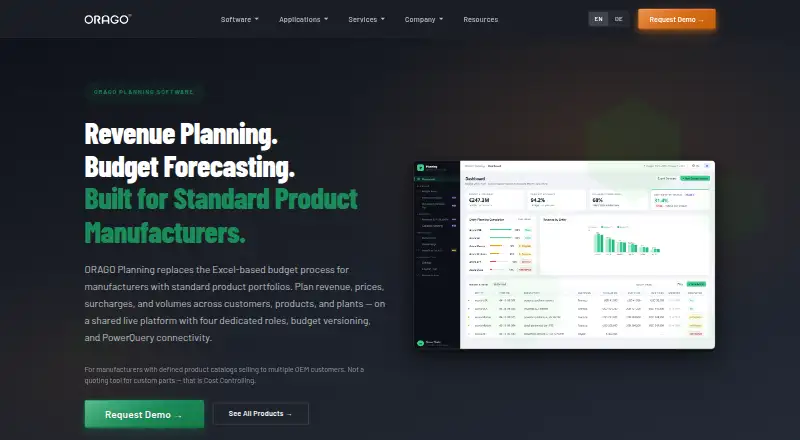
What ORAGO Planning is
ORAGO Planning supports revenue and budget planning for manufacturers with standard product portfolios. Its budget lines use base price, surcharges, and quantity to calculate revenue across monthly periods in a three-year horizon. Users can create named budget versions by copying and adjusting them; published versions cannot be changed. The product supports rolling monthly or quarterly forecasts and plan-versus-actual comparisons using actuals imported from Excel or SAP exchange tables. Planning dimensions include customers, products, plants, and months, while scenario planning and approval workflows are also listed. A shared workspace provides roles for Controllers, Sales or Product Managers, Plant Managers, and Finance or CFO users. Access rules are enforced at the data layer, with Sales and Plant Managers limited to assigned customers, products, or plants. Reporting connections include PowerQuery for Excel and Power BI, and a REST API with JWT authentication exposes planning data. It can be deployed on Microsoft Azure or on-premise Windows Server with IIS. Pricing is available on request.
Good
- Plans monthly budgets across a three-year horizon.
- Supports rolling forecasts and plan-versus-actual comparisons.
- Includes scenario planning and approval workflows.
- PowerQuery supports Excel and Power BI reporting.
- Role-based access is enforced at the data layer.
Watch out
- Pricing is available on request.
- CRM data sync is not supported.
- Several reporting and planning features remain in development or are coming soon.
Who it suits
It suits standard-product manufacturers with defined catalogs and multiple OEM customers, including companies with 2 to 20 production plants. It is not intended for custom-part RFQ costing or for ERP accounting, production scheduling, procurement, or inventory management.
Verdict
ORAGO Planning focuses on revenue and budget planning for standard-product manufacturers, with role-based collaboration and several deployment options. Prospective buyers should check whether its defined scope fits their workflows and request pricing from ORAGO.
The facts
Each one read from ORAGO Planning's own pages, with the date it was checked.
What it does
- Access controls
- Role-based access is enforced at the data layer, with Sales and Plant Managers scoped to assigned customers, products, or plants.checked 7 Oct 2026
- API
- A documented REST API with JWT authentication exposes budget versions, revenue data, master data, and actuals.checked 8 Oct 2026
- Budget model
- Budget lines use base price, surcharges, and quantity, with revenue calculated from those drivers across monthly periods in a three-year horizon.checked 8 Oct 2026
- Budget versions
- Users can create named versions through copy-and-adjust, and published versions are immutable.checked 8 Oct 2026
- Capacity
- The page says the product supports 50,000+ budget lines and 50 concurrent users.checked 7 Oct 2026
- Collaboration
- The shared workspace has four roles: Controller, Sales or Product Manager, Plant Manager, and Finance or CFO.checked 7 Oct 2026
- Deployment
- The planning page lists Microsoft Azure cloud and on-premise deployment on Windows Server with IIS.checked 8 Oct 2026
- Forecasting
- The product supports monthly planning across a three-year horizon and rolling forecasts using copy-and-adjust budget versions.checked 7 Oct 2026
- Forecasting and actuals
- It supports rolling monthly or quarterly forecasts and plan-versus-actual comparisons using actuals imported from SAP exchange tables or Excel.checked 8 Oct 2026
- Integrations
- Data can be entered manually or imported from Excel and SAP exchange tables; PowerQuery connects Excel or Power BI to planning data.checked 8 Oct 2026
- Intended users
- The product is designed for standard-product manufacturers with defined catalogs and multiple OEM customers, including companies with 2 to 20 production plants.checked 8 Oct 2026
- Notable limits
- It is not designed for custom-part RFQ costing, ERP financial accounting, production scheduling, procurement, or inventory management.checked 7 Oct 2026
- Not designed for
- The page says it is not designed for custom-parts suppliers calculating costs per RFQ or for ERP accounting, production scheduling, procurement, or inventory management.checked 8 Oct 2026
- Pricing
- The contact page invites prospective customers to discuss pricing; it does not state a price.checked 7 Oct 2026
- Pricing availability
- The contact page invites prospective customers to discuss pricing, and the planning page offers a demo; neither page states a price.checked 8 Oct 2026
- Purpose
- ORAGO Planning replaces Excel-based budgeting for manufacturers with standard product portfolios, planning revenue, prices, surcharges, and volumes across customers, products, and plants.checked 8 Oct 2026
- Reporting and API
- PowerQuery connectivity supports Excel and Power BI reporting, and a REST API with JWT authentication exposes planning data.checked 7 Oct 2026
- Roadmap
- Full variance bridge decomposition, top-down/bottom-up reconciliation, profitability reporting, and capacity planning are described as in development or coming soon.checked 7 Oct 2026
- Roles and access
- The product describes four roles—Controller, Sales or Product Manager, Plant Manager, and Finance—with role-based access controls enforced at the data layer.checked 8 Oct 2026
- Security
- The Planning page lists SSO, Azure AD, and JWT authentication and says changes are logged with user, timestamp, and old and new values.checked 7 Oct 2026
The company
- Company
- ORAGO GmbH says its platform has been developed since 2010 and lists its address in Frankfurt am Main, Germany.checked 8 Oct 2026
- Founded
- 2010checked 28 Sep 2026
- Headquarters
- Frankfurt am Main, Germanychecked 28 Sep 2026
Money
- Planning model
- Budget lines combine base price, surcharges, and quantity, with revenue calculated from those drivers.checked 7 Oct 2026
The full review of ORAGO Planning
ORAGO Planning is built for manufacturers that sell repeatable products through multiple OEM customers and need coordinated revenue and budget forecasts. It is most suitable for finance, sales, and plant teams working across several sites; its focused model is a strength when your catalog is standardised, but a poor fit for operational or custom-engineering work.
Overview
Budgets are constructed from base price, surcharges, and quantity, with revenue calculated from those drivers for each month. Planning can extend across a three-year horizon, while rolling monthly or quarterly forecasts let teams revise expectations without discarding the underlying plan. Named versions are created by copying and adjusting an existing budget, and published versions become immutable, giving finance a stable approved baseline alongside editable scenarios.
Forecast dimensions cover customers, products, plants, and months. Actuals can be imported from Excel or SAP exchange tables for plan-versus-actual comparisons. Approval workflows and scenario planning support a governed process, although the absence of CRM data synchronisation means customer-system updates must come through other data paths.
Key features
Collaboration and control
The shared workspace separates responsibilities among Controller, Sales or Product Manager, Plant Manager, and Finance or CFO roles. Data-layer permissions can restrict Sales and Plant Managers to assigned customers, products, or plants, which is materially safer than relying only on screen-level hiding when multiple sites share one plan.
SSO, Azure AD, and JWT authentication support enterprise access policies. An audit trail records the user, timestamp, and old and new values for changes, useful when budget revisions need accountability. Approval workflows add formal sign-off to the versioning process.
Data, reporting, and scale
Users can enter data manually or import Excel files and SAP exchange tables, and the system connects with ORAGO Cost Controlling. PowerQuery connectivity feeds Excel and Power BI reporting, while a documented REST API secured with JWT exposes budget versions, revenue, master data, and actuals. The stated capacity of more than 50,000 budget lines and 50 concurrent users is appropriate for a mid-sized manufacturing planning group, but not evidence of unlimited scale.
Defined boundaries
ORAGO Planning is deliberately not an ERP accounting system, production scheduler, procurement tool, or inventory manager. It is also not designed for suppliers calculating custom-part costs per RFQ. Those exclusions make the product clearer to evaluate: choose it for structured planning, not as a replacement for operational systems.
Pricing
Pricing is custom: ORAGO invites prospective customers to discuss it and offers a demo, but publishes no amount, seat schedule, trial term, renewal condition, or free tier. Buyers should request a quote that explains treatment of users, data volume, deployment, and support. Support is described as tiered, with guaranteed response times tied to issue severity; support-plan details also require contact with ORAGO.
Platforms
Deployment is available in Microsoft Azure cloud or on-premise Windows Server with IIS. The product is also listed for web, Windows, self-hosted, and API use, giving organisations a choice between managed cloud operation and infrastructure they control.
Who it's for
The clearest audience is a standard-product manufacturer with a defined catalog, multiple OEM customers, and roughly two to 20 production plants. Finance leaders gain controlled versions and auditability; sales and plant managers gain scoped views; analysts gain Excel, Power BI, SAP-table, and API connections. Custom-parts suppliers, or teams seeking accounting, scheduling, procurement, inventory, or CRM functionality, should look elsewhere.
Pros and cons
Pros
- Manufacturing-specific revenue logic: price, surcharge, and quantity drivers map directly to repeatable product planning.
- Long-range and rolling views: a three-year monthly horizon, rolling forecasts, and copy-and-adjust scenarios support changing assumptions.
- Governed collaboration: four defined roles, data-layer scoping, approvals, immutable published versions, and audit history strengthen control.
- Practical data access: Excel, SAP exchange tables, PowerQuery, Power BI, and a JWT-protected REST API reduce isolation from existing reporting flows.
Cons
- Narrow operational scope: it does not cover ERP accounting, production scheduling, procurement, inventory, or custom RFQ costing.
- No CRM synchronisation: customer data must be brought in through supported imports or other integrations.
- Unpublished pricing: every buyer must go through a sales discussion, with no public free plan or trial terms.
- Some capabilities are pending: variance-bridge decomposition, top-down/bottom-up reconciliation, profitability reporting, and capacity planning are described as in development or coming soon.
Alternatives
For a broader directory of tools, see Revenue Planning Software.
- Clive is worth considering when a web/API service with a free plan, one-week trial, and metered AI and compute credits is preferable.
- Predict.ai suits buyers seeking a freemium API, web, or self-hosted option with a forever-free tier capped at one seat, one workspace, and 500 credits per month.
- Salesforce Sales Cloud is the alternative when a freemium extension with a free suite and per-user starter subscription is the priority.
- Workday Adaptive Planning is a broader planning alternative with a 30-day trial and web, API, desktop, and mobile platforms.
- Kepion is another paid, self-hosted or cloud-capable planning product sold through a demo and sales contact.
- Xactly Incent is aimed at incentive management rather than ORAGO's manufacturing budget model.
- Fintastic offers an enterprise subscription with unlimited users and data, with pricing handled by its sales team.
- ModusCPG Scout is a paid web product whose pricing is provided through a demo.
Verdict
Choose ORAGO Planning if you are a standard-product manufacturer that needs controlled, multi-plant revenue planning with governed versions, scoped access, and Excel/SAP-compatible data flows. Its main reason to choose it is the combination of manufacturing-specific budget drivers and audit-ready collaboration. Look elsewhere if you need custom RFQ costing, CRM synchronisation, public pricing, or a system that also runs accounting and production operations.
Alternatives to ORAGO Planning
- 1

IBM Planning Analytics
iOSWebAPIExtension7.9 - 2
Workday Adaptive Planning
AndroidiOSWebAPI7.5 - 3

Clive
Free planWebAPI7.4From $224 a month - 4
Salesforce Sales Cloud
Free planExtension7.4From $25 a month - 5
Predict.ai
Free planWebAPISelf-hosted6.9From $149 a month - 6
Revcast
Web6.7From $7,000 a year