Kepion
Kepion is an FP&A platform for planning across finance, supply chain, and operations.
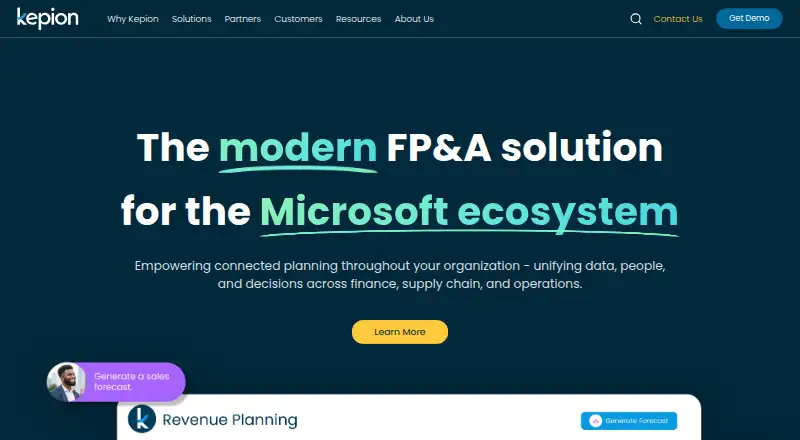
What Kepion is
Kepion is an FP&A platform for planning across finance, supply chain, and operations. Its use cases include budgeting, forecasting, revenue, workforce, capital, demand, and supply planning, along with variance analysis and financial consolidation. Teams can use real-time what-if modeling to compare best, worst, and expected outcomes for revenue, costs, and operational plans. Shared data connects finance, sales, operations, and supply chain planning for collaboration. Kepion says it works with Microsoft 365, Dynamics 365, Power BI, Azure Cloud, and SQL Server. Its integration guidance recommends SQL Server Management Studio, Azure Data Factory, and SQL Server Integration Services, though the documented application integration type currently supported is an Azure Data Factory pipeline. Deployment guidance covers cloud-hosted and on-premises setups. Single sign-on options include Windows Active Directory, Azure Active Directory, and custom identity providers. The platform is available through web, Windows, API, and self-hosted options. Pricing is on request. Kepion was founded in 2009 and is headquartered in Seattle, Washington.
Good
- Supports budgeting, forecasting, and variance analysis.
- Includes financial consolidation and workforce planning.
- Real-time scenario modeling compares possible outcomes.
- Supports several Microsoft products and identity providers.
Watch out
- Pricing is available on request.
- Documented application integration currently supports an Azure Data Factory pipeline.
Who it suits
Kepion suits organizations planning across finance, supply chain, and operations, including teams coordinating budgets, forecasts, and workforce or supply plans. Its audience spans industries and company sizes.
Verdict
Kepion brings several planning functions and teams together around shared data, with scenario modeling and variance analysis. Consider its pricing-on-request model and the stated limit on documented application integration.
Plans and prices
From Kepion's own pricing page, checked 8 Oct 2026.
| Plan | Price | What it gives you |
|---|---|---|
| Kepion | Priced on request | Contact sales for product information and a demo |
The facts
Each one read from Kepion's own pages, with the date it was checked.
What it does
- Audience
- Kepion says its planning software is used across industries and companies of any size.checked 8 Oct 2026
- Authentication
- Kepion documents Windows Active Directory, Azure Active Directory, and custom identity providers for single sign-on.checked 8 Oct 2026
- Budgeting
- Yeschecked 22 Sep 2026
- Collaboration
- The platform connects finance, sales, operations, and supply chain planning on shared data so teams can collaborate and align plans.checked 8 Oct 2026
- Data integration
- Kepion's support documentation recommends SQL Server Management Studio, Azure Data Factory, and SQL Server Integration Services for data integration.checked 8 Oct 2026
- Deployment
- Kepion's data integration guidance describes cloud-hosted and on-premises deployments.checked 8 Oct 2026
- Financial consolidation
- Yeschecked 22 Sep 2026
- Forecasting
- Kepion says rolling forecasts can integrate actuals from source systems and cover 12 to 24+ month horizons.checked 8 Oct 2026
- Integration limit
- The documented application integration type currently supported is an Azure Data Factory pipeline.checked 8 Oct 2026
- Microsoft ecosystem
- Kepion says it is built to work with Microsoft 365, Dynamics 365, Power BI, Azure Cloud, and SQL Server.checked 8 Oct 2026
- Product
- Kepion describes itself as an FP&A platform for planning across finance, supply chain, and operations.checked 8 Oct 2026
- Scenario modeling
- Yeschecked 22 Sep 2026
- Security
- Kepion's support documentation says Content Security Policy is enabled by default starting with version 6.1.24324.checked 8 Oct 2026
- Support
- Kepion directs users to its support center for best practices and troubleshooting and lets them submit a support ticket.checked 8 Oct 2026
- Use cases
- Its planning use cases include budgeting, forecasting, revenue, workforce, capital, demand, and supply planning.checked 8 Oct 2026
- Variance analysis
- Yeschecked 22 Sep 2026
The company
- Founded
- 2009checked 28 Sep 2026
- Headquarters
- Seattle, Washington, United Stateschecked 28 Sep 2026
Where it runs
- Scenarios
- Kepion supports real-time what-if modeling to compare best, worst, and expected outcomes for revenue, cost, and operational plans.checked 8 Oct 2026
Money
- Workforce planning
- Yeschecked 22 Sep 2026
The full review of Kepion
Kepion is a planning platform for organizations coordinating financial and operational decisions. It is best suited to teams spanning finance, sales, operations, and supply chain; its breadth is a strength, but custom pricing and a narrow documented application integration option merit close consideration.
Overview
Kepion combines budgeting, forecasting, revenue, workforce, capital, demand, and supply planning. It also supports variance analysis, financial consolidation, and forecast-versus-actuals work, so it can serve teams that need to connect plan creation with reviewing results. That breadth is most useful when planning crosses departments; a finance group with narrower needs may not benefit from the operational scope.
Shared data connects finance, sales, operations, and supply chain planning. This can help teams align assumptions instead of maintaining disconnected plans. Kepion is built to work with Microsoft 365, Dynamics 365, Power BI, Azure Cloud, and SQL Server, making it a natural candidate for organizations already using that ecosystem.
Key features
Scenario modeling
Real-time what-if modeling lets teams compare best, worst, and expected outcomes for revenue, cost, and operational plans. It is relevant when decisions need to account for changing assumptions across functions. The feature's value depends on teams having shared planning needs; it is less compelling for organizations seeking only a standalone budgeting tool.
Data integration and deployment
Kepion's integration guidance recommends SQL Server Management Studio, Azure Data Factory, and SQL Server Integration Services. Its documented application integration type currently supported is an Azure Data Factory pipeline, a meaningful constraint for buyers expecting a broad menu of application connectors. Deployment guidance covers both cloud-hosted and on-premises environments, giving organizations flexibility over where planning runs.
Identity and support
Single sign-on can use Windows Active Directory, Azure Active Directory, or custom identity providers. Content Security Policy is enabled by default starting with version 6.1.24324. Kepion's support center provides best practices and troubleshooting guidance, with support tickets available for assistance.
Pricing
Kepion is paid software with custom pricing. The Kepion plan directs prospective buyers to contact sales for product information and a demo. No seat limits, quotas, trial period, or renewal terms are provided, so organizations should confirm those commercial details with sales before comparing total cost. This model may fit buyers evaluating a broad planning platform with a sales team, but it offers less immediate price transparency than a published monthly plan.
Platforms
Kepion is available via API, as self-hosted software, on the web, and on Windows. The combination of cloud-hosted and on-premises deployment guidance may suit organizations with different infrastructure requirements. No mobile platforms are included among its stated options.
Who it's for
Kepion is aimed at organizations of any size and across industries, particularly those connecting financial plans with supply chain and operations decisions. It is strongest where teams need budgeting, forecasting, scenario comparisons, and actuals analysis around shared data. A smaller or single-function team that does not need cross-department planning may find the platform's range unnecessary, while organizations dependent on integrations beyond the documented Azure Data Factory pipeline should assess fit carefully.
Pros and cons
- Pro: Covers financial and operational planning, including budgeting, forecasting, workforce, demand, and supply planning, reducing the need to treat those functions as separate planning domains.
- Pro: Real-time scenario modeling and shared data support coordinated decisions across finance, sales, operations, and supply chain.
- Pro: Cloud-hosted and on-premises deployment guidance, plus several documented single sign-on options, address varied infrastructure and identity setups.
- Con: Custom pricing requires a sales conversation before buyers can compare costs.
- Con: The documented application integration type is limited to an Azure Data Factory pipeline, which may not suit teams expecting broader application integration options.
Alternatives
Consider these alternatives when their pricing, platform coverage, or planning scope better matches your requirements:
- OneStream is another paid planning platform, with API, self-hosted, web, Windows, Android, and iOS access. Choose it when those additional mobile platforms matter; its pricing also calls for a demo discussion.
- Workday Adaptive Planning has a 30-day trial and supports Android, iOS, macOS, web, Windows, and API access. It is a better fit if a defined trial period or those platforms is a priority.
- CXO Software is a paid option with a free trial and web, self-hosted, Windows, Android, and iOS platforms. Consider it if trial access or those deployment and device options are important.
- Calxa has a published Premier1 plan at $18 a month, billed monthly, for 1 organisation and unlimited users; extra organisations cost $18/mo. Choose it if a transparent monthly price and stated organisation allowance are more useful than Kepion's custom quote.
- Cube offers API and web access, with plans including full platform access, custom roles, and unlimited dimensions and users. Consider it if those stated plan features align with your needs.
- Finnivo is another paid option with API and web platforms.
- Syft Analytics has a free plan and web access, making it an option for readers prioritizing a no-cost entry point.
- Taxilla FP&A offers Essentials for up to 3 entities, Growth for up to 10, and Enterprise for 25+ entities. Consider it if entity-count tiers are a useful way to match a plan to your organization.
Readers comparing adjacent categories can also browse Management Reporting Software, Revenue Operations Software, Revenue Planning Software, Demand Planning Software, Corporate Performance Management Software, and Financial Forecasting Software.
Verdict
Choose Kepion if finance and operating teams need to plan together, model alternate outcomes, and review performance against forecasts on shared data. Its broad planning scope and Microsoft ecosystem alignment are the main reasons to shortlist it. Look elsewhere if you need published pricing or application integrations beyond the documented Azure Data Factory pipeline.
Getting started
- Visit the Kepion website
- Contact sales for product information and a demo
- Choose web, Windows, API, or self-hosted access
- Select a cloud-hosted or on-premises deployment
- Connect data using SQL Server Management Studio, Azure Data Factory, or SQL Server Integration Services
- Configure single sign-on with a supported identity provider
Limits worth knowing
The documented application integration type currently supported is an Azure Data Factory pipeline. Pricing and product information are provided through contact with sales.
Questions
What does Kepion cost?
Kepion uses paid pricing, with pricing available on request. The listed Kepion plan directs buyers to contact sales for product information and a demo.
Which platforms does Kepion support?
Kepion is available through web, Windows, API, and self-hosted options.
Can Kepion run on premises?
Yes. Its deployment guidance covers both cloud-hosted and on-premises environments.
What systems does Kepion work with?
Kepion says it works with Microsoft 365, Dynamics 365, Power BI, Azure Cloud, and SQL Server.
What single sign-on options are supported?
Documented options include Windows Active Directory, Azure Active Directory, and custom identity providers.
Alternatives to Kepion
- 1

frePPLe
Free planWebAPILinuxSelf-hosted7.2Free plan - 2

Forecast Pro
APILinuxSelf-hostedWindows7.0From $199 a month - 3

Inventory Planner
Free planWebAPI7.0Free plan - 4

Prediko
WebAPI7.0From $49 a month - 5

Flowlity
WebAPI6.9From €249 a month - 6
Anaplan
AndroidiOSWebAPI6.5