Predict.ai
Predict.ai is a forecasting platform for business outcomes, available through web, API, and self-hosted deployments.
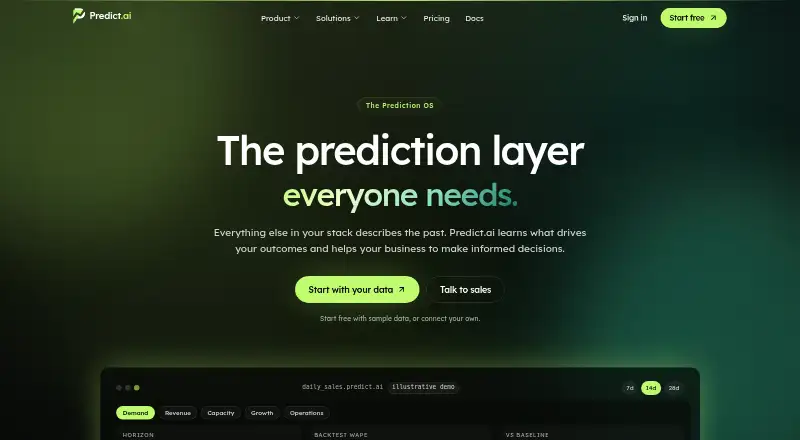
What Predict.ai is
Predict.ai is a forecasting platform for business outcomes, available through web, API, and self-hosted deployments. Choose an outcome and forecast horizon, and it searches for useful drivers, backtests multiple models against historical data, deploys a forecast, and reevaluates it as new data arrives. Connected data can come from file uploads, REST, Kafka, S3, BigQuery, PostgreSQL, and webhooks. The workspace highlights trends, anomalies, recurring rhythms, correlations, lead-lag relationships, and leading indicators across signals. Scenario planning lets users alter a driver or schedule an event, then compare the resulting forecast with a baseline; Predict.ai cautions that this comparison does not prove causation. Forecasts can be delivered through hosted REST, streaming, or batch endpoints with quantile bands. Developers get a REST API, Python SDK, TypeScript SDK, WebSockets, and MCP support for AI agents. Predict.ai states that workspace data is isolated and not used to train shared models or other customers’ models. Security details cite TLS 1.2 or higher in transit and AES-256 or equivalent encryption at rest. EU-region workspace content stays within the European Union unless the customer directs otherwise.
Good
- Backtests multiple models on historical data
- Scenario comparisons with baseline forecasts
- Broad data-source support, including Kafka and BigQuery
- REST, streaming, and batch forecast serving
- Python, TypeScript, WebSockets, and MCP interfaces
- Workspace data isolation and encrypted storage
Watch out
- Free tier is capped at 500 credits monthly
- Free plan includes one workspace and one seat
Who it suits
Starter suits solo builders shipping forecasts into production, while Team is aimed at groups delivering forecasts together. Enterprise is intended for mission-critical, regulated, or very large workloads, and the API and SDK options suit developers integrating forecast services.
Verdict
Pick Predict.ai when you need driver-focused forecasting, scenario comparisons, and deployable predictions with developer interfaces. Consider another option if the 500-credit free allowance, one-seat setup, or paid-plan pricing does not fit your workload.
Plans and prices
From Predict.ai's own pricing page, checked 4 Oct 2026.
| Plan | Price | What it gives you |
|---|---|---|
| Free | Free | 500 credits / mo ($5 of usage) · 1 workspace · 1 seat · 1 goal per workspace · 1 shared deployment · 1 GB ingestion / mo · forever |
| Starter | $149 a month | 5,000 credits / mo ($50 of usage) · 2 workspaces · 1 seat · 10 goals per workspace · 3 shared deployments · 20 GB ingestion / mo · per month |
| Team | $2,499 a month | 50,000 credits / mo ($500 of usage) · 5 workspaces · 5 seats included · $99/seat after · 50 goals per workspace · 10 shared + 2 dedicated deployments · 100 GB ingestion / mo · per month |
| Enterprise | Priced on request | Custom credit allowance · 25 workspaces · 200 goals per workspace · 50 shared + 5 dedicated deployments · 1,000 GB ingestion / mo · SSO / SAML · On-premises · annual contract |
The facts
Each one read from Predict.ai's own pages, with the date it was checked.
What it does
- Analytics
- The workspace surfaces trends, anomalies, recurring rhythms, correlations, lead-lag relationships, and leading indicators across connected signals.checked 4 Oct 2026
- API and agents
- The maker lists a REST API, Python SDK, TypeScript SDK, WebSockets, and MCP support for AI agents.checked 4 Oct 2026
- Data inputs
- The maker lists file uploads, REST, Kafka, S3, BigQuery, PostgreSQL, and webhooks as data sources.checked 4 Oct 2026
- Data isolation
- Predict.ai states workspace data is isolated and is not used to train shared models or models for other customers.checked 4 Oct 2026
- Forecasting
- The platform selects an outcome and forecast horizon, searches for useful drivers, backtests multiple models, deploys a result, and reevaluates it as data changes.checked 4 Oct 2026
- Intended users
- The maker describes Starter as for solo builders shipping into production, Team as for teams shipping forecasts together, and Enterprise as for mission-critical, regulated, or very large workloads.checked 4 Oct 2026
- Notable limits
- The Free tier is hard-capped at 500 credits per month; Starter and Team charge $0.01 per credit for usage above included credits.checked 4 Oct 2026
- Purpose
- Predict.ai finds drivers behind business outcomes, tests competing models on historical data, and keeps live forecasts current.checked 4 Oct 2026
- Regional storage
- The maker says each workspace has a home region and that EU-region workspace content remains within the European Union unless the customer instructs otherwise.checked 4 Oct 2026
- Security
- The security page states data in transit uses TLS 1.2 or higher and customer content and backups are encrypted at rest using AES-256 or equivalent.checked 4 Oct 2026
- Serving
- Forecasts can be served through hosted endpoints using REST, streaming, or batch inference, with quantile bands in responses.checked 4 Oct 2026
- Support
- The contact page invites product, sales, enterprise, security, and partnership inquiries by email and says it offers a real reply.checked 4 Oct 2026
The company
- Founded
- 2026checked 28 Sep 2026
Where it runs
- Scenarios
- Users can change a driver or schedule an event to compare a scenario forecast with the baseline, and the page cautions that this does not prove causation.checked 4 Oct 2026
The full review of Predict.ai
Predict.ai is a forecasting platform for businesses that want to identify drivers, compare models, and keep forecasts updated as inputs change. It is strongest for builders and teams deploying forecasts through software interfaces. Its flexible data and serving options are balanced by a strict free-tier ceiling and a substantial jump to the Team plan.
Overview
Choose a business outcome and forecast horizon, and Predict.ai searches for useful drivers, tests multiple models against historical data, and can deploy a forecast that is reevaluated as new data arrives. This continuous workflow is more suitable for changing operations than a forecast produced once and left untouched. Supported dimensions include product, region, bookings, pipeline, usage, renewals, pricing, and seasonality, including financial forecasting.
Scenario planning lets users adjust a driver or schedule an event, then compare the resulting forecast with a baseline. That is useful for weighing possible outcomes, but it does not establish that the changed factor caused them.
Key features
- Connected data and signal analysis: Inputs include file uploads, REST, Kafka, S3, BigQuery, PostgreSQL, and webhooks. The workspace can surface trends, anomalies, recurring rhythms, correlations, lead-lag relationships, and leading indicators. This breadth helps teams examine several kinds of business signals, though the value depends on having relevant data to connect.
- Model selection and deployment: Predict.ai backtests multiple models on historical data, then serves forecasts through hosted REST endpoints, streaming, or batch inference. Responses include quantile bands, giving consumers a range around forecasts rather than only a single value.
- Developer access: A REST API, Python and TypeScript SDKs, WebSockets, and MCP support for AI agents give engineering teams several ways to integrate forecasts. This is a practical advantage for software-driven workflows, but less compelling for buyers who do not need programmatic access.
- Data protection: Predict.ai says workspace data is isolated and is not used to train shared models or models for other customers. Data in transit uses TLS 1.2 or higher, and customer content and backups are encrypted at rest with AES-256 or equivalent. Each workspace has a home region; EU workspace content stays within the EU unless the customer instructs otherwise.
Pricing
Predict.ai uses a freemium model. The plans differ not only in monthly credits, but also in seats, workspaces, goals, deployments, and ingestion, so the lowest monthly price is not the whole cost or capacity picture.
| Plan | Price and terms | Included capacity |
|---|---|---|
| Free | free; billed forever | 500 credits per month ($5 of usage), 1 workspace, 1 seat, 1 goal per workspace, 1 shared deployment, and 1 GB ingestion per month |
| Starter | $149 a month; billed per month | 5,000 credits per month ($50 of usage), 2 workspaces, 1 seat, 10 goals per workspace, 3 shared deployments, and 20 GB ingestion per month |
| Team | $2,499 a month; billed per month | 50,000 credits per month ($500 of usage), 5 workspaces, 5 seats included, $99/seat after, 50 goals per workspace, 10 shared and 2 dedicated deployments, and 100 GB ingestion per month |
| Enterprise | Custom pricing; billed annual contract | Custom credit allowance, 25 workspaces, 200 goals per workspace, 50 shared and 5 dedicated deployments, 1,000 GB ingestion per month, SSO / SAML, and on-premises |
Free is a useful way to evaluate a small workflow, but 500 credits per month are a hard cap, and one seat, one goal, and one shared deployment restrict it to a narrow setup. Starter raises the allowance and ingestion ceiling and is positioned for solo builders shipping into production; it remains a one-seat plan. Usage above included credits costs $0.01 per credit on both Starter and Team, so sustained usage beyond the allowance adds to the monthly bill.
Team is designed for teams shipping forecasts together, with five seats included and shared as well as dedicated deployments. At $2,499 a month, it is a large step up from Starter; the extra seats, goals, and capacity matter only if the workload needs them. Additional seats cost $99/seat after the five included. Enterprise uses custom pricing under an annual contract and adds SSO / SAML and on-premises deployment, making it the plan aimed at mission-critical, regulated, or very large workloads rather than buyers seeking a published monthly rate.
Platforms
Predict.ai is available as a web product, API, and self-hosted option. The API and SDK choices suit teams embedding forecast outputs into applications or agent workflows; self-hosting and regional storage options may matter to organizations with deployment or data-location requirements.
Who it's for
Predict.ai is a good fit for solo builders moving forecasting into production and for teams that need to compare models, revisit assumptions, and deliver forecasts to other systems. Its scenario comparisons and broad business dimensions also suit financial and operational planning. It is a weaker fit for individual users who need more than one seat on a modest budget, or anyone whose work depends on proving causality rather than comparing forecast scenarios.
Pros and cons
- Pro: It joins driver discovery, historical model comparison, deployment, and reevaluation in one forecasting workflow, which is useful when inputs keep changing.
- Pro: Multiple data connectors, inference modes, SDKs, and API interfaces give technical teams several integration paths.
- Pro: Quantile bands, workspace isolation, encryption, and EU-region storage terms address forecast uncertainty and data-handling needs.
- Con: The free plan is capped at 500 credits monthly and limited to one seat, one goal, and one shared deployment, so it is not a roomy ongoing tier.
- Con: Starter permits only one seat, while Team costs $2,499 a month before any overage credits or additional seats, making collaboration expensive for smaller teams.
- Con: Scenario comparisons do not prove causation, so they cannot substitute for causal evidence when that is the decision requirement.
Alternatives
For a bank-connected cash forecast and a simpler small-team starting point, consider Dibein: its free Starter plan includes one bank connection, one accounting connection, a rolling 13-week forecast, up to two seats, and seven-day Anomaly Radar history. Pick Cashflow CaFE instead if you want a paid cash-flow app across Android, iOS, and web; it offers a free trial.
Kyriba is another paid option, with a custom-priced Treasury plan and Android, iOS, API, and web platforms. Consider Agicap if you want a paid cash-management alternative with a free trial, while accounting for its minimum 12-month subscription. Awesome Forecast is worth considering for a Windows user seeking a single-license annual plan, priced at £250 a year, with a free plan and trial.
If you want a web-based forecasting option with a free trial and unlimited users on its Premier1 plan, compare Calxa, which starts at $18 a month for one organisation. CashAnalytics is a paid web alternative with pricing on request. Nomentia Cash Flow Forecasting is another paid web option.
For category browsing, see Cash Forecasting Software, Revenue Planning Software, Augmented Analytics Software, and Revenue Intelligence Software.
Verdict
Choose Predict.ai if you need driver-focused forecasts that can be compared, served, and refreshed through production interfaces. Its strongest case is the combination of model comparison, scenario work, and integration breadth. Look elsewhere if the 500-credit free cap is too restrictive, you need multiple seats without paying for Team, or the 2499.00 USD monthly Team price does not fit the workload.
Getting started
- Open Predict.ai on the web or choose an API or self-hosted deployment
- Connect data through uploads, REST, Kafka, S3, BigQuery, PostgreSQL, or webhooks
- Select an outcome and forecast horizon
- Review drivers, backtests, and forecast results
- Deploy forecasts through REST, streaming, or batch inference
- Use scenario planning to compare a changed driver or scheduled event with the baseline
Limits worth knowing
The Free plan provides 500 credits per month, one workspace, one seat, one goal per workspace, one shared deployment, and 1 GB of ingestion monthly. Starter and Team charge $0.01 per credit for usage above their included allowances.
Questions
Is Predict.ai free?
Yes. The Free plan is billed forever and includes 500 credits per month.
What platforms does Predict.ai support?
Predict.ai is offered through its web platform, API, and self-hosted deployments.
Which data sources can it connect?
Listed sources include file uploads, REST, Kafka, S3, BigQuery, PostgreSQL, and webhooks.
Does scenario planning prove causation?
No. Predict.ai says changing a driver or scheduling an event compares forecasts with a baseline but does not prove causation.
What developer interfaces are available?
The maker lists a REST API, Python SDK, TypeScript SDK, WebSockets, and MCP support for AI agents.
What does Enterprise provide?
Enterprise uses an annual contract with a custom credit allowance, 25 workspaces, 200 goals per workspace, 50 shared and five dedicated deployments, 1,000 GB of monthly ingestion, SSO/SAML, and on-premises deployment.
Alternatives to Predict.ai
- 1

Kyriba
AndroidiOSWebAPI6.9 - 2

ZenTreasury
WebAPI6.8From €799 a month - 3

Dibein
Free planWebAPI6.7From €149 a month - 4
 6.7From $35 a month
- 5

Agicap
AndroidiOSWebAPI6.6 - 6
Calxa
Web6.6From $18 a month