Oracle Log Analytics
Oracle Log Analytics is an OCI cloud service for collecting and investigating logs from applications and infrastructure, whether they run in the cloud or on …
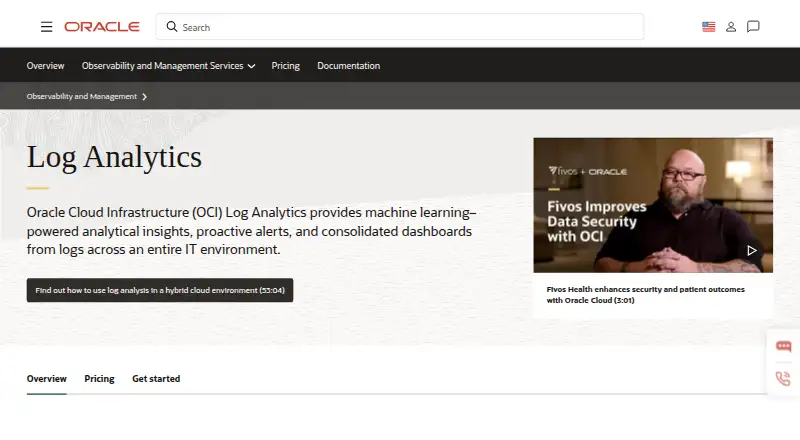
What Oracle Log Analytics is
Oracle Log Analytics is an OCI cloud service for collecting and investigating logs from applications and infrastructure, whether they run in the cloud or on premises. It indexes, parses, enriches, searches, analyzes, correlates, visualizes, and monitors log data. Machine-learning-based analysis helps teams narrow down possible root causes during troubleshooting. Users can build dashboards, and operators can monitor systems with dashboards, email reports, and alarms. The service includes more than 250 prebuilt parsers, geolocation enrichment, data masking, and active and archival storage. Collection options range from agents and Fluentd or Fluent Bit to streaming, Syslog, Object Storage, APIs, and SDKs. Oracle lists integrations for its database and other services, Kubernetes Engine, audit logs, and Enterprise Manager. The first 10 gigabytes of log storage are free; further active and archival storage is metered by Log Analytics Storage Units. Deployment is cloud based, with API, Linux, web, and Windows platforms listed.
Good
- First 10 gigabytes of log storage are free.
- Includes more than 250 prebuilt parsers.
- Supports dashboards, email reports, and alarms.
- Offers active and archival storage.
- Lists API, Linux, web, and Windows platforms.
Watch out
- Additional storage is metered by Storage Units.
- Deployment option listed is cloud.
- Query language is proprietary.
- Data retention is 90 days.
Who it suits
It suits DevOps teams, developers, administrators, operators, and IT or business teams that need to troubleshoot or monitor applications and infrastructure. It may also fit teams that want dashboards, alerts, and log collection from multiple sources.
Verdict
Oracle Log Analytics combines log collection, analysis, and monitoring in an OCI cloud service, with a free allowance for the first 10 gigabytes. Check the metered storage terms and 90-day retention against your requirements.
Plans and prices
From Oracle Log Analytics's own pricing page, checked 7 Oct 2026.
| Plan | Price | What it gives you |
|---|---|---|
| First 10 gigabytes of log storage | Free | First 10 gigabytes of log storage · First 10 gigabytes of log storage |
| Active Storage | — | First 35 units per month · Greater than 35 and less than 103 units per month · Greater than 103 units per month · Per Log Analytics Storage Unit per month; each Storage Unit is 300 gigabytes of logs stored during the month |
| Archival Storage | — | Archival storage · Per Log Analytics Storage Unit per hour; each Storage Unit is 300 gigabytes of logs stored during the hour |
The facts
Each one read from Oracle Log Analytics's own pages, with the date it was checked.
What it does
- Access control
- The service uses OCI IAM policies and compartments to govern access to resources such as entities, log groups, purge policies, and collection rules.checked 7 Oct 2026
- Archive export
- Yeschecked 22 Sep 2026
- Dashboards
- Users can create and customize dashboards, and operators can use dashboards, email reports, and alarms to monitor systems.checked 7 Oct 2026
- Deployment options
- cloudchecked 22 Sep 2026
- Encryption
- Oracle says logs in OCI are encrypted in transit over HTTPS and at rest with AES-256 server-side encryption enabled by default; customers can request use of OCI Vault keys.checked 7 Oct 2026
- Enrichment and masking
- Oracle says the service includes more than 250 prebuilt parsers, geolocation enrichment, data masking, and active and archival storage.checked 7 Oct 2026
- Ingestion
- Supported collection approaches listed by Oracle include containerized agents, Fluentd, Fluent Bit, Management Agent, service connectors, streaming, SQL, Syslog, Object Storage, APIs, and SDKs.checked 7 Oct 2026
- Integrations
- Oracle identifies monitoring support for Oracle E-Business Suite, Oracle Database, OCI Kubernetes Engine, OCI audit logs, other OCI services, and Oracle Enterprise Manager integration.checked 7 Oct 2026
- Intended users
- Oracle describes use by DevOps teams, developers, administrators, operators, and IT or business teams troubleshooting and monitoring applications and infrastructure.checked 7 Oct 2026
- Log pipelines
- Yeschecked 22 Sep 2026
- Pricing detail
- Oracle's pricing page lists the first 10 gigabytes of log storage as free and meters additional active and archival storage by Log Analytics Storage Units.checked 7 Oct 2026
- Purpose
- Oracle Log Analytics is an OCI cloud service that indexes, enriches, searches, analyzes, correlates, visualizes, and monitors logs from applications and infrastructure on cloud or on premises.checked 7 Oct 2026
- Retention
- The product page describes unlimited active and archival storage, with archived logs recallable in minutes.checked 7 Oct 2026
- Security integrations
- The security posture solution integrates with Oracle Cloud Guard and Oracle Threat Intelligence Service.checked 7 Oct 2026
- Structured log parsing
- Yeschecked 22 Sep 2026
- Support
- Oracle directs customers with active support contracts to My Oracle Support for technical questions and service requests.checked 7 Oct 2026
The company
- Founded
- 1977checked 28 Sep 2026
- Headquarters
- Austin, Texas, United Stateschecked 28 Sep 2026
Money
- Free plan
- Yeschecked 22 Sep 2026
- Trial
- Oracle Cloud Free Tier provides US$300 in credits for up to 30 days on eligible OCI services, and Oracle's Log Analytics page links to that free trial.checked 7 Oct 2026
Where it runs
- Machine learning
- The product uses machine learning based analytics to help narrow log data to root causes during troubleshooting.checked 7 Oct 2026
The full review of Oracle Log Analytics
Oracle Log Analytics is a cloud service for collecting, indexing, enriching and investigating logs from applications and infrastructure in OCI or on premises. It is aimed at DevOps, operations, developers and IT teams that need log analysis tied to Oracle’s monitoring and security ecosystem. The main decision is whether its broad ingestion and OCI integration justify metered storage and a cloud-only deployment model.
Overview
The service brings log search, correlation, visualization and monitoring into one OCI workspace. It can handle cloud and on-premises sources, making it relevant to organizations with mixed estates rather than only OCI-hosted applications. Machine-learning analytics are intended to narrow large volumes of records toward likely root causes, which is more useful for troubleshooting than simple log viewing.
Oracle has offered software since 1977 and is headquartered in Austin, Texas. Log Analytics is delivered as a cloud service, so teams seeking a self-hosted deployment should look elsewhere.
Key features
Ingestion supports containerized agents, Fluentd, Fluent Bit, Management Agent, service connectors, streaming, SQL, Syslog, Object Storage, APIs and SDKs. That breadth gives administrators several ways to connect different systems, but it also means choosing and configuring a suitable collection path for each environment. Log pipelines and archive export support movement and lifecycle handling beyond an initial search workflow.
Structured log parsing and more than 250 prebuilt parsers reduce the work needed to turn varied records into searchable fields. Geolocation enrichment adds context, while data masking helps limit exposure of sensitive values. Active and archival storage separate current investigation from longer-term retention, and archived logs can be recalled within minutes.
Users can build and customize dashboards, with dashboards, email reports and alarms available for operational monitoring. Custom metrics and SLO tracking extend the product beyond raw log review. Oracle identifies integrations for E-Business Suite, Oracle Database, OCI Kubernetes Engine, OCI audit logs, other OCI services and Oracle Enterprise Manager. Its security posture solution connects with Oracle Cloud Guard and Oracle Threat Intelligence Service.
OCI encrypts logs in transit over HTTPS and at rest with AES-256 server-side encryption enabled by default; customers can request OCI Vault keys. OCI IAM policies and compartments govern access to entities, log groups, purge policies and collection rules. The query language is proprietary, so teams bringing existing query expertise should account for a new syntax.
Pricing
The first 10 gigabytes of log storage cost 0.00 USD and are free. This is the practical entry point for small volumes or a limited pilot, but it is a storage allowance rather than an unlimited free service. Oracle describes 90-day data retention, so teams with longer compliance or investigative needs should validate whether that window meets their requirements.
Active Storage uses custom pricing, billed per Log Analytics Storage Unit per month. One unit represents 300 gigabytes stored during the month, with pricing bands for the first 35 units, more than 35 and fewer than 103 units, and more than 103 units. Archival Storage is also custom pricing, billed per Storage Unit per hour; each unit represents 300 gigabytes stored during that hour. The hourly archival meter can suit large, infrequently accessed collections, but forecasting requires careful attention to volume and time stored.
Oracle Cloud Free Tier provides US$300 in credits for up to 30 days on eligible OCI services, and the Log Analytics page links to that trial. Customers with active support contracts are directed to My Oracle Support for technical questions and service requests.
Platforms
Oracle lists API, Linux, web and Windows support. Deployment is cloud-based, while collection can reach on-premises systems through the supported agents, connectors and protocols.
Who it's for
Choose it when DevOps, administrators, operators and IT or business teams already work in OCI and want shared log analysis, dashboards, alarms and Oracle-specific integrations. It is also a credible fit for mixed cloud and on-premises estates that need parsing, masking, archival export and SLO-oriented monitoring in one service.
It is a weaker fit for organizations requiring self-hosting, a non-proprietary query language, or predictable flat-rate storage costs. The free allowance helps evaluation, but sustained or high-volume use moves into separately metered active and archival storage.
Pros and cons
Pros
- Broad collection coverage: agents, Fluentd/Fluent Bit, streaming, SQL, Syslog, Object Storage, APIs and SDKs accommodate varied environments.
- Useful log preparation: structured parsing, over 250 prebuilt parsers, geolocation enrichment and masking make records more workable and safer to share.
- Strong OCI alignment: integrations span Oracle databases, E-Business Suite, Kubernetes Engine, audit logs, Enterprise Manager, Cloud Guard and Threat Intelligence.
- Operational depth: machine-learning analytics, customizable dashboards, alarms, custom metrics and SLO tracking support ongoing service operations.
Cons
- Metered storage complexity: active and archival units use different billing periods and volume bands, complicating cost forecasting.
- Cloud-only deployment: teams that must run the analytics platform themselves cannot deploy this service on their own infrastructure.
- Proprietary queries: portability of existing query skills and tooling is more limited than with an open query standard.
- 90-day retention: the stated window may not suit longer investigations or regulatory archives without a separate retention strategy.
Alternatives
ELK Stack is the better choice for teams wanting a self-managed, cross-platform stack with a free plan and trial. Pick Google Cloud Logging when Google Cloud is your operational center and its usage pricing fits. Amazon CloudWatch Logs suits AWS-focused monitoring with pay-as-you-go ingestion.
Oracle Cloud Infrastructure Logging is the more focused Oracle option when basic OCI log storage and a 10 GB monthly allowance are enough. Sumo Logic offers a free tier with 20 daily credits, seven-day retention and up to three users. Fluentd is a free, open-source data collector rather than a complete hosted analytics service.
Elastic Observability is an alternative for teams wanting Elastic’s usage-based observability platform. Grafana Loki is suited to teams preferring a free, self-hosted log system or a Grafana Cloud free allowance with 14-day retention.
Verdict
Oracle Log Analytics is a strong choice for OCI-centered organizations that need broad ingestion, Oracle integrations, structured enrichment and operational dashboards in one managed service. Its free first 10 GB and 30-day OCI credit trial lower the barrier to evaluation. Look elsewhere if self-hosting, longer than 90-day retention, open query portability or simpler storage billing is more important than tight Oracle Cloud integration.
Alternatives to Oracle Log Analytics
- 1
Grafana Loki
Free planOpen sourceWebAPILinuxSelf-hosted8.9From $19 a month - 2
Grafana Cloud Application Observability
Free planAndroidiOSWebAPI8.9From $0.03 a month - 3
Logflare
Open sourceAndroidiOSWebAPI8.9$10 usage-based - 4

Google Cloud Logging
Free planiOSWebAPILinux8.8From $0.01 a month - 5

ClickStack
Free planOpen sourceWebAPILinuxSelf-hosted8.6From $53 a month - 6
HyperDX
Free planOpen sourceWebAPILinuxSelf-hosted8.5From $20 a month