
ELK Stack
The Elastic Stack combines Elasticsearch, Kibana, Beats, and Logstash to collect data from different sources for search, analysis, and visualization.
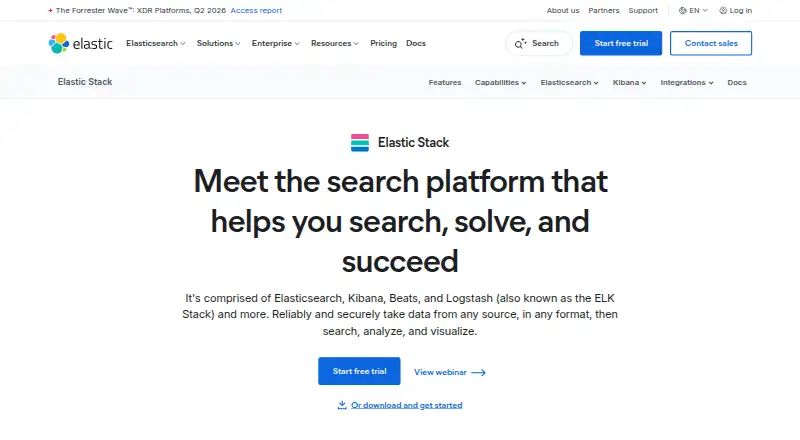
What ELK Stack is
The Elastic Stack combines Elasticsearch, Kibana, Beats, and Logstash to collect data from different sources for search, analysis, and visualization. Elasticsearch is a distributed, JSON-based search and analytics engine; Kibana provides dashboards, visualizations, live presentations, and deployment management. Elastic Agent, Beats, and a web crawler can ingest information from applications, infrastructure, and public content. The feature set includes alerting, machine learning, vector search, graph analytics, clustering, high availability, and data lifecycle management. Elastic describes its platform solutions as Search, Observability, and Security, including uses such as centralized logging, monitoring, and security analytics. Teams can use hosted Elastic Cloud or self-managed software on premises, in public or private clouds, or in hybrid environments. Elasticsearch and Kibana have an open source foundation, and Elasticsearch can be downloaded and started for free. Elastic Cloud offers a 14-day trial without requiring a credit card. Hosted options include AWS, Azure, and Google Cloud.
Good
- Combines search, analytics, and visualization components.
- Supports hosted and self-managed deployments.
- Elasticsearch can be downloaded and started for free.
- Elastic Cloud offers a 14-day trial without a credit card.
- Includes machine learning, alerting, and vector search.
Watch out
- Hosted pricing can include snapshot storage and data transfer charges.
- Gold is discontinued for paid self-managed subscriptions.
Who it suits
The Elastic Stack suits teams that need search, analytics, visualization, centralized logging, monitoring, or security analytics. Its hosted and self-managed deployment options support different infrastructure choices.
Verdict
The Elastic Stack provides a broad set of search, observability, and security capabilities, with hosted and self-managed options. Cloud costs depend on deployment details and may include additional storage and transfer charges.
Plans and prices
From ELK Stack's own pricing page, checked 21 Sep 2026.
| Plan | Price | What it gives you |
|---|---|---|
| Basic | — | Self-managed Elastic Stack features |
| Logs Essentials | Priced on request | Elastic Observability Serverless usage-based pricing. · 50 GB egress free · Pay for usage; ingest is measured per GB |
| Complete | $0.09 a month | 50 GB egress free · Pay for usage; ingest is measured per GB |
| Standard | $99 a month | Based on cloud production config, 120 GB storage / 2 zones; instance type usage-based pricing. · 120 GB storage · 2 zones · As low as; based on cloud production configuration |
| Gold | $114 a month | Everything in Standard plus reporting, third-party alerting actions, Watcher, and multi-stack monitoring. · 120 GB storage · 2 zones · As low as; based on cloud production configuration |
| Platinum | $131 a month | Everything in Gold plus advanced security, machine learning, cross-cluster replication, and enhanced support. · 120 GB storage · 2 zones · As low as; based on cloud production configuration |
| Enterprise | $184 a month | Everything in Platinum plus searchable snapshots, SAML SSO, Elastic Workflows, AI features, and premium support. · 120 GB storage · 2 zones · as low as $184 per month |
| Basic (self-managed) | Free | Free Basic features · no listed price for paid self-managed licensing · Free and open; self-managed |
| Elastic Cloud Serverless | Priced on request | Available in AWS, GCP, and Azure; pricing is usage based · Usage-based; pay as you go monthly or prepaid |
| Elastic Cloud hosted | Priced on request | Cost depends on deployment components, instance sizes, cloud provider, region, availability zones, snapshots, and data transfer · Resource-based; pay as you go monthly or prepaid |
| Self-managed paid subscriptions | Priced on request | License-based on node count and RAM used · Platinum is for existing customers only · Gold is discontinued · Contact sales for pricing |
| Observability Complete | Priced on request | Elastic Observability Serverless usage-based pricing. · as low as $0.09 per GB ingested for logs and traces |
The facts
Each one read from ELK Stack's own pages, with the date it was checked.
What it does
- Archive export
- Yeschecked 21 Sep 2026
- Certifications
- No encryption details or certification claims are stated in the supplied text.checked 27 Sep 2026
- Compliance
- Elastic's Trust Center lists certifications and attestations including SOC 2 Type 2, SOC 3, PCI, HIPAA, ISO 27001, and FedRAMP Moderate and High.checked 29 Sep 2026
- Dashboards
- Kibana provides visualizations, preconfigured dashboards, live presentations, and a UI for managing deployments.checked 29 Sep 2026
- Data ingestion
- Elastic Agent, Beats, and the web crawler can ingest data from applications, infrastructure, and public content sources.checked 29 Sep 2026
- Deployment
- Elastic Stack is available as hosted Elastic Cloud service or self-managed software for on-premises, public cloud, private cloud, or hybrid environments.checked 29 Sep 2026
- Deployment options
- Available as Serverless, Hosted, or self-managed Elasticsearch.checked 27 Sep 2026
- Download options
- Elasticsearch downloads include Windows packages, Linux package managers, Docker containers, and installation archives for Linux and macOS.checked 29 Sep 2026
- Egress allowance
- Serverless includes 50 GB transferred per month free, then charges $0.05 per GB.checked 27 Sep 2026
- Features
- The feature set includes clustering and high availability, cross-cluster search, vector search, machine learning, graph analytics, and data lifecycle management.checked 29 Sep 2026
- Integration count
- The hosted offering lists hundreds of integrations; another section says more than 200 pre-built integrations.checked 27 Sep 2026
- Integrations
- Elastic offers over 300 turn-key integrations for Search, Security, Observability, and cloud providers including AWS, Azure, and GCP.checked 29 Sep 2026
- Integration sources
- Integrations can connect applications, infrastructure, public content, S3, MySQL, and other systems.checked 27 Sep 2026
- Intended use
- Elastic describes its platform solutions as Search, Observability, and Security, for needs such as centralized logging, monitoring, and security analytics.checked 29 Sep 2026
- Live log tailing
- Yeschecked 21 Sep 2026
- Log pipelines
- Yeschecked 21 Sep 2026
- Log retention
- 30checked 21 Sep 2026
- Notable features
- Features include machine learning, security, reporting, dashboards, alerting, and vector search.checked 27 Sep 2026
- Open source base
- Elasticsearch and Kibana are built on an open source foundation.checked 27 Sep 2026
- Pricing limit
- Elastic Cloud pricing also includes charges for snapshot storage and data transfer, in addition to running deployment components.checked 29 Sep 2026
Where it runs
- Cloud platforms
- Hosted deployments are available on AWS, Azure, and Google Cloud.checked 27 Sep 2026
Money
- Free access
- Elasticsearch can be downloaded and started for free.checked 27 Sep 2026
- Free plan
- Yeschecked 21 Sep 2026
- Free trial
- A 14-day Elasticsearch Service trial is available without a credit card.checked 27 Sep 2026
The full review of ELK Stack
ELK Stack combines data ingestion, search and analytics, and visualization for teams working across logging, observability, search, or security. It suits organizations that want to choose between running the stack themselves and using Elastic Cloud. Its breadth is a strength, but hosted costs vary with resources and can include storage and transfer charges.
Overview
Elasticsearch is the distributed, JSON-based engine at the center of the stack; Kibana provides dashboards, visualizations, presentations, and deployment management. Elastic Agent, Beats, Logstash, and a web crawler help bring in data from applications, infrastructure, and public content. Together, these components support centralized logging, monitoring, security analytics, and broader search work.
Elasticsearch and Kibana have an open-source foundation. Teams can run Elasticsearch locally, in containers, Kubernetes, or custom orchestration, or use Elastic Cloud hosted on AWS, Azure, or Google Cloud. That flexibility is useful when deployment control matters, though it also means choosing and managing the operating model is part of the decision. See our Log Management Software list for more options.
Key features
The stack goes beyond collecting and retaining logs: it includes structured parsing, live log tailing, archive export, and log pipelines, alongside clustering, high availability, cross-cluster search, vector search, machine learning, graph analytics, and data lifecycle management. Kibana makes results explorable through dashboards and visualizations. This range can serve teams that want one platform for multiple data workloads, but may be more than a logging-only use case needs.
Elastic offers more than 300 turn-key integrations for Search, Security, Observability, and cloud providers. Connectors cover applications, infrastructure, public content, S3, MySQL, and other systems. Security capabilities include authentication integrations, role-based access control, SSL/TLS encryption, IP filtering, audit logging, field- and document-level controls, alerting, detection rules, malware prevention, and cloud posture management. Elastic's Trust Center lists SOC 2 Type 2, SOC 3, PCI, HIPAA, ISO 27001, and FedRAMP Moderate and High attestations and certifications.
Pricing
Elasticsearch can be downloaded and started for free, and the self-managed Basic tier is free and open. A 14-day Elastic Cloud trial requires no credit card. Basic is a practical starting point for teams prepared to self-manage; paid self-managed subscriptions use custom pricing based on node count and RAM. Gold is discontinued, and Platinum is for existing customers only.
Elastic Cloud pricing depends on deployment components, instance sizes, provider, region, availability zones, snapshots, and data transfer. Hosted Standard starts at $99 a month for a stated 120 GB storage and two zones. Gold starts at $114 a month for the same stated storage and zones, adding reporting, third-party alerting actions, Watcher, and multi-stack monitoring. Platinum starts at $131 a month, adding advanced security, machine learning, cross-cluster replication, and enhanced support. Enterprise starts at $184 a month, adding searchable snapshots, SAML SSO, Elastic Workflows, AI features, and premium support. These are “as low as” figures based on a cloud production configuration, not a fixed total for every deployment.
Serverless usage-based pricing includes Logs Essentials at $0.07 per contact and Complete at $0.09 a month; Observability Complete is also shown as low as $0.09 per GB ingested for logs and traces. Ingest is measured per GB, and serverless includes 50 GB of monthly transfer before charges of $0.05 per GB. Hosted and serverless costs may also include snapshot storage and data transfer charges, so account for workload and deployment choices rather than relying on an entry figure alone.
Platforms
Downloads support Windows, Linux, and macOS, while self-managed deployments can run locally, in Kubernetes, or through custom orchestration. Elastic Cloud offers hosted deployments on AWS, Azure, and Google Cloud, with both hosted and self-managed approaches available.
Who it's for
ELK Stack is a strong fit for teams that need search and analytics alongside centralized logs, observability, or security capabilities, especially when they value deployment choice and a wide integration ecosystem. It is less compelling for a narrow logging need if the team does not want to configure or manage a broad platform, or if variable cloud usage costs are a poor fit.
Pros and cons
- Pro: Open-source self-managed Elasticsearch and Kibana provide a free way to start without committing to hosted deployment.
- Pro: More than 300 integrations, broad ingestion options, and search, analytics, visualization, and security capabilities support varied workloads in one stack.
- Pro: Hosted and self-managed deployment options accommodate different infrastructure preferences.
- Con: Hosted totals depend on deployment configuration and may add snapshot and transfer charges, making headline starting prices an incomplete budget guide.
- Con: Advanced hosted capabilities sit in higher tiers, while paid self-managed licensing has custom pricing; Gold is discontinued and Platinum is limited to existing customers.
Alternatives
Elastic Observability is a focused option for readers primarily seeking observability; its serverless logs and traces ingest starts at $0.09, with usage-based pricing.
Amazon CloudWatch Logs may suit readers who want a pay-as-you-go log ingestion service: its stated first-10-TB rate is $0.50 a month in US East (N. Virginia), with rates varying by region and tier.
Google Cloud Logging is another freemium logging option, with the first 50 GiB per project per month free for non-vended network log storage.
Sumo Logic offers a free plan with 20 daily credits, seven-day log retention, and up to three users, which may fit smaller teams with modest retention needs.
SparkLogs offers a free forever tier under 25 GB per month and a $100 a month cloud plan with 300 GB ingested included, for readers comparing stated ingestion allowances.
Oracle Cloud Infrastructure Logging is a freemium alternative with a 10 GB monthly log-storage free allowance.
Oracle Log Analytics is another freemium option.
SolarWinds Loggly offers a Lite tier with 200 MB per day, seven-day retention, and unlimited users, a constrained starting option for smaller log volumes.
Verdict
Choose ELK Stack if your team needs a flexible platform that brings ingestion, search, visualization, and security together, and you can match its deployment model to your operating capacity. Its open-source starting point and breadth are persuasive; look elsewhere if you need only straightforward log handling or a predictable cloud bill without configuration-dependent charges.
Getting started
- Visit the Elastic Stack website.
- Choose Elastic Cloud hosting or self-managed software.
- For a hosted trial, start the 14-day Elastic Cloud trial; no credit card is required.
- For self-managed use, download Elasticsearch for Windows, Linux, or macOS, or use a Docker container.
- Use Elastic Agent, Beats, or the web crawler to ingest data.
Questions
Is ELK Stack free?
Yes. The Basic self-managed plan is listed as free, and Elasticsearch can be downloaded and started for free.
Is there a free trial?
Elastic Cloud has a 14-day free trial, and no credit card is required.
Which platforms does it support?
The listed platforms are API, Linux, macOS, self-hosted, and Windows. Elasticsearch downloads include Windows packages, Linux package managers, Docker containers, and installation archives for Linux and macOS.
Can it be self-hosted?
Yes. Self-managed software can run on-premises, in public or private cloud, or in hybrid environments. Self-managed Elasticsearch can run locally, through Kubernetes, or via custom orchestration.
What does hosted Elastic Cloud cost?
Hosted costs depend on deployment components and can include snapshot storage and data transfer charges.
What integrations are available?
Elastic offers more than 300 turn-key integrations across Search, Security, Observability, and cloud providers including AWS, Azure, and Google Cloud. Integrations can connect applications, infrastructure, public content, S3, MySQL, and other systems.
Alternatives to ELK Stack
- 1
Grafana Loki
Free planOpen sourceWebAPILinuxSelf-hosted8.9From $19 a month - 2
Grafana Cloud Application Observability
Free planAndroidiOSWebAPI8.9From $0.03 a month - 3
Logflare
Open sourceAndroidiOSWebAPI8.9$10 usage-based - 4
Google Cloud Logging
Free planiOSWebAPILinux8.8From $0.01 a month - 5

ClickStack
Free planOpen sourceWebAPILinuxSelf-hosted8.6From $53 a month - 6
HyperDX
Free planOpen sourceWebAPILinuxSelf-hosted8.5From $20 a month