OpenStack Heat
OpenStack Heat is a free, open-source orchestration service for building cloud applications from declarative templates in an OpenStack environment.
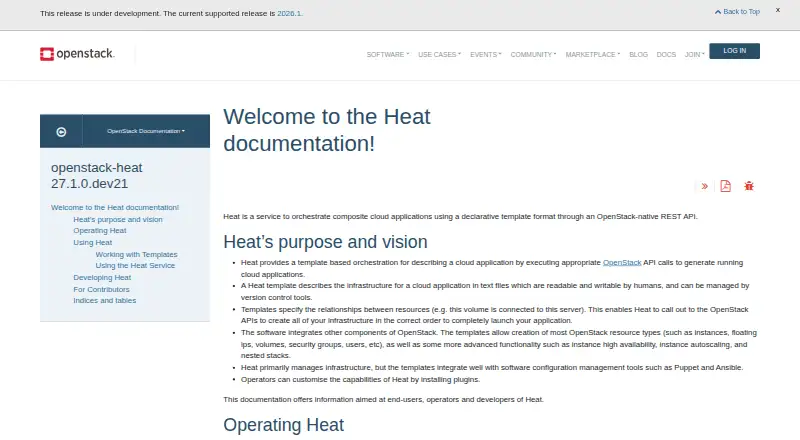
What OpenStack Heat is
OpenStack Heat is a free, open-source orchestration service for building cloud applications from declarative templates in an OpenStack environment. Teams describe infrastructure and resource relationships in human-readable files that can be tracked with version control. Heat runs HOT templates written in YAML and also accepts AWS CloudFormation templates. A template can create resources such as instances, floating IPs, volumes, security groups, and users. Orchestration features include instance high availability, autoscaling, and nested stacks. Templates can also work with configuration tools such as Puppet and Ansible, while operators can add capabilities through plugins. Heat offers an OpenStack-native REST API and a CloudFormation-compatible Query API. Users can work through a CLI, RESTful queries, or the OpenStack dashboard. It is intended for end users, operators, and developers. Heat runs on Linux as a self-hosted service, and installation assumes a working OpenStack environment with Compute, Image Service, and Identity already in place. Installation guidance covers several Linux distributions, with steps varying by distribution.
Good
- Templates define infrastructure and resource relationships
- Supports HOT YAML and CloudFormation templates
- Includes high availability, autoscaling, and nested stacks
- Accessible by CLI, REST queries, and dashboard
Watch out
- Requires an existing OpenStack environment
- Compute, Image Service, and Identity must already be installed
- Installation steps vary by Linux distribution
Who it suits
Heat suits OpenStack users, operators, and developers who want to define and orchestrate infrastructure through templates. It assumes an existing OpenStack environment and Linux deployment.
Verdict
Heat provides template-driven orchestration and multiple access methods for OpenStack deployments. Its dependency on an already working OpenStack environment makes it a fit for teams with that foundation in place.
Plans and prices
From OpenStack Heat's own pricing page, checked 9 Oct 2026.
| Plan | Price | What it gives you |
|---|---|---|
| OpenStack Heat | Free | Requires a working OpenStack environment with Compute, Image Service and Identity · Installation and configuration vary by distribution |
The facts
Each one read from OpenStack Heat's own pages, with the date it was checked.
What it does
- Access
- Heat can be accessed through a CLI, RESTful queries and the OpenStack dashboard web interface.checked 9 Oct 2026
- Advanced orchestration
- Heat supports instance high availability, instance autoscaling and nested stacks.checked 9 Oct 2026
- APIs
- The service provides an OpenStack-native REST API and a CloudFormation-compatible Query API.checked 9 Oct 2026
- Audience
- The documentation is aimed at end users, operators and developers of Heat.checked 9 Oct 2026
- Deployment requirement
- Installation assumes a working OpenStack environment with Compute, Image Service and Identity already installed.checked 9 Oct 2026
- Extensibility
- Operators can customize Heat capabilities by installing plugins.checked 9 Oct 2026
- Integrations
- Heat templates integrate with configuration management tools such as Puppet and Ansible.checked 9 Oct 2026
- License
- The OpenStack project is provided under the Apache 2.0 license.checked 9 Oct 2026
- Purpose
- Heat orchestrates composite cloud applications from declarative templates through an OpenStack-native REST API.checked 9 Oct 2026
- Resource types
- Templates can create OpenStack resources including instances, floating IPs, volumes, security groups and users.checked 9 Oct 2026
- Supported install guidance
- The installation documentation links instructions for Red Hat Enterprise Linux and CentOS, Ubuntu and Debian, and says installation varies by distribution.checked 9 Oct 2026
- Template formats
- Heat runs HOT templates written in YAML and also supports AWS CloudFormation templates.checked 9 Oct 2026
- Templates
- Heat templates describe infrastructure and resource relationships in human-readable text files that can be managed with version control.checked 9 Oct 2026
Alternatives to OpenStack Heat
- 1

Cloudify
Free planOpen sourceWebAPILinuxmacOS8.4From $395 a month - 2

Terraform
Free planWebAPILinuxmacOS8.0Free plan - 3

Terramate
Free planOpen sourceWebAPIExtensionLinux8.0From $449 a month - 4

AWS CloudFormation
Free planiOSWebAPILinux7.7Free plan - 5

Pulumi
Free planWebAPILinuxmacOS7.4From $40 a month - 6

Oracle Cloud Infrastructure Container Registry
Free planWebAPILinux7.0Free plan