OpenLSTO
OpenLSTO is free, open-source C++ software for level set based structural topology optimization.
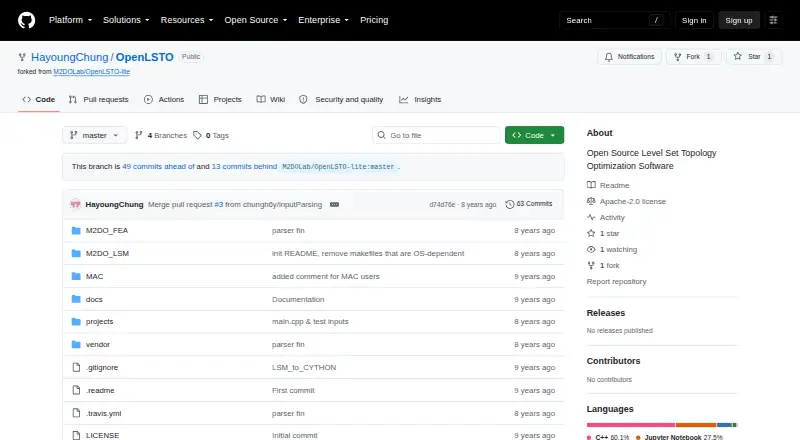
What OpenLSTO is
OpenLSTO is free, open-source C++ software for level set based structural topology optimization. It implements the M2DO lab’s method to minimize compliance, or maximize stiffness, subject to a volume constraint in a two-dimensional design domain. The described first light version covers that 2D problem scope. Researchers at UC San Diego and Cardiff University developed and maintain the software. It runs through command-line arguments in a terminal; for simple serial cases without external libraries, it can be compiled and executed with a C++ compiler. The project favors in-house code components over third-party packages where possible and is licensed under Apache 2.0. OpenLSTO produces `.vtk` output that ParaView can read, but users need a visualization tool to post-process solution files. The project provides a repository clone command and a ZIP download. It supports Linux, macOS, and Windows. Extended capabilities that use externally provided software are planned for a more advanced version.
Good
- Free and open-source under Apache 2.0.
- Supports Linux, macOS, and Windows.
- Simple serial cases can use only a C++ compiler.
- Produces `.vtk` files readable by ParaView.
Watch out
- The described first version is limited to 2D.
- Users need a visualization tool for post-processing.
- Execution uses command-line arguments in a terminal.
Who it suits
OpenLSTO is aimed at researchers and others working on structural topology optimization who are comfortable using command-line software. Its scope is limited to 2D compliance minimization under a volume constraint in the described first version.
Verdict
OpenLSTO provides a focused implementation of 2D level set topology optimization. Its terminal workflow and need for separate visualization software are relevant considerations before use.
Plans and prices
From OpenLSTO's own pricing page, checked 7 Oct 2026.
| Plan | Price | What it gives you |
|---|---|---|
| OpenLSTO | Free | Open-source software; first light version supports 2D compliance minimization under a volume constraint |
The facts
Each one read from OpenLSTO's own pages, with the date it was checked.
What it does
- Dependencies
- The project says it favors in-house code components over third-party packages or libraries where possible.checked 7 Oct 2026
- Download
- The project provides a repository clone command and a ZIP download link.checked 7 Oct 2026
- Extended capabilities
- The README says extended capabilities using externally provided software are planned for a more advanced version.checked 7 Oct 2026
- Installation
- In simple serial cases without external libraries, it can be compiled and executed with just a C++ compiler.checked 7 Oct 2026
- Intended users
- The software was developed and is maintained by researchers at UC San Diego and Cardiff University.checked 7 Oct 2026
- Interface
- OpenLSTO execution occurs via command-line arguments in a terminal.checked 7 Oct 2026
- License
- The project is available under the Apache 2.0 license.checked 7 Oct 2026
- Method
- It implements the M2DO lab’s level set topology optimization method to minimize compliance (maximize stiffness) under a volume constraint in a 2D design domain.checked 7 Oct 2026
- Purpose
- OpenLSTO is open-source software for level set based structural topology optimization, written in C++.checked 7 Oct 2026
- Scope limit
- The described first light version addresses a 2D design domain.checked 7 Oct 2026
- Visualization
- Users need a data visualization tool to post-process solution files; OpenLSTO supports .vtk output that ParaView can read.checked 7 Oct 2026
The company
- Founded
- 2017checked 28 Sep 2026
Where it runs
- Platforms
- The installation instructions mention native terminal applications for Unix/Linux and Mac OS X users.checked 7 Oct 2026
The full review of OpenLSTO
OpenLSTO is a focused, open-source C++ implementation of level set topology optimization for two-dimensional structural designs. It suits researchers and technically confident engineers whose objective is compliance minimization under a volume constraint. The trade-off is a specialist, terminal-first workflow rather than an all-in-one design and visualization environment.
Overview
OpenLSTO implements the M2DO lab’s level set method to minimize compliance, which is equivalent to maximizing stiffness, while keeping material within a volume constraint. The first light version is deliberately narrow: it works in a 2D design domain and concentrates on topology optimization rather than presenting a broad menu of structural objectives. Researchers at UC San Diego and Cardiff University developed and maintain the project. Apache 2.0 licensing makes it a practical choice for users who want open-source software they can study and use under that license.
Key features
- Level set topology optimization: The method targets a clearly defined structural problem. It is a strong fit when compliance and volume are the requirements, but users needing different objectives, constraints or three-dimensional domains will outgrow this first version.
- 2D design scope: Restricting the described release to two dimensions keeps the problem focused and suitable for teaching, research prototypes and method development. It is not a substitute for a broader 3D optimization platform.
- C++ implementation: In simple serial cases without external libraries, a C++ compiler is enough to build and run the software. That keeps the basic path comparatively lean for developers, although more advanced capabilities relying on externally provided software are planned rather than included in the described version.
- Command-line execution: OpenLSTO runs through terminal arguments. This favors reproducible scripts and users comfortable managing simulations from a shell, but it offers no graphical operating model for people who expect interactive setup.
- Post-processing output: The program can write .vtk files that ParaView can read. That gives the results a route into established visualization software, while requiring users to install and operate a separate tool for inspecting solution files.
- Simulation integration: Simulation integration is supported, making the optimizer relevant to computational workflows rather than only standalone demonstrations. Cloud processing is not provided, so computation remains on the user’s own environment.
- Download and code access: Users can clone the repository or download a ZIP archive. The project favors in-house code over third-party libraries where possible, which can simplify the basic build but does not remove the need to understand a developer-oriented setup.
Pricing
| Plan | Price | What it includes |
|---|---|---|
| OpenLSTO | free | Open-source software; the first light version supports 2D compliance minimization under a volume constraint. |
There is no paid tier, free trial or subscription renewal to manage. The free release is best for academic investigation, prototyping and users able to work with source code. Its cost advantage comes with the stated scope limits: 2D compliance optimization, terminal control and separate visualization rather than a commercial graphical suite or cloud service.
Platforms
OpenLSTO supports Linux, macOS and Windows. Simple serial builds can use a C++ compiler without external libraries, but platform setup still depends on compiling and running a command-line application. Choose it when your team can maintain that cross-platform development workflow; users seeking a browser-based or hosted process should look elsewhere.
Who it's for
Researchers and graduate students working on level set methods, structural optimization specialists studying compliance and stiffness, and developers building scripted 2D experiments are the clearest audience. It also suits technically comfortable users who value inspectable, Apache-licensed source and can handle ParaView for results. It is a poor match for designers seeking an interactive GUI, turnkey 3D work, built-in visualization or cloud execution.
Pros and cons
Pros
- Free and open source: There is no purchase price, trial expiration or recurring fee, and the Apache 2.0 license supports an open development model.
- Focused method: Compliance minimization with a volume constraint gives matched projects a clear, purposeful solver instead of an unfocused feature set.
- Light basic build: Simple serial cases can run with only a C++ compiler, reducing dependency overhead for that use.
- Portable targets: Linux, macOS and Windows coverage lets teams keep the same project across major desktop operating systems.
Cons
- Only the described 2D scope: Three-dimensional designs and broader optimization requirements are outside the first light version.
- Terminal-only operation: Command-line arguments demand technical comfort and provide no graphical setup experience.
- Separate visualization: Results require a post-processing tool such as ParaView to read the .vtk output.
- No cloud processing: Users must provide their own local computing environment.
Alternatives
Generative Design Software is the broader category to browse when you want to compare this specialist optimizer with other generative-design tools.
- TopOpt is the better pick for free MATLAB-based minimum-compliance and buckling optimization, with Linux, macOS, Windows, Android, iOS and web coverage.
- Avocado is a free, early-development option for users focused on its supported platforms and willing to meet its PlayStation BIOS requirement and variable game compatibility.
- Dakota is preferable when you want a free open-source project under the GNU LGPL across Linux, macOS and Windows.
- nTop is the alternative for a commercial nTop workflow, with a free non-commercial Education version for students, educators and academic researchers.
- ICEM Surf is for Windows users seeking its learning edition or commercial licensing rather than an open-source optimizer.
- NETVIBES is a paid, enterprise-oriented option with a free-trial offering and web, mobile and self-hosted availability.
- Plato is worth considering for Linux users who need its open-source objectives and constraints, with a licensed edition for eligible U.S. government work.
- OpenMDAO is the better choice when you need an open-source Apache 2.0 framework rather than OpenLSTO’s narrowly defined 2D topology solver.
Verdict
Choose OpenLSTO if you need a free, inspectable C++ implementation of level set topology optimization for 2D compliance minimization under a volume constraint. Its focused method, light serial setup and cross-platform availability are the main reasons to use it. Look elsewhere if you require 3D work, a graphical interface, integrated visualization or cloud computation.