TopOpt
TopOpt is a collection of topology optimization apps and code from a joint research effort between DTU Mechanical Engineering and DTU Compute.
What TopOpt is
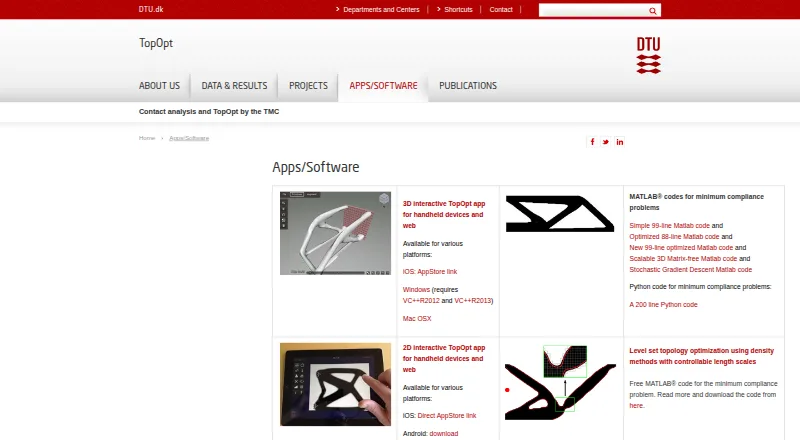
TopOpt is a collection of topology optimization apps and code from a joint research effort between DTU Mechanical Engineering and DTU Compute. The group develops and applies density-based topology optimization methods. Its Apps/Software page lists interactive 2D and 3D apps for handheld devices and web, plus code for minimum compliance, buckling optimization, and photonics. The 2D app is listed for iOS, Android, Linux, Mac OS X, and Windows; the 3D app is listed for iOS, Windows, and Mac OS X. Windows downloads for both require VC++R2012 and VC++R2013. The page offers a 99-line MATLAB implementation intended for engineering education and newcomers, as well as a 200-line Python implementation for minimum compliance problems. For larger-scale work, a PETSc-based parallel framework includes a 3D linear elasticity solver, filters, parallel MMA, and input/output tools. ParaView version 4.0 or newer is recommended for visualization. The photonics offering includes MATLAB code for 2D cylindrical metalens design and five COMSOL Multiphysics models. The listed code is free; no price is stated for the interactive apps.
Good
- Interactive 2D and 3D apps are listed.
- Includes MATLAB and Python minimum compliance code.
- 99-line MATLAB code targets engineering education.
- PETSc framework supports parallel optimization.
- Photonics code includes five COMSOL models.
Watch out
- Windows apps require VC++R2012 and VC++R2013.
- No price is stated for the interactive apps.
- ParaView 4.0 or newer is recommended for visualization.
Who it suits
TopOpt suits engineering students and newcomers studying topology optimization, as well as users working with optimization code and frameworks. Its interactive apps and code target different levels of exploration and computational work.
Verdict
TopOpt offers educational code, interactive apps, and a more extensive PETSc-based framework for topology optimization. Check the app-specific platform requirements and distinguish the free listed code from apps with no stated price.
Plans and prices
From TopOpt's own pricing page, checked 14 Oct 2026.
| Plan | Price | What it gives you |
|---|---|---|
| Free MATLAB and COMSOL photonics codes | Free | 200-line MATLAB inverse-design code and five COMSOL models |
| Free MATLAB code for buckling optimization | Free | TopBuck250 code for 2D buckling, compliance and volume-constrained designs |
| Free MATLAB code for minimum-compliance problems | Free | 99-line, 88-line, new 99-line optimized, scalable 3D matrix-free and stochastic-gradient-descent codes |
| TopOpt apps and software | Free | The Apps/Software page lists free MATLAB code for minimum compliance and buckling optimization and free MATLAB and COMSOL code for photonics; it gives no price for the interactive apps. |
The facts
Each one read from TopOpt's own pages, with the date it was checked.
What it does
- 3D constraints and controls
- The 3D app provides symmetry conditions, prescribed solid or void regions, load scaling and rotation, pause/resume, marching-cubes and voxel visualization, and mesh/domain presets.checked 14 Oct 2026
- 3D export
- The 3D app exports optimized structures for workflows such as 3D printing.checked 14 Oct 2026
- 3D optimization
- The interactive 3D app solves minimum-compliance topology optimization and lets users change loads, supports and volume fraction while optimization runs.checked 14 Oct 2026
- 3D system requirements
- The Windows 3D build requires the 64-bit Visual C++ 2012 and 2013 redistributables.checked 14 Oct 2026
- Buckling extensibility
- TopBuck250 can be coupled with the MMA MATLAB routine or other mathematical-programming tools.checked 14 Oct 2026
- Buckling optimization
- TopBuck250 supports fundamental buckling-load-factor maximization and minimum-volume designs with compliance and buckling constraints in two-dimensional domains.checked 14 Oct 2026
- Educational audience
- The 99-line MATLAB code is intended for engineering education and is offered to students and newcomers to topology optimization.checked 29 Sep 2026
- Framework components
- The PETSc framework includes mesh and optimization parameters, a 3D linear elasticity solver, standard and PDE based filters, parallel MMA, and IO and Python script converters.checked 29 Sep 2026
- Grasshopper
- The Apps/Software page lists TopOpt for Grasshopper and links to a Grasshopper project page.checked 29 Sep 2026
- Grasshopper integration
- TopOpt provides a plugin/project link for Rhino and Grasshopper workflows.checked 14 Oct 2026
- Group
- The group is a joint research effort between DTU Mechanical Engineering and DTU Compute.checked 29 Sep 2026
- Independent ecosystem
- MATLAB Central hosts a TopOpt GUI created to assist users of the DTU program; its page records zero reviews and six downloads.checked 14 Oct 2026
- Independent technical limit
- A 2026 Springer study says TopOpt does not present principal-stress, von-Mises-stress or displacement FEA results and is limited to two materials.checked 14 Oct 2026
- Integrations
- The PETSc framework is built upon PETSc, and the page recommends ParaView version 4.0 or newer for visualization.checked 29 Sep 2026
- Large scale framework
- The PETSc-based code is a fully parallel framework for very large scale topology optimization on structured grids.checked 29 Sep 2026
- Level-set education
- The level-set MATLAB code is aimed at engineering education and explains transition from density designs to level-set designs.checked 14 Oct 2026
- Level-set limitation
- The level-set code is explicitly not performance-optimized because it favors transparent loops over vectorization.checked 14 Oct 2026
Where it runs
- Android adoption
- The AppBrain listing estimates 22 thousand downloads and identifies version 2.8 as free with an Everyone content rating.checked 14 Oct 2026
- Android availability limitation
- AppBrain reports that the Android app was unpublished from Google Play on 6 December 2021 and last updated on 20 December 2014.checked 14 Oct 2026
- Apple compatibility
- The App Store listing requires iOS or iPadOS 11 or later and lists a 105 MB size.checked 14 Oct 2026
- Apple privacy limitation
- Apple says the developer has not provided privacy-practice details for the app.checked 14 Oct 2026
- Interactive apps
- The site lists 2D and 3D interactive TopOpt apps for handheld devices and web.checked 29 Sep 2026
The company
- Founded
- 1829checked 28 Sep 2026
- Headquarters
- Kongens Lyngby, Denmarkchecked 28 Sep 2026
The full review of TopOpt
TopOpt brings together research software and interactive tools from a university group focused on density-based topology optimization. It suits engineering students learning the methods and researchers or practitioners who need optimization code; the best fit depends on whether you want a teaching example, a focused application, or a parallel framework.
Overview
TopOpt is the short name for topology optimization, and the DTU group develops and applies density-based methods. The joint effort spans DTU Mechanical Engineering and DTU Compute in Kongens Lyngby, Denmark.
This is a collection rather than one unified app: it ranges from interactive 2D and 3D tools to compact code and a PETSc-based framework for large-scale work. That breadth is useful to people moving from introductory examples to specialized structural or photonics problems, but readers should choose by task rather than expect one package to cover every workflow.
Key features
Interactive tools and teaching code
Interactive 2D and 3D apps are offered for handheld devices and the web. The 99-line MATLAB code targets engineering education and newcomers, while additional MATLAB code and a 200-line Python implementation address minimum-compliance problems. The short implementations make the core problem more approachable; they are not substitutes for the parallel framework when scale is the priority.
Specialist methods and framework
TopBuck250 extends top99neo to 2D buckling, including buckling-load-factor maximization and minimum-volume design with compliance and buckling constraints. For photonics, the offering combines a 200-line MATLAB code for 2D cylindrical metalens design with five COMSOL Multiphysics models.
The PETSc-based framework is the more substantial option for very large structured-grid problems. It includes mesh and optimization parameters, a 3D linear-elasticity solver, standard and PDE-based filters, parallel MMA, and IO and Python script converters. Its reliance on PETSc and recommendation of ParaView 4.0 or newer for visualization make it better suited to technical workflows than casual exploration. TopOpt for Grasshopper is also part of the software collection.
Pricing
The plan “TopOpt apps and software” is free. Free MATLAB code covers minimum-compliance and buckling optimization, and free MATLAB and COMSOL code is offered for photonics. No seat counts, quotas, or trial terms are given for that plan. The interactive apps have no stated price, so do not assume their pricing from the free code.
For readers choosing among the free resources, the compact educational code is the natural starting point; the PETSc framework is the better fit when parallel, very-large-scale optimization is required. The difference is capability and scope, not a published paid tier.
Platforms
The 2D app is listed for iOS, Android, Linux, Mac OS X, and Windows; the 3D app is listed for iOS, Windows, and Mac OS X. The apps are also described as available on the web. Windows downloads for both apps require VC++R2012 and VC++R2013, a practical setup requirement for Windows users. Platform tags also include Linux, macOS, Android, and iOS, but code and framework requirements depend on the particular offering.
Who it's for
Students and newcomers should start with the 99-line MATLAB example, while researchers can select code for minimum compliance, buckling, or photonics. Teams working on very large structured grids have a stronger reason to consider the PETSc framework and its parallel components. Readers who need a polished, single-purpose commercial product or a published support commitment should look elsewhere: TopOpt's maker pages provide no security or compliance statements and no support plan.
Pros and cons
- Pros: The collection spans introductory code, interactive apps, specialist examples, and a parallel framework, giving technically minded users options at different scales.
- Pros: The photonics and buckling resources address concrete optimization problems rather than only general topology optimization.
- Cons: Windows app downloads require two VC++ runtimes, adding setup work for users who do not already have them.
- Cons: The range of separate resources means readers must match the tool to their problem; the collection is not presented as one integrated application.
- Cons: No support plan or security and compliance statements are provided, which may rule it out for organizations with formal operational requirements.
Alternatives
For an overview of related category options, see Generative Design Software.
- NETVIBES may suit readers seeking paid enterprise data-science software, with a free plan and free trial, rather than topology-optimization code.
- Avocado is a free, early-development option for readers focused on game compatibility; it requires a PlayStation BIOS and compatibility varies.
- Dakota is a free alternative for users seeking open-source software under the GNU LGPL.
- Plato may be preferable when its limited open-source set of objectives and constraints is sufficient, or for U.S. government agencies and contractors considering its licensed version.
- Ansys optiSLang is a paid option with a free trial; its Pro plan lists unlimited parameters, constraints, and objectives and LS-OPT enabled.
- modeFRONTIER is a paid alternative for readers seeking commercial licensing options through ESTECO.
- FEniTop is another free option for Linux or Windows users.
- CAESES may suit readers seeking paid geometry modeling and design-study tools, with a free trial.
Verdict
Choose TopOpt if you need accessible topology-optimization teaching code, a focused research implementation, or a PETSc-based route to very large structured-grid problems. Its strongest case is the range from compact examples to parallel methods; look elsewhere if you need a single supported commercial product or formal security and compliance assurances.
Getting started
- Visit the TopOpt Apps/Software website.
- Choose an interactive app or code resource for your optimization task.
- Use the listed platform for the selected app.
- Install VC++R2012 and VC++R2013 for a Windows app download.
- Use ParaView 4.0 or newer for visualization with the PETSc framework.
Limits worth knowing
The listed code is free, but no price is stated for the interactive apps. Windows downloads for the 2D and 3D apps require VC++R2012 and VC++R2013.
Questions
Is TopOpt free?
The page lists free MATLAB and Python code, including code for minimum compliance and buckling optimization, as well as free photonics code. It does not state a price for the interactive apps.
Which platforms are listed for the apps?
The 2D app is listed for iOS, Android, Linux, Mac OSX, and Windows. The 3D app is listed for iOS, Windows, and Mac OSX.
Who develops TopOpt?
It is a joint research effort between DTU Mechanical Engineering and DTU Compute.
Does TopOpt integrate with other software?
The PETSc framework is built upon PETSc, and ParaView 4.0 or newer is recommended for visualization. The photonics offering includes five COMSOL Multiphysics models, and the page also lists TopOpt for Grasshopper.
What does the PETSc framework include?
It includes mesh and optimization parameters, a 3D linear elasticity solver, standard and PDE-based filters, parallel MMA, and IO and Python script converters.