Dakota
Dakota provides software for optimization and uncertainty quantification using computational models.
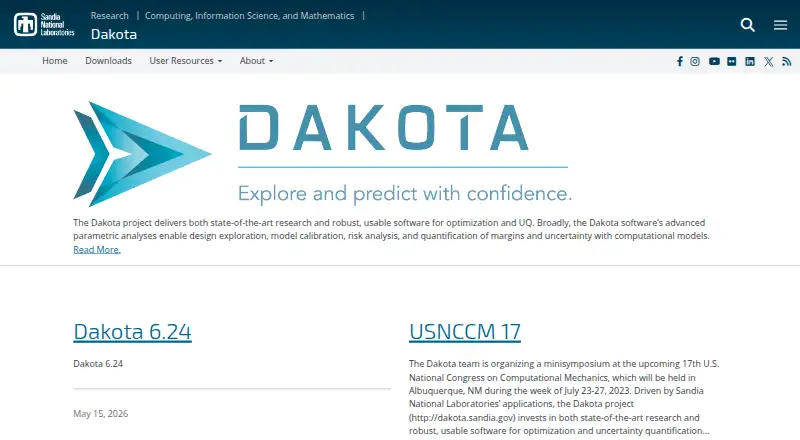
What Dakota is
Dakota provides software for optimization and uncertainty quantification using computational models. Its methods include optimization, parameter estimation, sensitivity or variance analysis, and uncertainty quantification. Engineering analysts can use it to explore design choices and assess confidence in computational predictions. The C++ toolkit connects simulation codes with iterative systems-analysis methods. Its capabilities can be combined in approaches such as hybrid optimization, surrogate-based optimization, and optimization under uncertainty. Dakota lists MPI as a utility for parallel distributed-memory communication. Installation instructions also describe an optional PYTHONPATH setup for using the dakota.interfacing Python module. Prebuilt binaries are available for macOS, Windows, and Red Hat Enterprise Linux 7 and 8; other platforms require building from source. Dakota versions 5.0 and newer are offered under the GNU Lesser General Public License. Some optional numerical libraries, including DOT, NLPQLP, and NPSOL/NLSSOL, require separate commercial licenses. Documentation is provided for releases 6.17 and later through Dakota’s documentation site, with older manuals available for download. User support is directed to GitHub Discussions.
Good
- Includes optimization and uncertainty analysis methods.
- C++ toolkit connects simulation codes to analysis methods.
- Versions 5.0 and newer use the GNU LGPL.
- Prebuilt binaries cover macOS, Windows, and specified Red Hat releases.
Watch out
- Other platforms require building from source.
- Some optional numerical libraries need separate commercial licenses.
- Release documentation is provided for 6.17 and later.
Who it suits
Dakota suits engineering analysts using computational models to explore designs, analyze uncertainty, or assess prediction confidence. Users on platforms without prebuilt binaries need to build from source.
Verdict
Dakota offers a broad set of computational-model analysis methods through an extensible C++ toolkit. Check the supported binary platforms and any separate licenses needed for optional numerical libraries.
Plans and prices
From Dakota's own pricing page, checked 3 Oct 2026.
| Plan | Price | What it gives you |
|---|---|---|
| Dakota | Free | Open-source software under GNU LGPL |
The facts
Each one read from Dakota's own pages, with the date it was checked.
What it does
- Advanced strategies
- Dakota capabilities can be combined in strategies such as hybrid optimization, surrogate-based optimization, and optimization under uncertainty.checked 3 Oct 2026
- Analysis methods
- Its methods include optimization, uncertainty quantification, parameter estimation, and sensitivity or variance analysis.checked 3 Oct 2026
- Commercial extensions
- Some optional numerical libraries, including DOT, NLPQLP, and NPSOL/NLSSOL, require separate commercial licenses.checked 3 Oct 2026
- Documentation
- Documentation for releases 6.17 and later is provided through Dakota’s documentation site, while older manuals are available for download.checked 3 Oct 2026
- Intended users
- The project describes its use for engineering analysts exploring designs and assessing confidence in computational predictions.checked 3 Oct 2026
- License
- Dakota versions 5.0 and newer are available under the GNU Lesser General Public License.checked 3 Oct 2026
- Operating systems
- Prebuilt binaries are available for macOS, Windows, and Red Hat Enterprise Linux 7 and 8; other platforms require building from source.checked 3 Oct 2026
- Parallel computing
- Dakota lists MPI as a utility for parallel distributed-memory communication.checked 3 Oct 2026
- Project history
- The Dakota project was initiated in 1994.checked 3 Oct 2026
- Purpose
- Dakota provides software for optimization and uncertainty quantification using computational models.checked 3 Oct 2026
- Python support
- The installation instructions provide an optional PYTHONPATH setup for using the dakota.interfacing Python module.checked 3 Oct 2026
- Software interface
- The C++ toolkit provides an extensible interface between simulation codes and iterative systems analysis methods.checked 3 Oct 2026
- Support
- The project directs users to GitHub Discussions for user support.checked 3 Oct 2026
- Training resources
- The project offers screencasts covering introductory use, input files, sensitivity analysis, and sampling.checked 3 Oct 2026
The full review of Dakota
Overview
Dakota is a computational-model analysis toolkit for engineers and analysts who need to optimize designs or assess uncertainty in simulation results. Its breadth of methods makes it a strong fit for model-centered engineering work; readers seeking a self-contained design application should look elsewhere.
Key features
Dakota brings optimization, uncertainty quantification, parameter estimation, and sensitivity or variance analysis into one toolkit. That combination helps analysts weigh candidate designs alongside confidence in computational predictions. It supports multi-objective optimization, as well as hybrid optimization, surrogate-based optimization, and optimization under uncertainty, which gives teams several ways to structure demanding analysis problems.
The C++ interface is designed to connect simulation codes with iterative systems-analysis methods. That extensibility suits workflows built around existing computational models, but it also makes Dakota a more technical choice than a standalone design tool. An optional dakota.interfacing Python module can be used by configuring PYTHONPATH. MPI is included as a utility for parallel distributed-memory communication.
Documentation for releases 6.17 and later is provided through Dakota’s documentation site, with older manuals available for download. GitHub Discussions is the support channel, and screencasts cover introductory use, input files, sensitivity analysis, and sampling. Those resources address core topics, though users should expect to work within a technical toolkit rather than a guided application.
Pricing
Dakota is free open-source software under the GNU Lesser General Public License for versions 5.0 and newer. The free plan includes Dakota itself, with no free trial required. Some optional numerical libraries, including DOT, NLPQLP, and NPSOL/NLSSOL, require separate commercial licenses, so users who need those components should account for additional licensing.
| Plan | Price | What it means |
|---|---|---|
| Dakota | free | Open-source software under GNU LGPL |
Platforms
Dakota supports Linux, macOS, and Windows. Prebuilt binaries are available for macOS, Windows, and Red Hat Enterprise Linux 7 and 8; other platforms require building from source. That distinction matters for Linux users outside the supported Red Hat releases, who may need to handle compilation themselves.
Who it's for
Dakota is best suited to engineering analysts exploring designs and assessing confidence in computational predictions, particularly when they need multiple analysis methods in one extensible toolkit. It is a less natural fit for users who want a ready-made design interface or a narrow, point-and-click workflow.
Pros and cons
- Pro: Optimization, uncertainty quantification, parameter estimation, and sensitivity analysis share one toolkit, supporting broader model-based investigations.
- Pro: The extensible C++ interface and optional Python module can fit into simulation-centered workflows.
- Pro: The core software is free under the GNU LGPL for versions 5.0 and newer.
- Con: Some optional numerical libraries require separate commercial licenses.
- Con: Prebuilt Linux binaries are limited to Red Hat Enterprise Linux 7 and 8; other platforms require a source build.
Alternatives
For topology-optimization-specific work, TopOpt is a free option with MATLAB code for minimum compliance and buckling optimization, while OpenLSTO is a free open-source alternative whose first light version supports 2D compliance minimization under a volume constraint. OpenMDAO is another free open-source framework, under Apache 2.0, to consider for a framework-oriented workflow.
nTop may suit students, educators, and academic researchers who qualify for its free non-commercial education version; commercial users can consider its commercial license, which has custom pricing. Plato offers a free open-source version with a limited set of objectives and constraints, plus a licensed version with custom pricing. Z88Arion is a free Windows-only option, with a separate license required for commercial use.
NETVIBES is a paid alternative with a free plan and trial, including an Enterprise Data Science plan with custom pricing. Avocado is a free alternative in early development that requires a PlayStation BIOS and has varying game compatibility. For a broader category comparison, browse Generative Design Software.
Verdict
Choose Dakota if you need a free, extensible toolkit for optimization and uncertainty analysis around computational models. Its strongest case is the combination of methods with simulation-code integration; look elsewhere if you need prebuilt binaries for a different Linux platform or rely on optional libraries with separate commercial licenses.
Getting started
- Open the Dakota website
- Choose the package for macOS, Windows, or Red Hat Enterprise Linux 7 or 8
- Build Dakota from source when using another platform
- Install and optionally configure PYTHONPATH for the dakota.interfacing Python module
- Connect simulation codes through the C++ toolkit interface
Limits worth knowing
Dakota is free under the GNU LGPL, but some optional numerical libraries, including DOT, NLPQLP, and NPSOL/NLSSOL, require separate commercial licenses. Platforms without listed prebuilt binaries require source compilation.
Questions
What does Dakota cost?
Dakota is free software, with a listed plan price of no cost.
Which operating systems have binaries?
Prebuilt binaries are available for macOS, Windows, and Red Hat Enterprise Linux 7 and 8. Other platforms require building from source.
Is Dakota open source?
Dakota versions 5.0 and newer are available under the GNU Lesser General Public License.
Can Dakota integrate simulations?
Yes. Its C++ toolkit provides an interface between simulation codes and iterative systems-analysis methods.
Does Dakota support Python?
Installation instructions include an optional PYTHONPATH setup for the dakota.interfacing Python module.