OpenIDE
OpenIDE is a multilingual development environment based on the IntelliJ IDEA Platform, available for Linux, macOS, and Windows.
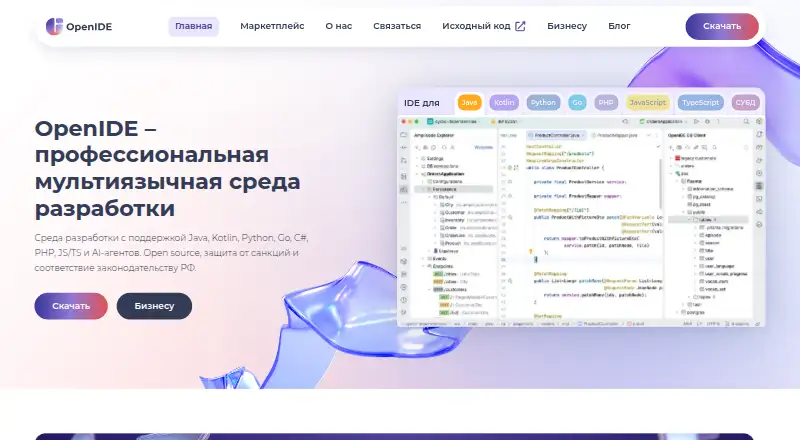
What OpenIDE is
OpenIDE is a multilingual development environment based on the IntelliJ IDEA Platform, available for Linux, macOS, and Windows. Its free plan is free; OpenIDE Pro is a corporate option with pricing and terms discussed with the company. The listed languages include Java, Kotlin, Python, Go, C#, PHP, JavaScript, and TypeScript, though C# is still in development. Spring support comes through the free Amplicode plugin. A built-in Git client handles branches, commits, rebase, cherry-pick, diffs, and history, and the marketplace offers more than 300 plugins subject to their distribution licenses. The maker also lists GitFlic and AI-plugin integrations. Docker, Go, and frontend support are marked experimental. The FAQ says the IDE can be used without registration or personal-data collection; anonymized usage statistics may be collected by default and disabled in settings. The maker says build and operating infrastructure is in Russia and that OpenIDE contacts only Russian servers for statistics, updates, and plugins.
Good
- Free plan costs nothing.
- Built-in Git client includes history and diffs.
- Marketplace offers more than 300 plugins.
- Spring support comes through the free Amplicode plugin.
Watch out
- C# support is still in development.
- Docker, Go, and frontend support are experimental.
- OpenIDE Pro pricing is discussed with the company.
- Anonymized usage statistics may be collected by default.
Who it suits
OpenIDE may suit developers working in its listed languages who want a desktop IDE with Git tools and a plugin marketplace. Organizations considering OpenIDE Pro can discuss its terms and pricing with the company.
Verdict
OpenIDE brings a broad language list, Git tools, and a large plugin marketplace to a free desktop IDE. Check the experimental status of some capabilities and the Pro pricing arrangement against your needs.
Plans and prices
From OpenIDE's own pricing page, checked 29 Sep 2026.
| Plan | Price | What it gives you |
|---|---|---|
| OpenIDE | Free | Free IDE; open source |
| OpenIDE Pro | Priced on request | Paid corporate solution; free access for educational programs, open-source contributors, and media content creators · Pricing and terms are discussed with the company |
The facts
Each one read from OpenIDE's own pages, with the date it was checked.
What it does
- Data and telemetry
- The FAQ says the IDE can be used without registration or collection of personal data; anonymized usage statistics may be collected by default and can be disabled in settings.checked 29 Sep 2026
- Experimental features
- Docker support, Go support, and frontend support for TypeScript/JavaScript and frameworks including React, Angular, Vue, and Next.js are marked experimental.checked 29 Sep 2026
- Git
- OpenIDE includes a Git client for branches, commits, rebase, cherry-pick, diffs, and history.checked 29 Sep 2026
- Infrastructure
- The maker says OpenIDE build and operating infrastructure is in Russia and that the IDE contacts only servers located in Russia for statistics, updates, and plugins.checked 29 Sep 2026
- Integrations
- The maker lists GitFlic integration and AI plugins including GigaCode, Continue, and Kilo Code.checked 29 Sep 2026
- Languages
- The site lists Java, Kotlin, Python, Go, C#, PHP, JavaScript, and TypeScript among its supported languages; C# is in development.checked 29 Sep 2026
- Plugins
- The OpenIDE Marketplace offers more than 300 plugins, subject to their distribution licenses.checked 29 Sep 2026
- Pro security
- OpenIDE Pro is described as running locally, not sending source code to external services, using no third-party telemetry, and not depending on foreign cloud infrastructure.checked 29 Sep 2026
- Pro support
- OpenIDE Pro offers legally documented supply and support under an SLA for corporate customers.checked 29 Sep 2026
- Purpose
- OpenIDE is a multilingual development environment based on the IntelliJ IDEA Platform.checked 29 Sep 2026
- Registry
- OpenIDE is listed in Russia’s domestic software registry, entry 31585 dated 30 December 2025.checked 29 Sep 2026
- Spring
- Spring support is provided through the free version of the Amplicode plugin.checked 29 Sep 2026
- Support channels
- The team invites questions by email and in its Telegram chat.checked 29 Sep 2026
The company
- Headquarters
- Moscow, Russiachecked 28 Sep 2026
- Maker
- The site identifies the operator as Open Development Environment LLC (ООО «Открытая среда разработки»), with a Moscow legal address.checked 29 Sep 2026
The full review of OpenIDE
OpenIDE is a desktop development environment built on the IntelliJ IDEA Platform, for developers who want one workspace for several languages and Git. It is strongest as a free, locally oriented option for PHP and general development; treat its experimental Go, Docker, and frontend capabilities cautiously.
Overview
OpenIDE runs on Linux, macOS, and Windows. Its language list spans Java, Kotlin, Python, Go, C#, PHP, JavaScript, and TypeScript, although C# remains in development. Spring support comes through the free version of the Amplicode plugin. PHP developers also get refactoring, Xdebug debugging, unit testing, and database tools, making the product relevant beyond basic editing.
The built-in Git client handles branches, commits, rebase, cherry-pick, diffs, and history. GitFlic integration and AI plugins including GigaCode, Continue, and Kilo Code add options for particular workflows. More than 300 plugins are offered through the OpenIDE Marketplace, subject to each plugin's distribution license.
Key features
Broad tooling, with caveats
OpenIDE’s feature range is appealing to developers who want language support and repository operations in a single desktop environment. But breadth should not be mistaken for equal maturity: Go support, Docker support, and frontend support for JavaScript and TypeScript—including React, Angular, Vue, and Next.js—are marked experimental. Those workflows may suit exploration, but teams that depend on them should weigh that status carefully.
Privacy and deployment
The FAQ says OpenIDE works without registration or personal-data collection. Anonymized usage statistics may be collected by default, but can be disabled in settings. The maker says its build and operating infrastructure is in Russia, and the IDE contacts only servers located there for statistics, updates, and plugins. OpenIDE is in Russia’s domestic software registry, entry 31585 dated 30 December 2025.
For Pro, the maker describes local operation, no source-code transmission to external services, no third-party telemetry, and no reliance on foreign cloud infrastructure. Corporate customers can also obtain legally documented supply and support under an SLA. These are specifically Pro assurances, not a reason to assume the same terms for every user of the free edition.
Pricing
| Plan | Price | What it suits |
|---|---|---|
| OpenIDE | free | Free, open-source IDE for individual developers and other users who do not need the corporate Pro arrangement. |
| OpenIDE Pro | Custom pricing | Paid corporate solution; pricing and terms are discussed with the company. Free access is offered for educational programs, open-source contributors, and media content creators. |
The free plan is the clear starting point for users who want the IDE without a paid commitment. Pro is aimed at organizations that need its stated security posture and SLA-backed support, but custom pricing means buyers must discuss costs and terms directly. The maker invites questions by email and in its Telegram chat.
Platforms
OpenIDE supports Linux, macOS, and Windows, so it can serve teams and individuals working across those desktop systems. The maker identifies Open Development Environment LLC (ООО «Открытая среда разработки») as the operator, with a Moscow legal address.
Who it's for
OpenIDE makes the most sense for developers who value a free, open-source desktop IDE with a wide language roster, substantial PHP tooling, and a built-in Git client. It can also suit Russian organizations assessing locally operated software and Pro’s documented corporate support. It is a less secure fit for production workflows that depend on its experimental Go, Docker, or frontend capabilities, or for buyers who need a fixed Pro price before engaging a vendor.
Pros and cons
- Pros: The free, open-source plan and support for Linux, macOS, and Windows make it broadly accessible without a platform lock-in.
- Pros: PHP refactoring, Xdebug debugging, unit testing, and database tools provide concrete development support for PHP projects.
- Pros: Git operations and a marketplace of more than 300 plugins give users room to shape the environment around their work.
- Cons: C# is still in development, while Go, Docker, and frontend capabilities are experimental, limiting confidence for teams that rely on those areas.
- Cons: Pro uses custom pricing, so organizations must contact the company to assess cost and terms.
- Cons: Anonymized usage statistics may be enabled by default, though users can turn them off in settings.
Alternatives
For a free PHP-focused choice on Linux, macOS, or Windows, Eclipse PHP Development Tools is an open-source alternative built as a PHP IDE framework for Eclipse. Choose it if that framework and its free terms suit your needs better than OpenIDE’s broader environment.
Visual Studio Code is another free option for Linux, macOS, Windows, and the web. It is worth considering if you want a free editor with web availability rather than OpenIDE’s desktop-only platform set.
ICEcoder is free and browser-based, with self-hosted and web options as well as desktop and Android platforms. It may fit better when browser access or self-hosting matters more than OpenIDE’s desktop IDE approach.
NuSphere PhpED is a paid alternative with a free trial. Its PhpED Personal plan costs $81, paid once, is for individual developers only, includes 1 year of free upgrades, and cannot be purchased by companies or reimbursed by a business; it suits an individual considering a paid PHP-specific option.
Apache NetBeans is free for commercial and non-commercial use under Apache License 2.0 on Linux, macOS, and Windows. Pick it if those licensing terms and its IDE-and-platform offering are a better match.
CodeLite is a free GPLv2 IDE whose plugin exception allows separately developed plugins to use any license; it may suit users who prefer that licensing arrangement.
PhpStorm is a paid alternative for Windows, macOS, and Linux. Bluefish is a free GNU GPL desktop editor for Linux, macOS, and Windows.
Browse more options in PHP IDEs.
Verdict
Choose OpenIDE if you want a free, open-source desktop IDE with broad language coverage, practical PHP tooling, and built-in Git. Its marketplace and locally oriented Pro offer broaden its appeal, particularly for Russian corporate buyers. Look elsewhere if your work depends on experimental Go, Docker, or frontend support, or if you need a known Pro price upfront.
Alternatives to OpenIDE
- 1

IntelliJ IDEA
Free planAPIExtensionLinuxmacOS7.8Free plan - 2
PaizaCloud Cloud IDE
Free planAndroidiOSWebLinux7.7From $9.80 a month - 3

Zed
Free planLinuxmacOSWindows7.6From $10 a month - 4
Geany
Free planOpen sourceLinuxmacOSWindows7.4Free plan - 5

Visual Studio Code
Free planWebLinuxmacOSWindows7.4Free plan - 6
ICEcoder
Free planAndroidWebAPILinux7.1Free plan