
Openfront Law Firm
Openfront Law Firm is an open-source application for managing law-firm operations, from intake and conflict review through matters, billing, trust records, a…
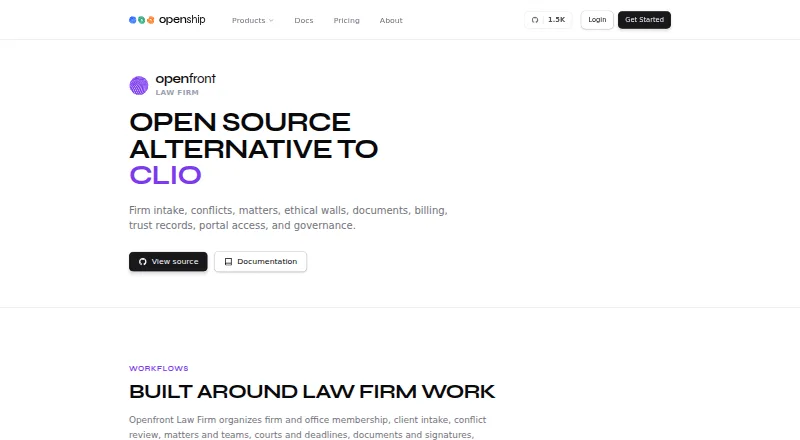
What Openfront Law Firm is
Openfront Law Firm is an open-source application for managing law-firm operations, from intake and conflict review through matters, billing, trust records, and client collaboration. Its workflows cover matter teams, courts and deadlines, communications, time and expenses, invoices, trust ledgers, and document history. Firm memberships and roles, matter team assignments, ethical walls, and precise resource grants define access. Records such as invoice lines, document versions, trust entries, signature events, and audit events use append-only records or compensating operations. Integration controls include provider connections, encrypted credential envelopes, external record links, communication and webhook records, API keys, and OAuth authorization code with S256 PKCE. Those integration boundaries do not themselves send email or SMS, store actual documents, collect payments, calculate court deadlines, submit filings, or obtain signatures. The current source also has no public intake or client-facing portal interface. Deployment uses Node.js, Next.js, Keystone, Prisma, and PostgreSQL, with public and internal HTTPS origins required for production. Firm use with real data also calls for reviewed migration and restore procedures, managed secrets and encryption keys, tested provider adapters, monitoring, incident response, and jurisdiction-specific legal review. Openfront’s maker cautions that the software does not guarantee legal-ethics, privilege, trust-accounting, privacy, retention, signature, security, or jurisdiction-specific compliance. The general pricing page lists plans but does not give a product-specific Openfront Law Firm price.
Good
- Open-source application for legal-practice operations.
- Workflows cover matters, court deadlines, time, expenses, and trust ledgers.
- Access controls include ethical walls and precise resource grants.
- Records preserve history through append-only records or compensating operations.
- Supports API-key authentication and OAuth authorization code with S256 PKCE.
Watch out
- Does not itself collect payments or send real email or SMS.
- No public intake or client-facing portal interface in the current source.
- Production use requires deployment and substantial operational safeguards.
- Maker does not guarantee legal-ethics, privilege, trust-accounting, privacy, retention, signature, security, or jurisdiction-specific compliance.
Who it suits
It suits law firms and legal operations teams seeking connected matter workflows, financial records, client collaboration, document history, and integration controls on infrastructure they choose. Teams should be prepared to deploy and operate the application and arrange their own production safeguards and legal review.
Verdict
Choose Openfront Law Firm if your team wants to manage connected legal operations on infrastructure it controls and can handle deployment and maintenance. Look elsewhere if you need built-in public intake, a client portal interface, or integrations that directly send messages, store documents, collect payments, or file with courts.
Plans and prices
From Openfront Law Firm's own pricing page, checked 14 Oct 2026.
| Plan | Price | What it gives you |
|---|---|---|
| Free | Free | Self-deploy · unlimited orders · unlimited products · unlimited regions · multi-location inventory · all built-in integrations · custom storefront · white-label ready · community support · full source code access · Free forever |
| Starter | $49 a month | Up to 500 orders/month · up to 1,000 products · 1 region · single-location inventory · standard integrations · managed infrastructure · automatic updates · email support · $49/month |
| Professional | $199 a month | Up to 5,000 orders/month · up to 10,000 products · up to 5 regions · multi-location inventory · advanced integrations · advanced analytics · priority support · SLA guarantee · $199/month |
| Enterprise | $399 a month | Unlimited orders · unlimited products · unlimited regions · multi-location inventory · custom integrations · custom analytics · dedicated account manager · onboarding and training · enterprise SLA · $399/month; Contact Us |
The facts
Each one read from Openfront Law Firm's own pages, with the date it was checked.
What it does
- Access controls
- The documentation describes firm memberships and roles, matter team assignments, ethical walls, and exact matter and resource grants for portal access.checked 29 Sep 2026
- Audience
- The maker describes the intended audience as law firms and legal operations teams needing connected matter work, financial records, client collaboration, document history, and integration controls in infrastructure they choose.checked 29 Sep 2026
- Authentication extensibility
- The documented integration layer implements API-key authentication, OAuth authorization-code flow with S256 PKCE, refresh-token rotation and grant-scoped agent credentials.checked 14 Oct 2026
- Client intake
- Yeschecked 21 Sep 2026
- Client portal controls
- Portal operations invite contacts, grant exact matter capabilities, share specific resources and revoke access without broad list reads.checked 14 Oct 2026
- Communications
- Communication records cover threads, participants, messages, delivery records and delivery attempts.checked 14 Oct 2026
- Compliance caveat
- The maker says the software does not guarantee legal-ethics, privilege, trust-accounting, privacy, retention, signature, security, or jurisdiction-specific compliance.checked 29 Sep 2026
- Compliance limitation
- The documentation says the software does not guarantee ethics, privilege, trust-accounting, privacy, retention, signature, security or jurisdiction-specific compliance.checked 14 Oct 2026
- Current interface limits
- The current source does not supply public intake or a client-facing portal UI.checked 29 Sep 2026
- Deployment
- The product documentation says to run it with Node.js, Next.js, Keystone, Prisma, and PostgreSQL, and requires explicit public and internal HTTPS origins for production.checked 29 Sep 2026
- Deployment limits
- A deployment for real firm data needs its own reviewed migration and restore procedure, managed secrets and encryption keys, tested provider adapters, monitoring, incident response, and jurisdiction-specific legal review.checked 29 Sep 2026
- Deployment model
- The product is designed to run on infrastructure chosen by the firm, with the application and PostgreSQL database deployed under organizational control.checked 14 Oct 2026
- Documents and signatures
- Document functionality includes documents, immutable versions, signature requests, signers and signature events.checked 14 Oct 2026
- Extension path
- Developers extend the product through Keystone models, reviewed migrations, narrow mutations, provider adapters, dashboard routes and explicit API, OAuth or agent scopes.checked 14 Oct 2026
- Founder
- The maker’s about page identifies Junaid Kabani as founder and CEO and says he began building Openship in 2019.checked 14 Oct 2026
- GraphQL API
- The application exposes a bounded GraphQL API with scoped queries and named operations for onboarding, intake, access, billing, trust, portal, integrations, retention and agent actions.checked 14 Oct 2026
- HTTP security boundary
- The GraphQL boundary requires JSON for ordinary POST calls, restricts multipart uploads to the configured public origin, limits bodies and list sizes, caps query depth, disables HTTP introspection and redacts internal error extensions.checked 14 Oct 2026
- Install workflow
- The documented setup starts with npm install, local PostgreSQL configuration, schema build, type checking, tests, linting and application build.checked 14 Oct 2026
- Intake and conflicts
- The system models contacts, intake submissions, consultations, conflict checks, matches and reviewer dispositions.checked 14 Oct 2026
Money
- Billing
- Billing models rate cards and rules, time, expenses, retainers, invoices, payments, allocations and refunds.checked 14 Oct 2026
- Free plan
- Yeschecked 21 Sep 2026
The company
- Company headquarters
- LinkedIn lists the company headquarters as Remote, US.checked 14 Oct 2026
- Company size
- LinkedIn lists Openship as a privately held internet-publishing company with 2–10 employees.checked 14 Oct 2026
- Founded
- 2019checked 28 Sep 2026
The full review of Openfront Law Firm
Overview
Openfront Law Firm is an open-source application for coordinating legal-practice operations, from intake and conflicts to billing and client sharing. It is best suited to firms with technical staff able to deploy and maintain their own infrastructure. Its connected workflows and granular access controls are a strong foundation, but the current interface and integration boundaries leave important client-facing work to other systems.
Key features
Matter work and record controls
The application brings intake and conflict review, matter teams, courts and deadlines, communications, time and expenses, invoicing, trust ledgers, and client sharing into one operational framework. That breadth can help legal operations teams keep related work connected; it is less useful to firms seeking a turnkey system that handles every external step as well.
Firm memberships and roles are complemented by matter assignments, ethical walls, and exact-resource grants for portal access. Append-only records or compensating operations preserve histories for invoice lines, document versions, trust entries, signature events, and audit events. These controls support traceability, but they do not guarantee that a firm's legal, accounting, or retention obligations are met.
Integrations and security
Openfront implements provider connection records, encrypted credential envelopes, external record links, communication delivery and webhook records, API-key authentication, and OAuth authorization code with S256 PKCE. Security controls include fail-closed authorization, credential omission from GraphQL reads, bounded requests, disabled HTTP introspection, and exact-resource portal shares. These are meaningful safeguards for a system handling sensitive work, but integration records are not equivalent to working services: the documented boundaries do not send real email or SMS, store real documents, collect payments, calculate court deadlines, submit filings, or obtain signatures.
Deployment and operational burden
Deployment uses Node.js, Next.js, Keystone, Prisma, and PostgreSQL, with explicit public and internal HTTPS origins required for production. Firms using real data must also own reviewed migration and restore procedures, managed secrets and encryption keys, tested provider adapters, monitoring, incident response, and jurisdiction-specific legal review. The maker warns that the software does not guarantee compliance with legal ethics, privilege, trust accounting, privacy, retention, signatures, security, or jurisdiction-specific rules. This is a fit for teams with engineering and governance capacity, not firms looking for a managed setup.
Pricing
Openfront Law Firm's pricing page asks visitors to select a platform and does not give a product-specific price, so its cost is custom pricing. The general Openfront plans show a free self-deployed option with full source access and community support, which suits teams prepared to run the software themselves.
The general Starter plan is $49 a month, billed monthly, and includes up to 500 orders per month, 1,000 products, and 1 region. Professional is $199 a month, billed monthly, with limits of 5,000 orders per month, 10,000 products, and 5 regions. Enterprise is $399 a month, with contact-based billing and unlimited orders, products, and regions. These order, product, and region limits describe general Openfront plans, not a stated Openfront Law Firm entitlement; firms should confirm applicable terms before budgeting. The paid general plans are framed around commerce quotas, so they are not a clear basis for choosing a legal deployment.
Platforms
Openfront Law Firm supports API, self-hosted, and web deployment. Self-hosting gives firms control over their infrastructure, while requiring them to take responsibility for production operations and security upkeep.
Who it's for
Law firms and legal operations teams that want connected matter workflows, financial records, document history, client collaboration, and integration controls on infrastructure they choose are the clearest fit. Firms that need public intake or a client-facing portal interface should look elsewhere: the current source supplies neither. The maker describes intake workflows, but that does not provide a public intake interface.
Pros and cons
Pros
- Broad operational scope: Intake, conflicts, matter work, time, invoicing, trust records, and client sharing are brought into a single framework.
- Fine-grained access and history: Ethical walls, matter assignments, exact-resource grants, and append-only or compensating records support controlled access and change traceability.
- Infrastructure choice: API and self-hosted options suit firms that need to keep operations on infrastructure they control.
Cons
- Substantial deployment ownership: Production use requires technical operations, tested adapters, recovery planning, monitoring, and legal review.
- External actions remain out of scope: The documented integrations do not send communications, store documents, collect payments, calculate deadlines, file with courts, or obtain signatures.
- Client-facing gaps: There is no public intake or client portal UI, limiting its use as a standalone front door for clients.
- No product-specific price: General Openfront plan figures do not establish the cost or included quotas for Openfront Law Firm.
Alternatives
For a different legal workflow option, compare Legal Workflow Automation Software and Legal Practice Management Software. Consider BriefBox if you want an app across Android, iOS, and web with a free Core plan; its LaunchPad pricing is by request. Docassemble is a free, self-hosted alternative with no software fee, though hosting typically costs $10–$40 per month or more depending on performance, availability, and support needs.
MatterFit is worth considering for intake scoring: its free 60-day Pilot supports up to 3 users and includes Clio integration, override tracking, an outcomes dashboard, and founder support. Litify, PerfectLaw DMS, Intapp Intake, DecisionVault, and Lawcadia are other options to compare.
Verdict
Choose Openfront Law Firm if your legal operations team wants connected matter and financial workflows on infrastructure it controls and can take responsibility for deployment, integrations, and ongoing maintenance. Its access controls and record history are compelling for technically capable firms. Look elsewhere if you need ready-to-use public intake or client-facing tools, or expect integrations to carry out communications, document storage, payments, signatures, or court filings.
Getting started
- Visit the Openfront Law Firm website.
- Prepare an environment with Node.js, Next.js, Keystone, Prisma, and PostgreSQL.
- For production, configure explicit public and internal HTTPS origins.
- Review and prepare migration, restore, secrets, encryption, provider adapters, monitoring, and incident response before using real firm data.
- Review jurisdiction-specific legal requirements before deployment.
Limits worth knowing
The pricing page lists general Openfront plans but asks visitors to select a platform and does not state a price specifically for Openfront Law Firm. The integration boundaries do not provide real messaging, document storage, payment collection, deadline calculation, court filing, or signature capture.
Questions
Is Openfront Law Firm open source?
Yes. It is described as an open-source legal-practice operations application.
What platforms does it support?
The listed platforms are api, self-hosted, and web.
How much does it cost?
The pricing page lists general Openfront plans but asks visitors to select a platform and does not state a price specifically for Openfront Law Firm.
Who makes Openfront?
The About page identifies Junaid Kabani as founder and CEO and says he began building Openship in 2019.
Does it collect payments or send client messages?
The documented integration boundaries do not themselves collect payments or send real email or SMS.
What does deployment require?
The product documentation says to run it with Node.js, Next.js, Keystone, Prisma, and PostgreSQL. Production requires explicit public and internal HTTPS origins.
Alternatives to Openfront Law Firm
- 1
CaseFox
Free planAndroidiOSWebAPI8.7From $45 a month - 2
RunSensible
Free planAndroidiOSWebAPI8.7From $49 a month - 3

8am MyCase
Free planiOSmacOS8.6From $39 a month - 4
CaseDesk
Free planAndroidiOSAPILinux8.6From $290 a year - 5
Clio Manage
AndroidiOSWebAPI8.5 - 6

CosmoLex
AndroidiOSWeb8.5From $49 a month