
OpenBrowser
OpenBrowser is a free, MIT-licensed framework for browser automation in which an LLM writes Python code to navigate pages, interact with them, and extract in…
What OpenBrowser is
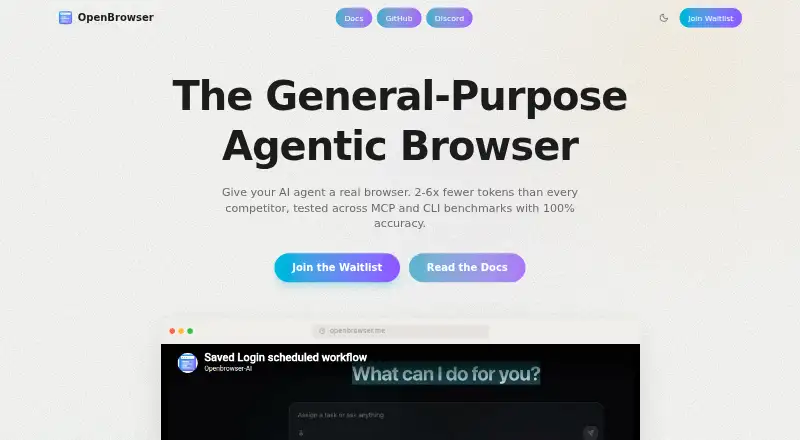
OpenBrowser is a free, MIT-licensed framework for browser automation in which an LLM writes Python code to navigate pages, interact with them, and extract information. It communicates directly through Chrome DevTools Protocol and can analyze screenshots. Its MCP server exposes one execute_code tool that runs Python in a persistent namespace. Listed integrations include OpenAI, Anthropic, Google, Groq, AWS Bedrock, Azure, Ollama, DeepSeek, Cerebras, OpenRouter, OCI, and other providers, along with MCP clients and n8n workflows. Browser sessions can be recorded and replayed, then exported to Jupyter notebooks or API crawler code. Example uses include research, scraping, form filling, end-to-end testing, page analysis, accessibility audits, and downloads. Installation instructions cover Windows, macOS, and Linux, with Docker, Kubernetes, and cloud deployment options. A hosted version is offered through a waitlist; described features include a web interface, real-time VNC streaming, saved logins, scheduled workflows, and email notifications. Hosted saved logins are described as KMS-encrypted.
Good
- LLM-driven Python browser automation
- Direct Chrome DevTools Protocol communication
- Many listed LLM and MCP integrations
- Records and replays browser sessions
- Supports Docker, Kubernetes, and cloud deployment
Watch out
- Hosted version requires waitlist access
- MCP automation uses one execute_code tool
- Allowed-domain whitelist is unset by default
- Hosted features differ from local installation
Who it suits
It suits developers automating Chromium-based browser tasks through Python, LLMs, or MCP clients. It also fits teams needing recorded workflows or deployment through containers and cloud environments.
Verdict
OpenBrowser offers an extensible framework for LLM-directed Chromium automation and workflow export. Decide whether local deployment or the waitlisted hosted feature set matches your needs.
The facts
Each one read from OpenBrowser's own pages, with the date it was checked.
What it does
- Agent interface
- Its MCP server exposes one execute_code tool that runs Python in a persistent namespace for browser automation.checked 8 Oct 2026
- Automation
- Its MCP server exposes browser automation through one execute_code tool that runs Python code in a persistent namespace.checked 9 Oct 2026
- Deployment
- The production guide describes persistent browser profiles, headless production use, allowed-domain restrictions, proxies, and connecting to remote browsers through CDP.checked 9 Oct 2026
- Developer integrations
- The maker lists compatibility with Claude Desktop, Claude Code, Codex, OpenCode, other MCP clients, and n8n workflows.checked 9 Oct 2026
- Hosted features
- The repository README says its hosted version includes a cloud dashboard for saved cookies and scheduled tasks; the homepage invites visitors to join a waitlist for hosted early access.checked 9 Oct 2026
- Hosted security
- The repository README describes hosted saved logins as KMS-encrypted and scheduled workflows as using EventBridge and SQS.checked 9 Oct 2026
- Hosted version
- The homepage invites users to join a waitlist for early access to the hosted version.checked 8 Oct 2026
- Integrations
- The maker lists compatibility with MCP clients and names Claude Code, Cursor, Windsurf, VS Code, n8n, Cline, and Roo Code.checked 8 Oct 2026
- License
- The homepage states that OpenBrowser is open source under the MIT license.checked 9 Oct 2026
- LLM integrations
- The documentation lists integrations including Google Gemini, OpenAI, Anthropic, Azure OpenAI, AWS Bedrock, Groq, OCI, Ollama, Qwen, DeepSeek, Novita, and OpenRouter, plus OpenAI-compatible models.checked 9 Oct 2026
- LLM providers
- The repository lists support for providers including OpenAI, Anthropic, Google, Groq, AWS Bedrock, Azure, Ollama, DeepSeek, Cerebras, OpenRouter, OCI, and Browser-Use.checked 8 Oct 2026
- Product
- OpenBrowser describes itself as a framework for intelligent browser automation in which an LLM writes Python code in a persistent namespace to navigate, interact with, and extract information from web pages.checked 9 Oct 2026
- Security
- The repository says hosted saved logins are KMS-encrypted.checked 8 Oct 2026
- Security controls
- The MCP documentation lists an optional comma-separated allowed-domain whitelist, which is unset by default.checked 9 Oct 2026
- Support
- The documentation directs users to GitHub Issues and Discord, and lists an email address for enterprise support.checked 9 Oct 2026
- Use cases
- The maker presents examples including web research, scraping, form filling, end-to-end testing, page analysis, accessibility audits, and file downloads.checked 8 Oct 2026
- Workflow tools
- The project describes recording and replaying browser sessions and exporting them to Jupyter notebooks or API crawler code.checked 8 Oct 2026
Where it runs
- Browser compatibility
- The quickstart says OpenBrowser detects installed Chromium-based browsers including Chrome, Edge, Brave, and Chromium, and can install Chromium automatically on first run if none is found and uvx is available.checked 9 Oct 2026
- Browser control
- It uses direct Chrome DevTools Protocol communication and supports screenshot analysis for visual understanding of pages.checked 9 Oct 2026
- Installation platforms
- The maker provides installation instructions for macOS, Linux, and Windows, including shell or PowerShell installers and Python package installation.checked 9 Oct 2026
Alternatives to OpenBrowser
- 1

Genspark AI Browser
Free planAndroidiOSWebExtension8.1From $19.99 a month - 2
BrowserOS
Free planOpen sourceAPIExtensionLinuxmacOS7.6Free plan - 3

Aside
Free planAPImacOSWindows7.5From $200 a year - 4

Dia
Free planmacOS7.3From $20 a month - 5

Comet
Free planAndroidiOSmacOSWindows7.0Free plan - 6
Oh My Browser
Free planOpen sourceAPIExtension7.0Free plan