
OKD
OKD is a free, self-hosted Kubernetes platform for managing applications and clusters at scale.
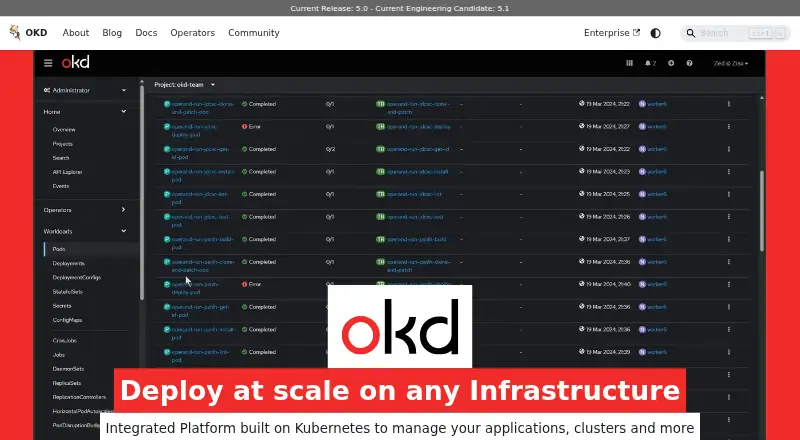
What OKD is
OKD is a free, self-hosted Kubernetes platform for managing applications and clusters at scale. It adds more than 100 preinstalled Operators for cluster components, with a web console, authentication, image registry and tooling, monitoring, networking, node configuration and upgrades, and Operator management. Cluster nodes run an immutable operating system managed and updated through cluster APIs. OKD says it is 100% compliant with Kubernetes, with additional patches for some advanced features; it also supports autoscaling, rolling updates, and policy controls. Deployments can run on bare metal, virtualization platforms, or cloud platforms, with either installer-provisioned or user-provisioned infrastructure. Integrated deployments cover projects in GitOps, service mesh, virtualization, and storage. The platform's defaults include hardened configuration. Installation requires infrastructure with sufficient resources, so the installation guide says Code-Ready Containers may suit a typical developer workstation better when compute and memory are limited. The guide points to stable releases and nightly builds and explains how to verify downloads with signed checksums and the maintainers' public key.
Good
- More than 100 preinstalled Operators
- Supports bare metal, virtualization, and cloud
- Includes autoscaling, rolling updates, and policy controls
- Hardened configuration is included by default
Watch out
- Installation requires infrastructure with sufficient resources
- May not suit workstations with limited compute and memory
Who it suits
OKD suits technologists and students who want to learn, experiment, and contribute, as well as OpenShift contributors and partners building lab or development environments. It fits teams with infrastructure resources for a self-hosted Kubernetes platform.
Verdict
OKD brings cluster management components and multiple deployment options into a free, self-hosted Kubernetes platform. Plan for the infrastructure it requires, particularly for a workstation-sized setup.
Plans and prices
From OKD's own pricing page, checked 7 Oct 2026.
| Plan | Price | What it gives you |
|---|---|---|
| OKD | Free | Community Kubernetes platform · installation requires infrastructure with sufficient resources |
The facts
Each one read from OKD's own pages, with the date it was checked.
What it does
- Architecture
- OKD augments Kubernetes primarily by preinstalling more than 100 Operators that provide cluster components.checked 7 Oct 2026
- Components
- The platform includes a web console, authentication, image registry and tooling, monitoring, node configuration and upgrades, networking, and Operator management.checked 7 Oct 2026
- Deployment
- OKD supports installation on bare metal, virtualization platforms, and cloud platforms, using installer-provisioned or user-provisioned infrastructure.checked 7 Oct 2026
- Downloads
- The installation guide directs users to stable releases and nightly builds for the installer and client tools.checked 7 Oct 2026
- Integrations
- OKD describes integrated deployments of projects in areas including GitOps, service mesh, virtualization, and storage.checked 7 Oct 2026
- Intended users
- The site describes OKD as a platform for technologists and students to learn, experiment, and contribute, and as a lab and development environment for OpenShift contributors and partners.checked 7 Oct 2026
- Kubernetes compliance
- The site states that OKD is 100% compliant with Kubernetes, with additional patches for some advanced features.checked 7 Oct 2026
- Operating system
- Cluster nodes run an immutable operating system updated and managed through cluster APIs.checked 7 Oct 2026
- Purpose
- OKD is an integrated Kubernetes platform for managing applications and clusters at scale.checked 7 Oct 2026
- Release verification
- The installation guide provides instructions to verify downloads using signed checksums and the OKD maintainers' public key.checked 7 Oct 2026
- Security
- The project site says its recommended design patterns enhance security posture and its defaults include hardened configuration.checked 7 Oct 2026
- Small workstation use
- The installation guide says Code-Ready Containers may be a better option for a typical developer workstation because it is a cut-down installation for limited compute and memory.checked 7 Oct 2026
- Support and community
- The OKD site links users to the Kubernetes Slack #okd-dev channel and a Google Group.checked 7 Oct 2026
Where it runs
- Download platforms
- The guide's checksum example lists client and installer archives for Linux and macOS, and client archives for Windows.checked 7 Oct 2026
Alternatives to OKD
- 1

KubeSphere
Free planOpen sourceWebAPILinuxSelf-hosted8.1From $65 a month - 2

Google Kubernetes Engine
Free planWebAPILinuxSelf-hosted7.6Free plan - 3

HashiCorp Nomad
Free planWebAPILinuxmacOS7.3Free plan - 4

Oracle Cloud Infrastructure Container Registry
Free planWebAPILinux7.0Free plan - 5
MicroK8s
Free planLinuxmacOSSelf-hostedWindows6.9From $25 a year - 6

Kubermatic Kubernetes Platform
Free planWebAPILinuxmacOS6.8Free plan