NodeX Cloud
NodeX Cloud is distributed cloud storage aimed at EU-regulated enterprises.
What NodeX Cloud is
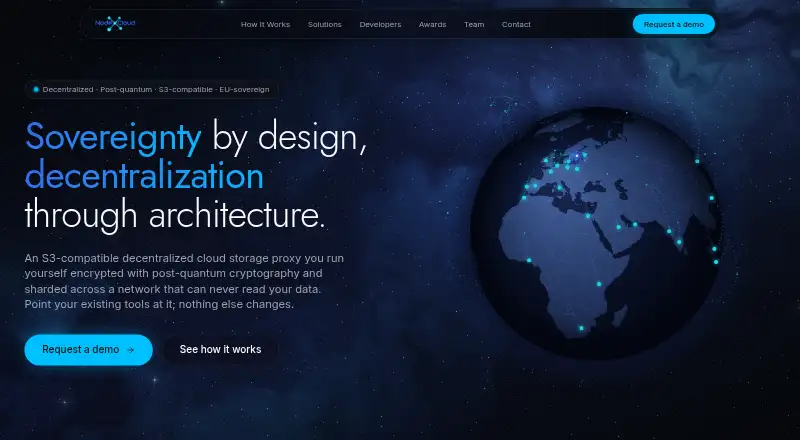
NodeX Cloud is distributed cloud storage aimed at EU-regulated enterprises. A proxy inside the customer’s perimeter encrypts files and divides them into shards before distributing them across independent EU storage nodes. NodeX says encryption keys remain within the customer’s network, preventing storage nodes from reading data, while post-quantum encryption addresses harvest-now, decrypt-later attacks. Geo-fenced placement is intended to keep EU deployment shards in-region. The company says files can be reconstructed from surviving shards if some nodes go offline, and deleting an object destroys the only key to its shards. S3 operations include buckets, objects, multipart uploads, and range reads. Listed compatible tools include aws-cli, rclone, Veeam, Restic, aws-sdk-s3, and MinIO client. Customers may use NodeX’s network, operate a private network on their hardware, or embed it in an existing storage service. Target sectors include healthcare, defense, public services, finance, enterprise, SaaS, backup, disaster recovery, and archival.
Good
- Customer-network key control
- Geo-fenced EU shard placement
- S3 API compatibility
- Reconstructs files from surviving shards
- Three deployment models
Watch out
- Pricing is available on request
- Requires a customer-perimeter proxy
Who it suits
NodeX Cloud suits organizations needing distributed storage, customer-controlled keys, EU data residency, and S3 compatibility. Its stated sectors include regulated healthcare, finance, defense, public services, enterprise, and SaaS teams.
Verdict
NodeX Cloud combines sharded storage, customer-held keys, and EU-focused placement with familiar S3 operations. Buyers should confirm regulatory requirements and deployment details directly with the company.
The facts
Each one read from NodeX Cloud's own pages, with the date it was checked.
The company
- Company
- NodeX Cloud AB says it is based at MINC Incubator in Malmö, Sweden; the site does not state a founding year.checked 9 Oct 2026
- Headquarters
- Malmö, Swedenchecked 28 Sep 2026
What it does
- Compliance context
- The site says the platform is designed for organizations subject to GDPR, NIS2, and DORA; it does not state that the product is certified for these regimes.checked 5 Oct 2026
- Data distribution
- The platform splits encrypted files into redundant shards and distributes them across independent EU storage nodes.checked 9 Oct 2026
- Data handling
- A proxy running inside the customer’s perimeter encrypts and shards objects before distributing them across storage nodes.checked 5 Oct 2026
- Deployment
- The site describes using NodeX's network, deploying a private network on customer hardware, or embedding NodeX in an existing storage service.checked 9 Oct 2026
- Encryption
- NodeX Cloud says its proxy encrypts data with post-quantum keys that remain inside the customer's network.checked 9 Oct 2026
- Integrations
- The site lists aws-cli, rclone, Veeam, Restic, aws-sdk-s3, and MinIO client as compatible tools.checked 9 Oct 2026
- Intended customers
- The site names healthcare, defense and public sector, financial services, and enterprise and SaaS as target sectors.checked 9 Oct 2026
- Key control
- The site says encryption keys stay within the customer’s network and storage nodes cannot read the data.checked 5 Oct 2026
- Product
- NodeX Cloud describes itself as post-quantum encrypted, decentralized cloud storage for EU-regulated enterprises.checked 9 Oct 2026
- Regulatory focus
- NodeX Cloud says its design supports EU data sovereignty and is intended for organizations subject to GDPR, NIS2, and DORA.checked 9 Oct 2026
- Residency
- NodeX says geo-fenced placement keeps shards in-region, with EU data residency for its EU deployment.checked 5 Oct 2026
- Resilience
- NodeX Cloud says its proxy can reconstruct files from surviving shards when some storage nodes go offline.checked 9 Oct 2026
- S3 compatibility
- The platform offers an S3-compatible API for buckets, objects, multipart uploads, and range reads.checked 9 Oct 2026
- Support
- The site lists 24/7 Enterprise Support and invites visitors to request a demo or contact the company.checked 9 Oct 2026
- Use cases
- The company names healthcare, defense and public sector, financial services, enterprise and SaaS, backup and disaster recovery, and long-term archival as target uses.checked 5 Oct 2026
- Zero-knowledge design
- The company says individual storage nodes cannot read the data and that deleting an object destroys the only key to its shards.checked 9 Oct 2026
Alternatives to NodeX Cloud
- 1

Sia
Free planOpen sourceAndroidiOSWebAPI8.4From $7.99 a month - 2

Aleph Cloud (formerly Aleph.im)
Free planOpen sourceWebAPILinuxmacOS8.1$0.01 usage-based - 3
Datum Storage
Free planAndroidiOSWebAPI7.9From $3.99 a month - 4
Carbide Network
Free planAndroidiOSAPImacOS7.6$0.01 usage-based - 5

Peergos
Free planAndroidWebLinuxmacOS6.9Free plan - 6

Storj
WebAPILinuxmacOS6.8From $29 a month