Nesalizer
Nesalizer is a free, open-source NES emulator for Linux/POSIX, with an experimental Windows port.
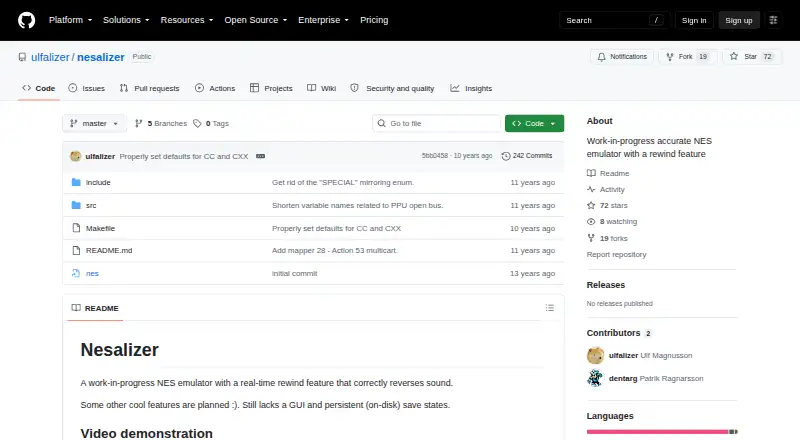
What Nesalizer is
Nesalizer is a free, open-source NES emulator for Linux/POSIX, with an experimental Windows port. It is a work in progress and currently has no graphical interface. Its distinctive feature is real-time rewind: the emulator stores one state per frame in a ring buffer, then restores those states backward while reversing audio. A 30-minute rewind history uses about 1.3 GB of memory for most games because states are uncompressed. Nesalizer supports iNES mapper numbers 0, 1, 2, 3, 4, 5, 7, 9, 10, 11, 13, 28, 71, and 232, which the README says covers most ROMs. PAL and NTSC systems are supported, with NTSC ROMs recommended. Keyboard controls are hardcoded for the D-pad, A, B, Start, Select, rewind, save/load state, and reset. Save states stay in memory and are not written to disk. Movie recording is described as broken because of libav changes. SDL2 is the only stated final-output dependency, and the project uses GPLv2.
Good
- Real-time rewind reverses audio
- Supports listed iNES mapper numbers
- Handles PAL and NTSC systems
- Uses SDL2 as its stated dependency
- Licensed under GPLv2
Watch out
- No graphical interface
- Rewind consumes substantial memory
- Save states are not persistent
- Movie recording is broken
Who it suits
It suits users seeking a source-available NES emulator with reversible audio and real-time rewind. Linux/POSIX users are the primary fit; Windows support is experimental.
Verdict
Nesalizer focuses on technically distinctive rewind behavior rather than a polished interface. Its memory-only saves, high rewind memory use, and experimental Windows port are important constraints.
The facts
Each one read from Nesalizer's own pages, with the date it was checked.
What it does
- Audio
- During rewind, audio is added in reverse from the end of the audio buffer.checked 8 Oct 2026
- Build dependency
- SDL2 is the only dependency for final output.checked 8 Oct 2026
- Compatibility
- The README lists supported iNES mappers as 0, 1, 2, 3, 4, 5, 7, 9, 10, 11, 13, 28, 71, and 232.checked 8 Oct 2026
- Controls
- Controls are hardcoded and include keyboard mappings for the D-pad, A, B, Start, Select, rewind, save/load state, and reset.checked 4 Oct 2026
- Interface
- The emulator lacks a GUI and its controls are hardcoded.checked 8 Oct 2026
- License
- The project is licensed under GPLv2.checked 8 Oct 2026
- Memory use
- A 30-minute rewind buffer uses around 1.3 GB of memory for most games, and states are not compressed.checked 4 Oct 2026
- Movie recording
- Built-in movie recording support is described as broken due to libav changes.checked 4 Oct 2026
- Operating system
- The project says it currently requires a *nix system and provides Ubuntu build commands.checked 8 Oct 2026
- Performance
- The author reports about 6× emulation speed on a single core of an older Core i7 2600K.checked 4 Oct 2026
- Purpose
- Nesalizer is a work-in-progress NES emulator with real-time rewind that correctly reverses sound.checked 8 Oct 2026
- Rewind
- It stores emulator state once per frame in a ring buffer and loads states in reverse order during rewind.checked 8 Oct 2026
- Rewind memory
- A 30-minute rewind buffer uses around 1.3 GB of memory for most games, and states are not compressed.checked 8 Oct 2026
- Save states
- Save states are in memory and are not saved to disk; persistent on-disk save states are listed as missing.checked 8 Oct 2026
- Support
- The README invites bug reports and contributions and provides the author's email in reversed form.checked 4 Oct 2026
- Support and contributions
- The author invites users to report issues and contribute to the project.checked 8 Oct 2026
- TV systems
- Both PAL and NTSC are supported, and the README recommends NTSC ROMs.checked 4 Oct 2026
- Video standards
- It supports both PAL and NTSC, and the README recommends NTSC ROMs.checked 8 Oct 2026
Where it runs
- Platforms
- The README says a *nix system is currently required and describes an experimental Windows port by a contributor.checked 4 Oct 2026
- Windows status
- The README describes a quick-and-dirty experimental Windows port by a contributor.checked 8 Oct 2026