Naia
Naia is a free Rust networking library for multiplayer games built around server-controlled entity replication and typed messages.
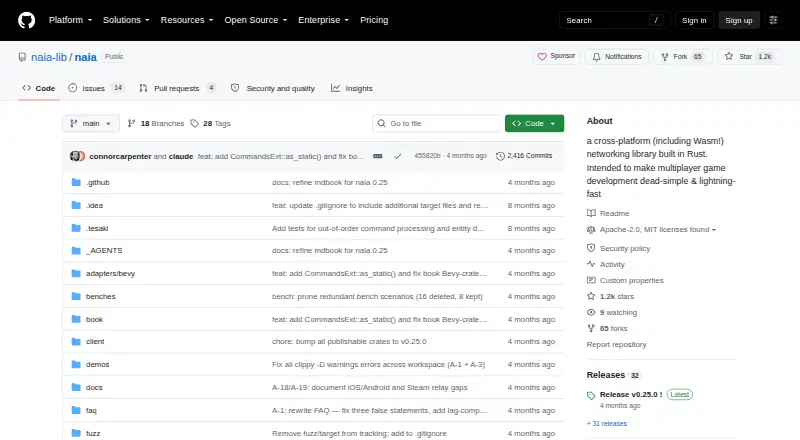
What Naia is
Naia is a free Rust networking library for multiplayer games built around server-controlled entity replication and typed messages. The server tracks changes to replicated component fields and sends them to clients that share a room with the relevant entities; clients receive spawn, update, and despawn events. Rooms can separate matches, zones, or lobbies. Client-server messages use channels with configurable ordering and reliability, and servers can grant, deny, or revoke a client’s write authority over an entity. Naia is not tied to a particular ECS and includes adapters for Bevy and macroquad. Native Linux, macOS, and Windows clients use UDP, while browser clients can use WebRTC data channels through WebAssembly builds. Native iOS and Android support is not available, though WASM clients can run in mobile web views. The library provides tick-buffered input delivery for prediction and rollback, but leaves prediction and interpolation logic to the developer. Native UDP is unencrypted, and Naia does not provide packet authentication or encryption.
Good
- Server sends entity spawn, update, and despawn events.
- Message channels offer configurable ordering and reliability.
- Includes Bevy and macroquad adapters.
- Tick-buffered input delivery supports prediction and rollback.
Watch out
- Native iOS and Android are not supported.
- Native UDP transport is unencrypted.
- Prediction and interpolation logic are not built in.
- Steam relay networking is not built in.
Who it suits
Naia suits Rust game developers who need server-authoritative replication and typed client-server messages. It may also fit teams using Bevy or macroquad and willing to implement prediction or interpolation logic themselves.
Verdict
Naia supplies replication, typed messaging, rooms, and authority controls for multiplayer game networking. Developers need to account for its mobile-native and security limits, and provide prediction or interpolation logic themselves.
The facts
Each one read from Naia's own pages, with the date it was checked.
What it does
- Authority
- The server can delegate write authority over an entity to a client and can grant, deny, or revoke that authority.checked 2 Oct 2001
- ECS compatibility
- Naia is ECS-agnostic and includes Bevy and macroquad adapters.checked 3 Oct 2001
- Engine support
- Naia is ECS-agnostic and includes Bevy and macroquad adapters.checked 2 Oct 2001
- Integrations
- The project lists adapters for Bevy and macroquad, plus optional feature-gated metrics and tracing integration.checked 3 Oct 2001
- Licensing
- The repository lists Apache-2.0 and MIT licenses.checked 3 Oct 2001
- Messaging
- Typed messages support ordered-reliable, unordered-reliable, and unreliable channels, including tick-buffered channels for client input.checked 3 Oct 2001
- Mobile support
- Native iOS and Android clients are not yet supported; the project describes running the WASM client in iOS or Android WebViews as an option.checked 3 Oct 2001
- Native networking
- Linux, macOS, and Windows use UDP through naia-socket-native.checked 2 Oct 2001
- Not built in
- Steam relay networking is not built in, though the Socket trait can be extended by a community crate.checked 2 Oct 2001
- Prediction
- Naia provides tick-buffered input delivery for prediction and rollback, but prediction and interpolation logic are not built in.checked 2 Oct 2001
- Product
- Naia is a Rust networking library for server-authoritative entity replication and typed message passing in multiplayer games.checked 3 Oct 2001
- Purpose
- Naia is a Rust networking library for server-authoritative entity replication and typed message passing in multiplayer games.checked 2 Oct 2001
- Replication
- The server sends changed replicated component fields to in-scope clients, which receive entity spawn, update, and despawn events.checked 3 Oct 2001
- Room scoping
- A user and entity must share a room for replication, and rooms can represent matches, zones, or lobbies.checked 2 Oct 2001
- Security limits
- Naia does not provide packet authentication or encryption, anti-cheat, application-layer rate limiting, or validation of client-authoritative component values.checked 3 Oct 2001
- Security model
- Naia describes itself as a networking library, not a security framework, and states that native UDP transport is unencrypted.checked 3 Oct 2001
- Security reporting
- The GitHub repository links to a security policy.checked 2 Oct 2001
- Support
- The security policy asks people to report security issues privately to maintainers via Discord or email before filing a public GitHub issue.checked 3 Oct 2001
- Transports
- Native clients use UDP, while browser clients can use WebRTC data channels through the WASM target.checked 3 Oct 2001
Where it runs
- Browser networking
- Browser clients can use WebRTC data channels with the wbindgen feature and builds made with wasm-pack or trunk.checked 2 Oct 2001
- Browser security
- The security policy says browser WebRTC data channels use DTLS, while AuthEvent credentials are plaintext from Naia’s application-layer perspective.checked 3 Oct 2001
Money
- Planned transport
- Native QUIC transport with TLS 1.3 is listed as planned, with no set timeline.checked 3 Oct 2001
Alternatives to Naia
- 1

Colyseus
Free planOpen sourceAndroidiOSWebAPI8.5From $15 a month - 2

Photon Realtime
Free planAndroidiOSWebAPI8.1From $0.29 a month - 3

Unity
Free planAndroidiOSWebLinux7.8Free plan - 4

Normcore
Free planAndroidiOSWebLinux7.5From $49 a month - 5
SmartFoxServer
Free planAndroidiOSWebAPI7.5From €32.50 a month - 6

Photon Fusion
Free planAndroidiOSWebLinux7.4From $0.50 a month