MS-DOS Player
MS-DOS Player is a free Windows command-line emulator for running 16-bit DOS-compatible commands.
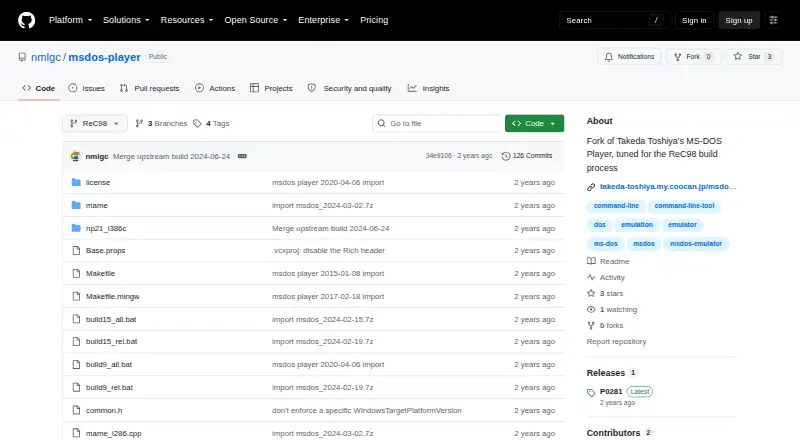
What MS-DOS Player is
MS-DOS Player is a free Windows command-line emulator for running 16-bit DOS-compatible commands. It targets text-mode utilities such as file converters, compilers, assemblers, debuggers, and text editors rather than games. DOS programs inherit Windows environment variables and can access host file paths directly. The archive includes binaries emulating 8086, 80286, 80386, 80486, Pentium 4, NEC V30, and IA32 processors. Documented emulation covers selectable 1 MB, 16 MB, or 32 MB RAM, LIM EMS, serial and parallel I/O, keyboard and mouse input, timers, and text display hardware. Virtual COM1–COM4 can connect to host COM ports at up to 9600 bps, while parallel output is written to a timestamped .PRN file in TEMP. A 16-bit command file can be embedded into a 32-bit or 64-bit executable that runs without msdos.exe. Graphics, sound hardware, games, and Win16 executable files are unsupported. Source code is available under GNU General Public License version 2; this fork is tuned for the ReC98 build process.
Good
- Free command-line DOS emulation
- Supports multiple emulated CPU variants
- Direct host file-path access
- Virtual COM1–COM4 connections
- Can create standalone executables
Watch out
- No graphics or sound hardware
- Not intended for games
- Win16 executables are unsupported
- Windows platform only
Who it suits
MS-DOS Player suits Windows users running legacy DOS text utilities or building ReC98-related workflows. It is not intended for DOS games or graphical and sound applications.
Verdict
MS-DOS Player provides focused DOS command support for text-based workloads on Windows. Its hardware and executable limitations make it unsuitable for graphical, audio, or gaming software.
Plans and prices
From MS-DOS Player's own pricing page, checked 9 Oct 2026.
| Plan | Price | What it gives you |
|---|---|---|
| MS-DOS Player | Free | No price stated on the opened project page |
The facts
Each one read from MS-DOS Player's own pages, with the date it was checked.
What it does
- Build requirements
- The README lists Visual C++ 2008 with Service Pack 1 or Visual C++ 2017 as requirements for building the binaries.checked 8 Oct 2026
- CPU choices
- The archive provides binaries emulating 8086, 80286, 80386, 80486, Pentium 4, NEC V30, and IA32 processors for Windows.checked 8 Oct 2026
- CPU variants
- The archive includes binaries emulating 8086, 80286, 80386, 80486, Pentium 4, NEC V30, and IA32 processors.checked 9 Oct 2026
- Debugger
- An internal developer debugger is included but disabled in the archive binaries; enabling it requires rebuilding, and it opens a telnet port.checked 9 Oct 2026
- Executable conversion
- It can embed a 16-bit command file into a 32-bit or 64-bit executable that can run without msdos.exe.checked 8 Oct 2026
- Fork purpose
- This repository is a fork of Takeda Toshiya's MS-DOS Player tuned for the ReC98 build process.checked 8 Oct 2026
- Graphics and sound
- Graphics and sound hardware are not implemented, and the project says it does not aim to support games.checked 9 Oct 2026
- Host access
- The emulator inherits host Windows environment variables and lets DOS programs access host file paths directly.checked 8 Oct 2026
- Host file access
- The emulator inherits host Windows environment variables and lets DOS programs access host file paths directly.checked 9 Oct 2026
- Intended workloads
- It aims to support text-interface utilities such as file converters, compilers, assemblers, debuggers, and text editors.checked 9 Oct 2026
- License
- The source code is available under GNU General Public License version 2.checked 8 Oct 2026
- Memory and hardware
- The documented emulation includes up to 32 MB of RAM, LIM EMS, serial and parallel I/O, keyboard, mouse, timers, and text display hardware.checked 8 Oct 2026
- Memory and peripherals
- The documented emulation includes 1 MB, 16 MB, or 32 MB RAM, up to 32 MB LIM EMS, serial and parallel I/O, and a two-button mouse.checked 9 Oct 2026
- Print output
- Parallel-port output is written to a timestamped .PRN file in the TEMP directory.checked 9 Oct 2026
- Purpose
- MS-DOS Player is a command-line MS-DOS emulator for 32-bit and 64-bit Windows.checked 9 Oct 2026
- Release note
- The P0281 release says the fork focuses on optimizations and that later upstream versions were not merged because they counteract those optimizations.checked 8 Oct 2026
- Serial integration
- Virtual COM1–COM4 can connect to host COM ports, with optional DTR/DSR and RTS/CTS flow control.checked 9 Oct 2026
- Serial I/O
- Serial I/O can connect virtual COM1–COM4 to host COM ports, with a maximum baud rate of 9600 bps.checked 8 Oct 2026
- Standalone conversion
- A 16-bit command file can be embedded into a generated 32-bit or 64-bit executable that runs without msdos.exe.checked 9 Oct 2026
- Target workloads
- It is aimed at text-mode utilities such as file converters, compilers, assemblers, debuggers, and text editors.checked 8 Oct 2026
- Win16 limitation
- The emulator does not support Win16 executable files.checked 9 Oct 2026
The company
- Maker location
- The GitHub profile for nmlgc lists Germany as the account location.checked 9 Oct 2026
Where it runs
- Supported Windows versions
- The listed binaries support 32-bit and/or 64-bit Windows, with x64-only variants also provided.checked 9 Oct 2026
Alternatives to MS-DOS Player
- 1

DOSBox-X
Free planOpen sourceLinuxmacOSSelf-hostedWindows7.4Free plan - 2
DOSBox Pure
Free planOpen sourceLinuxmacOSSelf-hostedWindows7.2Free plan - 3
DOSBox Staging
Free planOpen sourceAPILinuxmacOSSelf-hosted7.2Free plan - 4
DOSBox
Free planOpen sourceLinuxmacOSSelf-hostedWindows7.1Free plan - 5
Magic DosBox
Free planAndroid7.1$3.99 one-time - 6
DOS Browser
Free planAndroidWebLinuxmacOS6.7Free plan