Mockzilla
Mockzilla turns OpenAPI specifications or plain JSON files into hosted mock APIs for frontend work, integration tests and demos.
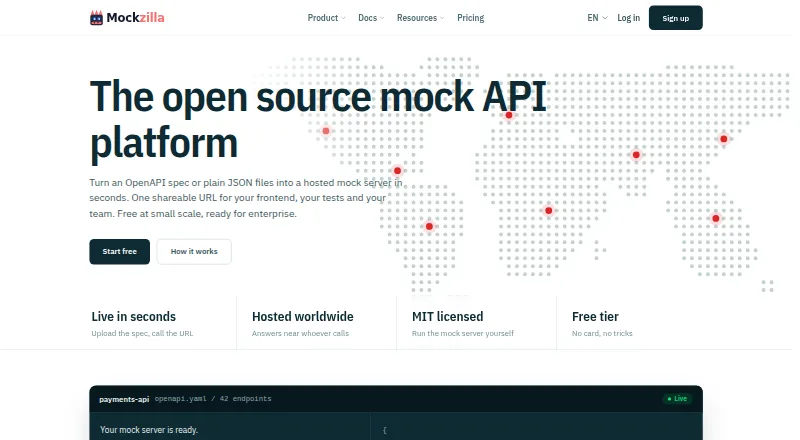
What Mockzilla is
Mockzilla turns OpenAPI specifications or plain JSON files into hosted mock APIs for frontend work, integration tests and demos. It can generate responses from OpenAPI schemas, validate requests and simulate latency or errors for services or individual endpoints. Its proxy can forward requests to a real backend and use mock responses for routes that backend does not serve. A GitHub Action creates a mock URL for each pull request, updates it after pushes and removes it when the branch is gone. Mockzilla records request status and timing and lets users replay requests individually or in sets. The MIT-licensed CLI runs offline on a laptop or in CI; hosted cloud features are optional. The site also lists a GitHub Action and an MCP server, with CLI setup instructions for Claude and Gemini. The Free plan is $0.00 per free, but API access is unavailable and request history lasts two hours. Hobby is $10.00 per month. Uploaded content must not contain personally identifiable information, financial data, health records, credentials or other sensitive data.
Good
- Generates responses from OpenAPI schemas.
- Can simulate latency and endpoint errors.
- GitHub Action creates pull-request mock URLs.
- CLI runs offline and is MIT-licensed.
Watch out
- Free plan has no API access.
- Free request history lasts two hours.
- Sensitive data must not be uploaded.
Who it suits
Mockzilla may suit developers creating mock APIs for frontend work, tests or demos. The listed plans also address side projects, solo developers, small teams and teams with CI pipelines.
Verdict
Mockzilla offers API simulation tools for both local work and optional hosted workflows. Its Free plan has notable access and history limits, and its terms exclude sensitive uploaded content.
Plans and prices
From Mockzilla's own pricing page, checked 15 Oct 2026.
| Plan | Price | What it gives you |
|---|---|---|
| Free | Free | 1K requests/month · 5 requests/second · 1 API key · 2-hour request-history retention · 8 MB stored data · 200 deploys/month · 20 route updates/month · 1 team member |
| Hobby | $10 a month | 100K requests/month · 10 requests/second · 2 API keys · 1-day history retention · 600 MB stored data · 600 deploys/month · 60 route updates/month · 2 team members · monthly |
| Starter | $20 a month | 200K requests/month · 20 requests/second · 5 API keys · 3-day history retention · 1.2 GB stored data · 2.5K deploys/month · 200 route updates/month · 5 team members · monthly |
| Pro | $50 a month | 400K requests/month · 40 requests/second · 25 API keys · 7-day history retention · 2.3 GB stored data · 10K deploys/month · 500 route updates/month · 10 team members · 3 admins · monthly |
| Enterprise | Priced on request | Dedicated infrastructure · Custom traffic sizing · Custom domain |
The facts
Each one read from Mockzilla's own pages, with the date it was checked.
What it does
- Access controls
- Simulations support API-key protection, explorer credentials and IP allowlists.checked 15 Oct 2026
- API key roles
- API keys have administrator or editor roles and are managed by organization owners and administrators.checked 15 Oct 2026
- Audit logging
- The settings area includes an audit log showing organizational changes and their actors.checked 15 Oct 2026
- CLI installation
- The CLI is distributed through Homebrew and prebuilt binaries for macOS, Linux and Windows, and runs without an account.checked 15 Oct 2026
- Codegen
- Codegen mode produces typed Go handlers from an OpenAPI specification while keeping the specification in the repository.checked 15 Oct 2026
- Documentation depth
- The documentation is organized into getting started, simulations, resilient backends, developer tools, settings, billing and help sections.checked 15 Oct 2026
- Error simulation
- Users can set service-wide or endpoint-specific error rates to exercise failure handling.checked 15 Oct 2026
- External praise: Go implementation
- A Reddit commenter specifically recommended mockzilla.org for running multiple specifications on one port and identified it as Go-based.checked 15 Oct 2026
- External praise: multi-service use
- A Reddit commenter said Mockzilla can run multiple API specifications on one port with URL prefixes and CI support without extra setup.checked 15 Oct 2026
- External repository size
- The public GitHub repository showed 110 stars and 6 forks when opened.checked 15 Oct 2026
- External validation claim
- The GitHub README reports validation against more than 2,200 OpenAPI specifications and 98,000 endpoints.checked 15 Oct 2026
- Fault simulation
- Users can inject latency and errors per service or endpoint to test retry and fallback behavior.checked 29 Sep 2026
- History and replay
- Mockzilla records requests with status and timing and allows users to replay individual requests or sets of requests.checked 29 Sep 2026
- Hosted retention limit
- Request history is a rolling debugging window whose default retention is one hour, with plan-specific retention limits.checked 15 Oct 2026
- Integrations
- The site lists a GitHub Action and an MCP server for coding agents; its CLI page gives setup instructions for Claude and Gemini.checked 29 Sep 2026
- Latency simulation
- Latency can be configured for an entire service or individual endpoint.checked 15 Oct 2026
- License
- The Mockzilla engine is released under the MIT license.checked 15 Oct 2026
- Local execution
- Simulations can run locally with the CLI, Docker or Docker Compose.checked 15 Oct 2026
- MCP integration
- Mockzilla provides an MCP server that lets Claude Code, Cursor and Gemini CLI launch mock APIs from OpenAPI definitions.checked 15 Oct 2026
- Notable news: payment coverage
- A LinkedIn post dated about four weeks before the research date said payment simulations covered 12 providers, including Stripe, PayPal, Adyen and Klarna.checked 15 Oct 2026
- Open source and local use
- The CLI is MIT-licensed, runs offline, and the site says it can run on a laptop or in CI; hosted cloud features are opt-in.checked 29 Sep 2026
- Payment backends
- Mockzilla describes payment-provider simulations with decline cases, 3D Secure flows, payment lifecycle operations, and idempotency behavior.checked 29 Sep 2026
The company
- Company identity
- GitHub marks the Mockzilla organization as domain-verified for mockzilla.org and lists [email protected] as its contact email.checked 15 Oct 2026
Where it runs
- External platform coverage
- The GitHub organization README lists 24 AWS regions with latency-based routing for hosted simulations.checked 15 Oct 2026
The full review of Mockzilla
Overview
Mockzilla creates mock APIs from OpenAPI specifications or plain JSON, for frontend development, integration tests and demos. It is best suited to developers who want controllable responses locally or in CI, with hosted workflows as an option. Its strongest case is a broad simulation toolkit; the Free tier’s restricted access and short history window make it more of an evaluation path than a durable service.
Key features
OpenAPI imports can generate realistic schema-based responses and validate requests against the spec, helping teams catch contract mismatches while frontend work proceeds. Plain JSON offers a simpler starting point when no spec is available. Per-service or per-endpoint latency and error injection lets developers exercise retry and fallback behavior deliberately rather than waiting for failures to occur.
The proxy can send requests through to a real backend while mocking routes that backend does not serve. That makes it a useful fit for partially implemented APIs, though it is less compelling when a team needs only static fixtures. A GitHub Action creates a mock URL for each pull request, updates it on pushes and removes it when the branch is gone, which supports isolated review and CI environments. Request history records status and timing, with replay for individual requests or sets; the Free plan retains that history for only two hours.
Mockzilla also describes payment-provider simulations covering declines, 3D Secure flows, lifecycle operations and idempotency. The site lists a GitHub Action and an MCP server for coding agents, and its CLI instructions cover Claude and Gemini. The CLI is MIT-licensed, runs offline and can be used on a laptop or in CI; hosted cloud features are opt-in. HTTP is the supported protocol.
Privacy protections include TLS in transit, encryption at rest and simulations in isolated environments with scoped access. Those safeguards do not make Mockzilla suitable for sensitive uploads: its terms prohibit personally identifiable information, real financial data, health records, credentials and other sensitive content.
Pricing
The Free plan costs nothing and allows 1K requests/mo, 5 req/s, one simulation and 10 MB of data transfer. API access is unavailable, so the free allowance is most useful for evaluation rather than an ongoing API workflow.
Hobby costs $10/mo and raises the limits to 100K requests/mo, 10 req/s, two simulations and 1 GB of transfer, making it the entry paid option for side projects. Starter costs $20/mo for 200K requests/mo, 20 req/s, five simulations and 4 GB of transfer; it is aimed at solo developers and small teams. Pro costs $50/mo for 400K requests/mo, 40 req/s, ten simulations and 16 GB of transfer, a better match for teams running CI pipelines. Each step up increases capacity, but the published allowances still make traffic and simulation count important buying constraints.
Enterprise has custom pricing, dedicated infrastructure, an own domain and sizing to traffic, for organizations needing a deployment tailored to their workload. Verified students can apply for a free tier without a card; applications receive manual review, which usually takes 1–2 business days.
Platforms
Mockzilla supports API, Linux, macOS, Windows, web and self-hosted use. The offline CLI gives local and CI users a route that does not depend on hosted cloud features, while hosted workflows remain optional.
Who it's for
Mockzilla is a strong candidate for developers coordinating frontend work against evolving APIs, teams testing failure handling, and CI users who want a mock environment per pull request. Its schema validation and proxy fallback are especially useful when a real service is incomplete. It is a poor fit for workflows that require uploading sensitive data, or for anyone who needs API access on a no-cost plan.
Pros and cons
- Pros: OpenAPI response generation and request validation help keep mock behavior tied to an API contract.
- Pros: Fault injection, proxy fallback, and request replay cover several practical integration-testing needs.
- Pros: The CLI runs offline, and the GitHub Action automates per-PR mock URLs and cleanup.
- Cons: Free has no API access and keeps request history for only two hours.
- Cons: The terms rule out sensitive uploaded content, limiting use with real customer or payment data.
- Cons: Paid plans impose request, rate, simulation and transfer caps, so teams with heavier usage may need Enterprise sizing.
Alternatives
API Mocking Tools is the broader category directory for comparing options. Choose Microcks instead if a fully open-source, community-driven CNCF Incubating project is the priority. MockServer is a free and open-source alternative for self-hosting without a SaaS account. WireMock offers a free plan and a free trial, and is worth comparing when those access terms matter. Knockout API is another freemium API option, with a free allowance of 30 images per month and metered pay-as-you-go pricing. Mockfly offers a free Starter plan capped at 500 requests per day, one project, four endpoints and two responses per endpoint. moqapi.dev offers a free mode with three projects, unlimited mock endpoints and all features unlocked, making it worth a look when project count matters more than a monthly request quota. WireMock is a second WireMock listing with a free plan and free trial. MockAPI has a free plan limited to one project and two resources, with paid monthly and annual options for 20 projects and 50 resources.
Verdict
Choose Mockzilla if you need schema-aware mocks, deliberate failure testing and pull-request environments across local work and CI. The combination is the main reason to pay for it; the main reasons to look elsewhere are the Free plan’s lack of API access, its two-hour history retention and the strict ban on sensitive uploads.
Getting started
- Open https://mockzilla.org/
- Choose the hosted service or self-hosted/local CLI approach
- Import an OpenAPI specification or plain JSON file
- Configure services, responses, and optional fault injection
- Connect the GitHub Action, MCP server, or CLI workflow as needed
- Select a plan, starting with Free or Hobby at $10/mo
Limits worth knowing
The Free plan includes 1K requests per month, 5 requests per second, one simulation, and 10 MB of data transfer. API access is unavailable and request history is retained for 2 hours; Hobby provides 100K requests per month, 10 requests per second, two simulations, and 1 GB of transfer for $10.00 per month.
Questions
Is Mockzilla free?
Yes. The Free plan costs nothing. Paid plans start with Hobby at $10 a month.
Which platforms does it support?
Mockzilla supports API, Linux, macOS, self-hosted, web, and Windows use.
Can it run locally?
Yes. Its MIT-licensed CLI runs offline on a laptop or in CI, and local deployment is supported.
Does it integrate with GitHub?
A GitHub Action creates, updates, and removes mock URLs for pull-request branches.
Is Mockzilla open source?
The CLI is MIT-licensed. Hosted cloud features are optional.
What data restrictions apply?
Uploaded content must not include personally identifiable information, real financial data, health records, credentials, or other sensitive data.