
WireMock
WireMock simulates APIs and software dependencies, letting teams test without relying on those services, explore edge cases, and develop dependent features i…
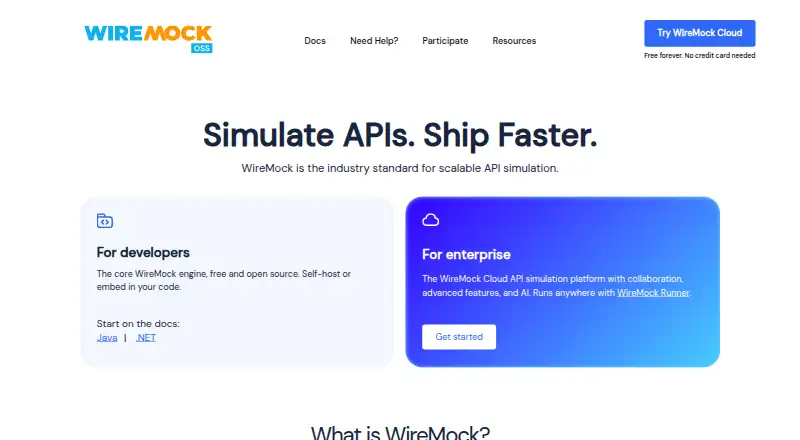
What WireMock is
WireMock simulates APIs and software dependencies, letting teams test without relying on those services, explore edge cases, and develop dependent features in parallel. It matches requests using URL patterns, headers, query parameters, cookies, and body content. Responses can use Handlebars templates, and the software can simulate delays, network faults, or malformed responses. It can also record exchanges with real services for playback during tests. WireMock integrates with JUnit and other testing frameworks, with setup options for Maven, Gradle, Scala SBT, standalone use, and Docker. Its capabilities include HTTP-based protocols and REST, plus WebSockets, webhooks, HTTPS, gRPC, and GraphQL. Distributions include a standalone JAR, Docker image, experimental Helm chart, NPM package, and WireMock Cloud. The Free plan is free and includes 1,000 calls per month, one user, three mock APIs, a 10 requests-per-second limit, and community support. Free and trial plans are rate limited; mocks stop when the API quota is exceeded until the next quota cycle.
Good
- Matches requests by URL, headers, queries, cookies, and body.
- Simulates faults, delays, and malformed responses.
- Records real-service interactions for playback.
- Integrates with JUnit and other testing frameworks.
- Free plan includes 1,000 monthly calls and three mock APIs.
Watch out
- Free and trial plans are rate limited.
- Mocks stop after the API quota is exceeded.
- Open-source project generally has no support or guarantees.
Who it suits
WireMock suits developers and teams that need simulated services for testing or parallel development. Its Free plan is described for individual users and solo projects, while Enterprise is aimed at larger teams or higher API volumes.
Verdict
WireMock offers request matching, response simulation, and recorded playback for teams working with dependent APIs. The Free plan has defined call and rate limits, while WireMock Cloud Enterprise includes priority support with a guaranteed SLA.
Plans and prices
From WireMock's own pricing page, checked 30 Sep 2026.
| Plan | Price | What it gives you |
|---|---|---|
| Free | Free | Free forever · 1,000 calls/month · single user · 3 mock APIs · 10 requests/second rate limit · community support |
| Enterprise | Priced on request | Unlimited API calls and team members · dedicated private instance · priority support and SLA · rate limits and other maximums defined by plan · Get a tailored quote |
The facts
Each one read from WireMock's own pages, with the date it was checked.
What it does
- Cloud features
- WireMock Cloud lists stateful mocking, versioning, team collaboration, SSO, role-based access control, chaos testing, Git sync, and test data import among its Enterprise features.checked 30 Sep 2026
- Distributions
- WireMock Java is distributed as a standalone JAR, Docker image, Helm chart marked experimental, and NPM package, as well as WireMock Cloud.checked 30 Sep 2026
- Integrations
- The project describes integration with JUnit and other testing frameworks, and offers Maven, Gradle, Scala SBT, standalone, and Docker getting-started options.checked 30 Sep 2026
- Intended users
- The pricing page describes the Free plan as intended for individual users and solo projects, and the Enterprise plan for larger teams or API volume.checked 30 Sep 2026
- Limits
- The pricing page says free and trial plans are rate limited; when the API request quota is exceeded, mocks stop running until the next quota cycle.checked 30 Sep 2026
- Protocols
- WireMock Java documentation lists HTTP-based protocols and REST, with additional capabilities for WebSockets, webhooks, HTTPS, gRPC, and GraphQL.checked 30 Sep 2026
- Purpose
- WireMock simulates APIs and software dependencies so teams can test without those dependencies, simulate edge cases, and develop dependent features in parallel.checked 30 Sep 2026
- Record and playback
- WireMock can record interactions with real services and play them back during testing.checked 30 Sep 2026
- Request matching
- WireMock can match requests by URL patterns, headers, query parameters, cookies, and request body content.checked 30 Sep 2026
- Response and fault simulation
- WireMock supports Handlebars response templating and simulating network faults, delays, and malformed responses.checked 30 Sep 2026
- Security
- WireMock Inc.’s trust center states that WireMock has attained SOC 2 Type 2 compliance and lists encryption in transit and at rest among its data security measures.checked 30 Sep 2026
- Support
- The open-source project generally provides no support or guarantees under Apache License 2.0; users can seek community assistance, while WireMock Cloud Enterprise includes priority support with a guaranteed SLA.checked 30 Sep 2026
Money
- Cloud trial
- The pricing page offers access to the full Enterprise trial and a guided proof of concept, but does not state a trial duration.checked 30 Sep 2026
The company
- Founded
- 2011checked 23 Sep 2026
The full review of WireMock
WireMock is API and dependency simulation software for teams that need to test when live services are unavailable or unreliable. It suits developers working on integration and contract tests, especially when they need to exercise varied responses and failure conditions.
Overview
By replacing a service with a controllable stand-in, WireMock lets teams test dependent software without waiting for the real dependency and develop connected features in parallel. It supports both service virtualization and contract testing, but it is not a database-testing tool.
Its strongest case is flexibility: requests can be matched on URL patterns, headers, query parameters, cookies and body content, and responses can be templated or made deliberately faulty. That breadth is useful when a test needs to reflect realistic variation; teams with only a single fixed response to simulate may not need it.
Key features
Handlebars response templating supports variable responses. WireMock can also simulate delays, network faults and malformed responses, giving teams ways to exercise error paths without relying on a live service to fail at the right moment. It can record interactions with real services and replay them in tests, a practical option when a dependency is inconvenient to access.
The project describes integration with JUnit and other testing frameworks, and offers Maven, Gradle, Scala SBT, standalone and Docker getting-started paths. WireMock Java documents HTTP-based protocols and REST, plus capabilities for WebSockets, webhooks, HTTPS, gRPC and GraphQL. Distribution options include a standalone JAR, Docker image, Helm chart marked experimental, NPM package and WireMock Cloud.
Cloud Enterprise features include stateful mocking, versioning, team collaboration, SSO, role-based access control, chaos testing, Git sync and test data import. WireMock Inc. states that WireMock has SOC 2 Type 2 compliance and lists encryption in transit and at rest. These cloud capabilities suit teams with coordination and access-control needs; they are separate from what the open-source project guarantees.
Pricing
The Free plan costs nothing and is free forever. It includes 1,000 calls per month, one user, three mock APIs, a 10 requests-per-second rate limit and community support. That is a sensible starting point for an individual or solo project, but the call and rate caps make it restrictive for sustained or team-wide testing. Free and trial plans are rate limited; once the API request quota is exceeded, mocks stop until the next quota cycle.
Enterprise uses custom pricing, with a tailored quote. It includes unlimited API calls and team members, a dedicated private instance, priority support and a guaranteed SLA; rate limits and other maximums are defined by plan. It is intended for larger teams or higher API volume. The open-source project generally offers no support or guarantees under Apache License 2.0, though community assistance is available, so teams needing an SLA have a clear reason to consider Enterprise.
The pricing page offers access to a full Enterprise trial and a guided proof of concept, but does not state a trial duration. That makes it possible to evaluate the larger-team offering, though the trial's length is not defined.
Platforms
WireMock is available for API, Linux, self-hosted and web use. Its deployment model is both self-hosted and cloud-based. Supported languages include Java, Python, .NET, Golang, Rust, Kotlin and Scala.
Who it's for
WireMock is best suited to development and test teams that need controllable API behavior for integration or contract testing, especially when they must cover edge cases or build features in parallel. Solo users can start with the capped Free plan. Larger teams that need shared access, higher volume or guaranteed support are better aligned with Enterprise. It is not the right choice for database testing.
Pros and cons
- Pros: Detailed request matching and templated responses support varied test scenarios rather than only fixed endpoint replies.
- Pros: Fault, delay and malformed-response simulation helps exercise failure paths without depending on live-service behavior.
- Pros: Recorded playback, testing-framework integrations and multiple setup options fit different development workflows.
- Pros: Enterprise adds team controls, a private instance, unlimited API calls and members, and priority support with an SLA.
- Cons: The Free plan is limited to one user, three mock APIs, 1,000 monthly calls and 10 requests per second.
- Cons: Exceeding a free or trial API quota stops mocks until the next quota cycle, which can interrupt testing.
- Cons: The open-source project generally has no support or guarantees, while Enterprise requires a tailored quote.
Alternatives
For a free, open-source, community-driven option, consider Microcks, which is available across a broader set of desktop and server platforms. MockServer is another free, open-source choice, particularly if self-hosting without a SaaS account is the priority. For paid backend simulation with appliance or virtual-machine deployment, consider Cavisson NetOcean.
Traffic Parrot is a paid alternative with a free trial. LocalStack may suit users seeking its free Hobby plan for AWS emulation, which includes 30+ emulated services and one personal sandbox for non-commercial use. OpenText Service Virtualization offers free and enterprise editions. Hoverfly is a paid option whose underlying framework is open source and has no GUI. For a free local Azure Storage emulator, consider Azurite.
Explore Service Virtualization Software, API Mocking Tools and Integration Testing Tools for related categories.
Verdict
Choose WireMock when your team needs precise API matching, realistic response variation and reliable failure simulation for dependent-service tests. Its range of testing and deployment options makes it a strong fit for integration and contract work. Look elsewhere if you need database testing, or if the Free plan's tight call and rate caps do not fit and Enterprise's custom pricing and SLA-oriented offering are beyond your needs.
Alternatives to WireMock
- 1

LocalStack
Free planOpen sourceWebAPIExtensionLinux8.2Free plan - 2

Beeceptor
Free planWebAPILinuxmacOS7.9From $10 a month - 3

ReadyAPI
WebAPILinuxmacOS7.6 - 4

Microcks
Free planWebAPIExtensionLinux7.2Free plan - 5

Hoverfly
WebAPILinuxmacOS6.7From $10 a month - 6

MockServer
Free planWebAPILinuxmacOS6.6Free plan