
LocalStack
LocalStack simulates cloud environments on customer infrastructure so developers and AI agents can validate cloud applications before deployment.
What LocalStack is
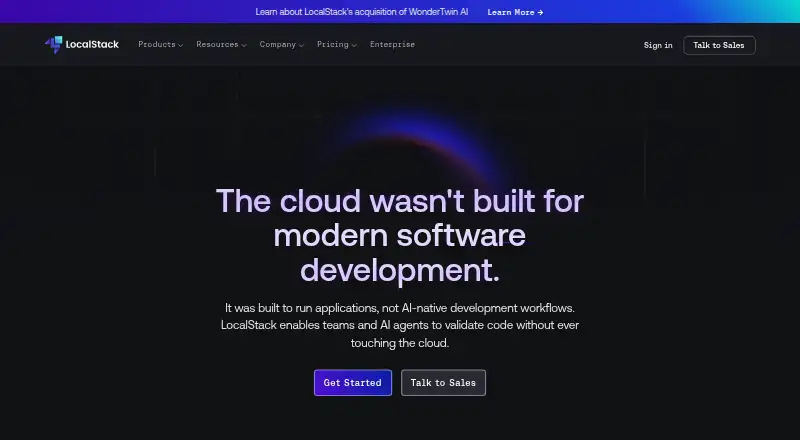
LocalStack simulates cloud environments on customer infrastructure so developers and AI agents can validate cloud applications before deployment. It currently emulates AWS and Snowflake, with AWS coverage listed at 120+ services; an Azure public preview is described as coming soon. Developers can deploy application code and infrastructure-as-code resources into a local container, review failures, validate fixes, and then change the endpoint when ready to ship. LocalStack can run in GitHub Actions, GitLab CI, CircleCI, and Jenkins using a Docker image, and the listed infrastructure-as-code tools include CDK, Terraform, and Pulumi. Plans include a free Hobby option for non-commercial use and AWS Base at $39 a year, billed at $39 per license per month annually. LocalStack is intended for development and testing, not production customer-facing applications. It supports API, Linux, macOS, self-hosted, web, and Windows environments.
Good
- Emulates AWS, Snowflake, and 120+ AWS services.
- Supports GitHub Actions, GitLab CI, CircleCI, and Jenkins.
- Works with CDK, Terraform, and Pulumi.
- Offers a free Hobby plan.
- Supports self-hosted and offline operation options.
Watch out
- Hobby terms prohibit commercial software development use.
- Built for development and testing, not production applications.
- Azure is described as a preview coming soon.
Who it suits
It suits developers and AI teams that want to validate cloud application changes before deployment, including in CI workflows. The Hobby plan is limited to non-commercial use, and LocalStack says it is not for production customer-facing applications.
Verdict
LocalStack provides local cloud simulation for development and test workflows, with CI and infrastructure-as-code integrations. Check the Hobby non-commercial restriction and keep its stated development-and-testing scope in mind.
Plans and prices
From LocalStack's own pricing page, checked 15 Oct 2026.
| Plan | Price | What it gives you |
|---|---|---|
| Azure Public Preview | Free | core Azure emulation · ARM and Bicep deployments · self-serve account access · documented coverage and limitations |
| Hobby | Free | 30+ emulated AWS services · 1 personal sandbox · CI testing · VS Code integration · non-commercial use |
| Hobby (LocalStack for AWS) | Free | 30+ emulated services · 1 personal sandbox · non-commercial use · basic support · Free |
| Snowflake Base (annual) | $29 | CI testing · local state persistence · initialization hooks · standard support · billed annually; per license/month |
| Base (LocalStack for Snowflake) | $29 | Snowflake emulator · CI tests · local state persistence · initialization hooks · standard support · $29 per license/per month billed annually; $35 per license/per month billed monthly |
| Snowflake Base (monthly) | $35 a month | CI testing · local state persistence · initialization hooks · standard support · billed monthly; per license/month |
| Base (LocalStack for AWS) | $39 | 55+ emulated services · personal sandbox for each developer · 300 MB/workspace lifetime state storage · 100 mins/workspace/month previews · standard support · $39 per license/per month billed annually; $45 per license/per month billed monthly |
| Base (annual) | $39 | 55+ emulated services · personal sandbox per developer · state persistence · basic IAM enforcement · 300 MB/workspace lifetime · 100 preview minutes/workspace/month · billed annually; per license/month |
| Base (monthly) | $45 a month | 55+ emulated services · personal sandbox per developer · state persistence · basic IAM enforcement · 300 MB/workspace lifetime · 100 preview minutes/workspace/month · billed monthly; per license/month |
| Ultimate (LocalStack for AWS) | $89 | 110+ emulated services · advanced IAM policy testing · live AWS resource replicator · 3 GB/workspace lifetime state storage · 500 mins/workspace/month previews · priority support · $89 per license/per month billed annually; monthly plan available via AWS Marketplace public offer |
| Ultimate | $89 | 110+ emulated services · advanced IAM testing · live AWS resource replicator · 3 GB/workspace lifetime · 500 preview minutes/workspace/month · priority support · billed annually; per license/month |
| Enterprise (LocalStack for AWS) | Priced on request | Flexible deployment · custom workspaces · Kubernetes delivery · GovCloud · custom SSO + SCIM · offline/air-gapped image delivery · enterprise support · Custom |
| Enterprise | Priced on request | all AWS services/features · Kubernetes delivery · custom SSO and SCIM · GovCloud/additional regions · offline and air-gapped delivery · enterprise support |
| Snowflake Enterprise | Priced on request | flexible deployment · customized usage · fully offline operation · enterprise compliance controls · SSO · dedicated support |
The facts
Each one read from LocalStack's own pages, with the date it was checked.
Where it runs
- Air-gapped operation
- Fully offline or air-gapped image delivery is offered on the Enterprise tier.checked 15 Oct 2026
What it does
- API
- The Ephemeral Instance API allows programmatic creation and teardown of isolated cloud development environments.checked 15 Oct 2026
- AWS service coverage
- The documentation describes LocalStack for AWS as emulating more than 120 AWS services.checked 15 Oct 2026
- CI/CD
- LocalStack can run inside CI jobs and supports workflows for GitHub Actions, GitLab CI, CircleCI, Jenkins and other providers.checked 15 Oct 2026
- CI integrations
- The product page says LocalStack can run in GitHub Actions, GitLab CI, CircleCI, and Jenkins using a Docker image.checked 29 Sep 2026
- Cloud coverage
- LocalStack currently emulates AWS with 120+ services and Snowflake, with a public preview of Azure described as coming soon.checked 29 Sep 2026
- Data residency
- Cloud Pod data is stored on LocalStack-managed infrastructure in AWS eu-central-1; users can instead save snapshots to their own S3 bucket.checked 15 Oct 2026
- Developer tooling
- The Hobby plan lists an Extensions Marketplace and VS Code integration, and the FAQ names CDK, Terraform, and Pulumi as infrastructure-as-code tools used with LocalStack.checked 29 Sep 2026
- Developer tools
- Official developer tools include App Inspector, AWS Replicator, chaos engineering, Cloud Sandbox, Lambda tools, security testing and snapshots.checked 15 Oct 2026
- Development workflow
- Users can deploy application code and infrastructure-as-code resources into a local container, review failures, validate fixes, and then change the endpoint to ship.checked 29 Sep 2026
- Documentation depth
- The documentation includes installation, local development, CI pipelines, customization, integrations, developer tools, licensing, support and a release changelog.checked 15 Oct 2026
- Ephemeral environments
- Paid AWS plans include application preview allowances of 100 minutes per workspace per month on Base and 500 minutes on Ultimate.checked 29 Sep 2026
- Extensions
- Extensions can add services or integrations to the container; the marketplace lists AWS Proxy, MailHog, Stripe, WireMock, Keycloak and other extensions.checked 15 Oct 2026
- Founding history
- LocalStack’s own milestones page dates the first open-source commits to August 2016.checked 15 Oct 2026
- Funding
- TechCrunch reported that LocalStack raised a $25 million Series A led by Notable Capital on November 12, 2024, after an undisclosed $3 million seed round from CRV and Heavybit.checked 15 Oct 2026
- IAM security testing
- IAM Policy Enforcement evaluates identity, resource, boundary and service-control policies when enabled with ENFORCE_IAM=1; enforcement is disabled by default.checked 15 Oct 2026
- Installation
- The recommended installation uses the lstk CLI, with Homebrew, npm and downloadable binaries, and requires Docker.checked 15 Oct 2026
- Integrations
- Documentation covers integrations with SDKs, application frameworks, testing tools and LocalStack Extensions.checked 15 Oct 2026
The company
- Company headquarters
- LinkedIn lists LocalStack headquarters in Zurich and classifies it as privately held.checked 15 Oct 2026
- Company history
- The company page records LocalStack’s first open-source GitHub commits in August 2016.checked 29 Sep 2026
- Company legal name
- Crunchbase identifies the legal entity as LocalStack GmbH.checked 15 Oct 2026
- Company size
- LinkedIn lists the company size as 51–200 employees.checked 15 Oct 2026
- Founded
- 2016checked 28 Sep 2026
- Headquarters
- Zurich, Switzerlandchecked 28 Sep 2026
The full review of LocalStack
LocalStack is a cloud-emulation environment for developers who want to check application and infrastructure changes before deployment. It suits AWS- and Snowflake-focused development teams best; its strongest case is bringing cloud-oriented tests into local and CI workflows.
Overview
LocalStack runs simulated cloud environments on customer infrastructure. Developers can deploy application code and infrastructure-as-code resources into a local container, inspect failures, validate fixes, and then switch the endpoint when preparing to ship. That makes it a practical fit for testing changes before deployment, but not for serving production customer-facing applications.
Its core strengths are service virtualization and database testing, with support for local and other deployment models. The company traces its first open-source GitHub commits to August 2016 and is based in Zurich, Switzerland.
Key features
LocalStack emulates AWS and Snowflake; AWS coverage varies by plan, from 30+ services on Hobby to 110+ on Ultimate, while overall coverage is described as 120+ services. Azure remains a public preview described as coming soon, so teams needing established Azure emulation should not treat it as a current substitute.
The workflow can incorporate CDK, Terraform, and Pulumi, and Hobby includes an Extensions Marketplace and VS Code integration. A Docker image lets teams run LocalStack in GitHub Actions, GitLab CI, CircleCI, and Jenkins. These options make it useful for catching integration problems within existing development and CI routines, though the product's stated scope remains development and testing.
Paid AWS plans add application previews: Base provides 100 minutes per workspace per month, while Ultimate provides 500. LocalStack can often run without internet after authentication; fully offline or air-gapped image delivery is an Enterprise feature.
Supported languages include C#, C++, Go, Java, JavaScript, PHP, Python, and Ruby. Those broad language options complement its cloud-focused workflow without changing its development-and-testing role.
Pricing
LocalStack is freemium, with a free Hobby plan and paid plans. Hobby costs nothing and includes 30+ emulated services, one personal sandbox, and basic support. Its non-commercial restriction is decisive: the terms prohibit using it for commercial software development, so it is not a safe free option for commercial teams.
Base (LocalStack for AWS) is $39 per license/per month billed annually or $45 per license/per month billed monthly. It includes 55+ services, a personal sandbox for each developer, 300 MB of lifetime state storage per workspace, 100 preview minutes per workspace per month, and standard support. It is the entry paid AWS choice for teams needing commercial use and a defined preview allowance.
Base (LocalStack for Snowflake) is $29 per license/per month billed annually or $35 per license/per month billed monthly. It includes the Snowflake emulator, CI tests, local state persistence, initialization hooks, and standard support. This is the relevant Base option for Snowflake workflows rather than AWS emulation.
Ultimate (LocalStack for AWS) is $89 per license/per month billed annually; a monthly plan is available via AWS Marketplace public offer. It raises AWS coverage to 110+ services and includes advanced IAM policy testing, a live AWS resource replicator, 3 GB of lifetime state storage per workspace, 500 preview minutes per workspace per month, and priority support. The added capacity and testing tools suit teams with broader AWS validation needs, but cost more than Base.
Enterprise (LocalStack for AWS) has custom pricing. It adds flexible deployment, custom workspaces, Kubernetes delivery, GovCloud, custom SSO and SCIM, offline or air-gapped image delivery, and enterprise support, making it the tier for organizations with deployment or access-control requirements beyond the AWS plans.
A free trial is available. LocalStack's offline operation after authentication may suit disconnected development, but Enterprise is required for fully offline image delivery.
Platforms
LocalStack supports API, Linux, macOS, self-hosted, web, and Windows platforms. Its deployment options include local use as well as other deployment models.
Who it's for
Choose LocalStack if your team builds cloud applications and wants to validate AWS or Snowflake behavior locally or in CI before deployment. It is particularly relevant when infrastructure-as-code, database testing, or per-workspace previews are part of the workflow. Look elsewhere if you need a production hosting platform, or if commercial development must stay on a free plan.
Pros and cons
Pros
- Cloud checks fit into development and CI: Local containers and support for four named CI systems let teams validate changes before shipping.
- Plan choices scale AWS coverage: AWS service counts rise from 30+ on Hobby to 110+ on Ultimate, with added preview time on higher paid tiers.
- Enterprise controls cover specialized environments: GovCloud, custom SSO and SCIM, and air-gapped image delivery address needs absent from the lower tiers.
Cons
- Hobby is non-commercial only: Its terms bar commercial software development, limiting the free tier to personal or other non-commercial use.
- Not for production customer applications: Its stated purpose is development and testing, so it should not be selected as a production-serving platform.
- Azure is not established coverage: It is described only as a public preview coming soon.
- Preview and state allowances differ by tier: Base and Ultimate have fixed monthly preview minutes and lifetime workspace storage, so teams with larger needs may have to move up a plan.
Alternatives
Microcks is worth considering when a free, open-source, community-driven CNCF Incubating project better fits a service-mocking need. MockServer is a free, open-source self-hosted option with no SaaS account. Azurite is a free local Azure Storage emulator for teams focused specifically on Azure Storage. Wilma is a free GPLv3.0-licensed option.
WireMock may fit a smaller mock-API workload: its free tier allows 1,000 calls per month, one user, three mock APIs, and a 10 requests-per-second rate limit. Amazon RDS is the alternative to consider when the need is the RDS service rather than local cloud emulation. mountebank is a free open-source service-virtualization option. Parasoft SOAtest is a paid alternative with a free trial and tailored quote-based pricing.
For broader directories, browse Service Virtualization Software or Integration Testing Tools.
Verdict
LocalStack is the right choice for development teams that need AWS- or Snowflake-oriented cloud behavior in local and CI testing, with paid AWS tiers offering progressively broader coverage and preview capacity. Its commercial Hobby restriction, development-only scope, and tier-bound allowances are the main reasons to look elsewhere.
Getting started
- Open the LocalStack website
- Start with the free Hobby plan or choose a paid plan
- Run LocalStack in a local container
- Deploy application code and infrastructure-as-code resources
- Review failures and validate fixes
- Use the endpoint when ready to ship
Limits worth knowing
Hobby provides 30+ emulated services, one personal sandbox, basic support, and non-commercial use. AWS Base includes 100 preview minutes per workspace monthly, while Ultimate includes 500; Enterprise terms are custom.
Questions
Is LocalStack free?
Yes.
Which cloud services does it emulate?
LocalStack emulates AWS and Snowflake. Azure is described as a public preview coming soon.
Where can LocalStack run?
Supported environments include API, Linux, macOS, self-hosted, web, and Windows.
Which infrastructure-as-code tools work with it?
The listed tools are CDK, Terraform, and Pulumi.
Can it run in CI?
Yes. It can run in GitHub Actions, GitLab CI, CircleCI, and Jenkins using a Docker image.
Is the free plan for commercial software development?
No. Hobby is designated for non-commercial use, and its terms prohibit commercial software development use.
Alternatives to LocalStack
- 1

Beeceptor
Free planWebAPILinuxmacOS7.9From $10 a month - 2

ReadyAPI
WebAPILinuxmacOS7.6 - 3

Microcks
Free planWebAPIExtensionLinux7.2Free plan - 4

Hoverfly
WebAPILinuxmacOS6.7From $10 a month - 5

MockServer
Free planWebAPILinuxmacOS6.6Free plan - 6

Automic Continuous Delivery Automation
WebAPILinuxSelf-hosted6.5