MIND Data Discovery
MIND Data Discovery helps organizations locate and classify sensitive information across their systems, producing an inventory of data, users, and activity.
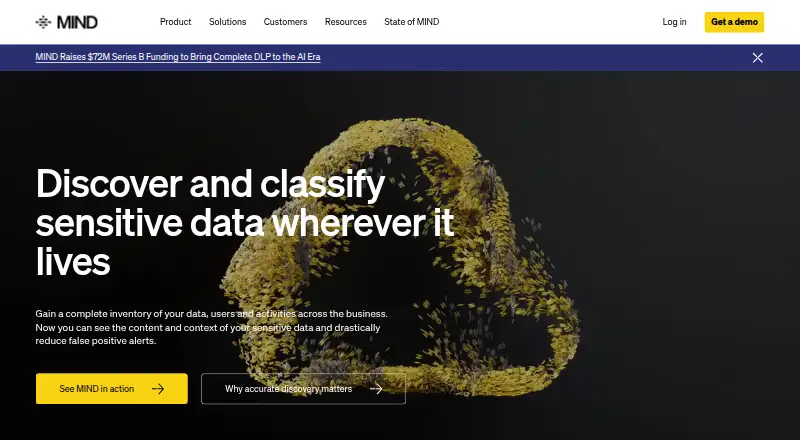
What MIND Data Discovery is
MIND Data Discovery helps organizations locate and classify sensitive information across their systems, producing an inventory of data, users, and activity. It covers SaaS and GenAI applications, on-premise file shares, endpoints, and email. Its living catalog brings together resources, users, authorization, file activity, and metadata, adding business context about where sensitive data resides and why it matters for policies, compliance, and response.
MIND AI applies tailored algorithms to categorize file types and identify sensitive elements within files. The product handles formats from images to archives and applies tags and user-based labels automatically; classification automation is hybrid. It is cloud-deployed and described as cloud-native, with connections to existing systems said to take minutes. Listed integrations include Google Drive, OneDrive, Box, Microsoft Teams, Slack, GitHub, Salesforce, SharePoint, Dropbox, Jira, and Notion. It runs on Linux, macOS, Windows, and the web. Pricing is available on request.
Good
- Catalog combines resources, users, authorization, activity, and metadata.
- Identifies sensitive elements inside files.
- Supports formats from images to archives.
- Lists integrations with services including Slack and Salesforce.
Watch out
- Pricing is available only on request.
- Cloud deployment is the listed deployment model.
Who it suits
MIND Data Discovery suits organizations seeking to inventory and classify sensitive data across applications, endpoints, file shares, and email. It may also suit teams that need business context for policies, compliance, or response.
Verdict
MIND Data Discovery brings sensitive-data discovery, classification, and business context into a cloud-deployed product. Organizations should contact MIND for pricing and product information.
Plans and prices
From MIND Data Discovery's own pricing page, checked 9 Oct 2026.
| Plan | Price | What it gives you |
|---|---|---|
| Contact sales | Priced on request | Get a live demo or contact MIND for product information |
The facts
Each one read from MIND Data Discovery's own pages, with the date it was checked.
What it does
- AI classification
- MIND AI uses hundreds of tailored algorithms to categorize file types and identify sensitive elements inside files.checked 9 Oct 2026
- Business context
- MIND provides context about where sensitive data lives and its business significance to support policies, compliance and response.checked 9 Oct 2026
- Catalog
- MIND’s living data catalog includes resources, users, authorization, file activities and metadata.checked 9 Oct 2026
- Cloud deployment
- MIND describes itself as cloud-native and says it connects to existing systems in minutes.checked 9 Oct 2026
- Data sources
- The product covers SaaS apps, on-premise file shares, endpoints and email systems.checked 9 Oct 2026
- File types
- MIND supports file types ranging from images to archives and automatically applies tags and user-based labels.checked 9 Oct 2026
- Integrations
- MIND lists integrations including Google Drive, OneDrive, Box, Microsoft Teams, Slack, GitHub, Salesforce, SharePoint, Dropbox, Jira and Notion.checked 9 Oct 2026
- Purpose
- MIND discovers and classifies sensitive data across an organization to provide an inventory of data, users and activities.checked 9 Oct 2026
- Security and compliance
- MIND’s Trust Center lists CCPA, GDPR, HIPAA, ISO/IEC 27001:2022, ISO/IEC 42001:2023 and SOC 2 Type 2 under compliance.checked 9 Oct 2026
- Security documentation
- The Trust Center offers access to security documentation and lists a SOC 2 Type 2 report, data flow diagram, data processing agreement and pentest report as featured documents.checked 9 Oct 2026
- Support and sales
- MIND invites prospective customers to request a live demo or contact the company.checked 9 Oct 2026
- Target users
- MIND says it helps organizations protect sensitive data, mitigate risks and preserve brand reputation in the AI era.checked 9 Oct 2026
Where it runs
- Endpoint platforms
- MIND lists Windows, Mac, Linux and ChromeOS endpoints.checked 9 Oct 2026
The company
- Headquarters
- Seattle, Washington, United Stateschecked 28 Sep 2026
The full review of MIND Data Discovery
MIND Data Discovery is a cloud-deployed service for locating and classifying sensitive information across SaaS, GenAI applications, endpoints, file shares and email. It suits organizations that need a single view of unstructured data, access and activity across varied systems. Its broad coverage and business context are compelling, while custom pricing and a cloud-only deployment make fit and procurement important considerations.
Overview
MIND combines discovery, classification and cataloging in one inventory of data, users and activities. The living catalog records resources, users, authorization, file activity and metadata, so security and compliance teams can see not only what information exists but also who can access it and how it is being used. That context is more useful for policy decisions and incident response than a simple list of files.
Coverage spans SaaS applications, GenAI applications, endpoints, on-premise file shares and email systems. This breadth favors organizations with information distributed across cloud and legacy environments. MIND describes the service as cloud-native and says it connects to existing systems in minutes, an approach that can reduce deployment friction for teams seeking a hosted product. Organizations requiring an on-premises deployment should look elsewhere or confirm whether the cloud connection meets their architecture and security requirements.
Key features
Discovery, catalog and context
The catalog brings together data resources, identities, permissions and file activity with metadata. That relationship between content and business context helps teams judge the significance of a sensitive item, prioritize policy work and support compliance or response efforts. It is a stronger proposition than classification without ownership or usage information, particularly where authorization and activity trails matter.
AI-assisted classification
MIND AI uses hundreds of tailored algorithms to categorize file types and detect sensitive elements inside files. It handles formats ranging from images to archives, then automatically applies tags and user-based labels. The hybrid automation model is suited to large, mixed repositories where manual review would not scale, while organizations with highly specialized detection requirements should validate coverage during the sales process.
Integrations and endpoints
Listed integrations include Google Drive, OneDrive, Box, Microsoft Teams, Slack, GitHub, Salesforce, SharePoint, Dropbox, Jira and Notion. Endpoint coverage includes Windows, Mac, Linux and ChromeOS. Together, these options make MIND relevant to workplaces using a mix of collaboration, development, CRM and productivity systems rather than a single storage platform.
Security and compliance information
MIND’s Trust Center lists CCPA, GDPR, HIPAA, ISO/IEC 27001:2022, ISO/IEC 42001:2023 and SOC 2 Type 2 under compliance. It also provides security documentation, including a SOC 2 Type 2 report, data-flow diagram, data-processing agreement and penetration-test report. Those materials give procurement and security reviewers concrete documents to examine before approving a cloud deployment.
Pricing
Contact sales
MIND uses custom pricing rather than a published rate. The plan includes a live-demo or sales-contact process for product information, with no stated seat allowance, quota, trial period or renewal term. This model is most appropriate for organizations expecting a scoped deployment across multiple data sources and needing a tailored commercial proposal. Smaller teams that need transparent, self-service pricing will have less certainty before engaging sales.
Platforms
MIND Data Discovery is offered through the web and supports Linux, macOS and Windows environments. Its endpoint list also includes ChromeOS, while the service connects to SaaS, GenAI applications, on-premise file shares and email systems. Deployment is cloud-based rather than self-hosted.
Who it's for
MIND is aimed at organizations protecting sensitive data, reducing risk and preserving brand reputation, especially as AI use expands. It is a strong fit for security, privacy and compliance teams that need broad unstructured-data discovery plus user, authorization and activity context. It is less suitable for buyers seeking a narrowly focused labeling utility, a free tier, or a self-hosted product with publicly posted pricing.
Pros and cons
- Pro: Coverage across SaaS, GenAI applications, endpoints, file shares and email supports a consolidated view of fragmented data.
- Pro: The catalog links content to users, permissions and file activity, making findings more actionable for policy and response work.
- Pro: AI classification handles many file formats and applies tags and user-based labels automatically.
- Pro: A broad integration list and Windows, Mac, Linux and ChromeOS endpoint support suit heterogeneous environments.
- Con: Custom pricing means buyers cannot estimate cost from a public rate or compare plans without contacting MIND.
- Con: Cloud deployment may exclude organizations that require on-premises processing or infrastructure control.
Alternatives
Data Discovery and Classification Software is the broader category list for comparing products with different deployment and pricing models.
- Thales CipherTrust Data Security Platform is a better starting point when a freemium option, free plan and self-hosted or API deployment are priorities.
- Ketch Consent Management fits teams focused on web consent workflows, with a free plan capped at 5,000 monthly unique visitors and two integrations.
- Ground Labs Enterprise Recon is an alternative paid discovery product available across API, self-hosted and desktop environments, including a PCI-focused plan.
- Netwrix Password Secure is worth considering when password management and a published self-service price are the primary needs.
- GEODI DSPM suits buyers wanting feature, data-size and user-count choices with on-premises deployment and yearly or three-year subscriptions.
- Strac Data Classification is an option for organizations seeking a scope-based quote tied to surfaces, integrations, data volume and employees.
- Transcend Data Discovery and Classification is another paid alternative with web, API, mobile and self-hosted platform coverage.
- ActiveNav Discovery Center is a paid alternative supporting web and Windows.
Verdict
Choose MIND Data Discovery when your organization needs cross-environment sensitive-data discovery backed by classification, permissions, activity and business context. Its integration breadth, endpoint support and compliance documentation strengthen the case for enterprise security and privacy programs. Look elsewhere if transparent pricing, a free plan or self-hosted deployment is essential.
Alternatives to MIND Data Discovery
- 1
Diskover
Free planOpen sourceWebAPILinuxmacOS7.7Free plan - 2
Microsoft Defender for Business
AndroidiOSAPImacOS7.5 - 3
Google Cloud Secret Manager
Free planWeb6.5From $0.02 a month - 4
DataSunrise
WebLinuxSelf-hostedWindows6.1 - 5
DiskBoss
Windows5.8From $450 a month - 6
Varonis Data Discovery and Classification
WebLinuxSelf-hosted5.8