GEODI DSPM
GEODI DSPM is a paid data security posture management platform for discovering, classifying, and governing structured and unstructured data across cloud and …
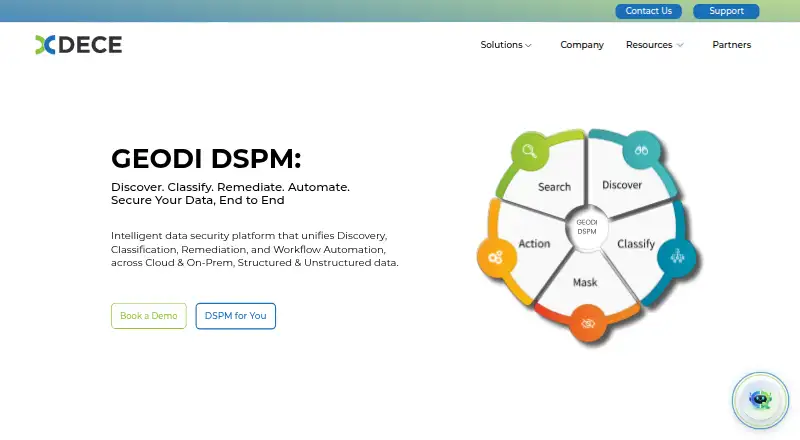
What GEODI DSPM is
GEODI DSPM is a paid data security posture management platform for discovering, classifying, and governing structured and unstructured data across cloud and on-premises environments. Its AI-powered discovery covers sources such as file servers, Microsoft Teams, S3, MinIO, file shares, and databases. Classification can be automatic or manual for Office, SharePoint, OWA, and legacy data, with custom classifications and DLP integration. Workflows can automate deletion, masking, encryption, or quarantine across cloud and on-premises systems, databases, and email platforms. GEODI also provides visibility into permissions and high-risk access, with consent-based remediation workflows for data owners and DPOs. GEODI Q supports cloud or on-premises LLM deployments, prompt-driven discovery, automated classification, and custom AI assistants. The vendor says the platform connects to more than 200 data sources through adapters and provides an API for integrations and custom development. The web application runs on customer servers, and the vendor says internet access is not required to install or run it. Pricing depends on chosen features, data size, and user count and is available from the sales team.
Good
- Discovers structured and unstructured data.
- Supports custom classifications and hybrid automation.
- Automates deletion, masking, encryption, and quarantine.
- Connects to 200+ data sources via adapters.
- Can run on customer servers without internet access.
Watch out
- Pricing is available only on request.
- Deployment requires customer servers.
Who it suits
The vendor describes GEODI DSPM as purpose-built for CISOs, DPOs, and IT managers. It may suit organizations that need data discovery, classification, and remediation across varied cloud and on-premises sources.
Verdict
GEODI DSPM combines discovery, classification, governance, and automated remediation across varied data environments. Organizations should request pricing based on their feature, data-size, and user-count requirements.
Plans and prices
From GEODI DSPM's own pricing page, checked 15 Oct 2026.
| Plan | Price | What it gives you |
|---|---|---|
| Custom subscription | Priced on request | pricing varies by users, data volume and functionality · custom pricing may be available |
| GEODI DSPM | Priced on request | Choose features, data size and user count; on-premises deployment; yearly or 3-year subscription |
The facts
Each one read from GEODI DSPM's own pages, with the date it was checked.
What it does
- AI and search
- GEODI Q supports cloud or on-premises LLM deployments, prompt-driven discovery, automated classification and custom AI assistants.checked 8 Oct 2026
- AI discovery
- The platform uses artificial intelligence, natural-language processing and semantic analysis to identify sensitive information.checked 15 Oct 2026
- AI layer
- GEODI Q adds prompt-driven discovery, automated classification and custom AI assistants for cloud or on-premises deployments.checked 15 Oct 2026
- API
- DECE publishes detailed GEODI API documentation and sample code through its developer portal.checked 15 Oct 2026
- Classification
- GEODI offers automatic, manual and legacy classification for structured data, unstructured content, email and attachments.checked 15 Oct 2026
- Compliance
- Official materials list templates and recognizers for regulations including GDPR, LGPD, KVKK, DPDPA, PDPL, HIPAA and PCI-DSS.checked 15 Oct 2026
- Data sources
- GEODI connects to file servers, databases, email systems, S3, Google Drive, Dropbox, OneDrive, websites, SharePoint and endpoint agents.checked 15 Oct 2026
- Deployment
- GEODI is a web application whose server runs on the customer's servers, and the vendor says internet access is not required to install or run it.checked 8 Oct 2026
- Discovery
- It uses AI-powered discovery to find sensitive data across sources such as file servers, Microsoft Teams, S3, MinIO, file shares and databases.checked 8 Oct 2026
- Documentation
- DECE provides a searchable support knowledge base, API material, training courses, installation guidance and video resources.checked 15 Oct 2026
- Featured integration
- GEODI integrates with SealPath to combine its classification metadata with automated protection for Microsoft Office and PDF documents.checked 8 Oct 2026
- Governance
- GEODI provides visibility into permissions and high-risk access, with consent-based remediation workflows for data owners and DPOs.checked 8 Oct 2026
- Integrations
- The vendor says the platform connects to 200+ data sources via adapters and provides an API for integrations and custom development.checked 8 Oct 2026
- Intended users
- The vendor describes GEODI DSPM as purpose-built for CISOs, DPOs and IT managers.checked 8 Oct 2026
- Legal name
- The app stores identify the seller as DECE YAZILIM ANONIM SIRKETI.checked 15 Oct 2026
- Licence
- GEODI is proprietary commercial software under a DECE licence; copying, redistribution and reverse engineering are restricted.checked 15 Oct 2026
- Limit: mobile privacy disclosure
- Apple says the developer has not supplied privacy-practice details for the GEODI mobile app.checked 15 Oct 2026
- Limit: offline maintenance
- Offline operation is supported, but updates and module installations must then be performed manually and Support Q is unavailable.checked 15 Oct 2026
- Limit: pricing transparency
- TrustRadius lists no GEODI pricing plans, while Gartner describes user, data-volume and functionality-based subscription pricing.checked 15 Oct 2026
Where it runs
- Apple app
- The free GEODI mobile app supports iPhone and iPad, requires iOS 11 or later, and connects to a GEODI Server for search, viewing, mapping, notes and sharing.checked 15 Oct 2026
- Endpoint platforms
- The GEODI Desktop Explorer agent runs on Windows, Pardus, Linux and Mac computers.checked 15 Oct 2026
The company
- Company size
- LinkedIn lists DECE Software as privately held with 11–50 employees.checked 15 Oct 2026
- Founded
- LinkedIn lists the company founding year as 2015.checked 15 Oct 2026
- Headquarters
- The Google Play listing gives the developer address as Tepe Prime İş Merkezi in Çankaya, Ankara, Türkiye.checked 15 Oct 2026
The full review of GEODI DSPM
GEODI DSPM is a data-security posture platform for organizations that must locate, classify and control information spread across cloud and on-premises repositories. It suits CISOs, DPOs and IT managers with mixed estates; its strongest argument is unified governance and remediation, while on-premises operation and custom pricing demand careful planning.
Overview
GEODI combines discovery, classification, permission visibility and workflow-based remediation for structured and unstructured data. It reaches file servers and shares, Microsoft Teams, S3, MinIO, databases, email, documents and other cloud environments, making it a practical choice when sensitive information is scattered across many systems rather than concentrated in one repository.
The platform normally reads source data and keeps both that data and extracted information inside the configured environment. Authorized integrations, exports, workflows or remediation can move or alter information. That handling model is attractive to organizations with strict residency or isolation requirements, but the web application runs on customer-owned servers and does not remove the operational responsibility of maintaining that environment.
Key features
Discovery and classification
AI-powered discovery searches connected repositories for sensitive information, covering both structured databases and unstructured files. Automatic and manual classification support Office, SharePoint, OWA and legacy data, with DLP integration and custom classification schemes. The hybrid approach lets teams automate broad coverage while retaining human control for unusual or high-impact categories.
Remediation and governance
Workflows can delete, mask, encrypt or quarantine data across cloud and on-premises systems, databases and email platforms. Permission visibility highlights high-risk access, and consent-based workflows involve data owners and DPOs before corrective action. This is more useful than a reporting-only scanner for teams that need findings to result in controlled changes, although workflow design and approvals will require governance discipline.
AI, search and integrations
GEODI Q supports cloud or on-premises LLM deployments, prompt-driven discovery, automated classification and custom AI assistants. The vendor says adapters connect more than 200 data sources, while an API supports integrations and custom development. A SealPath integration combines GEODI classification metadata with automated protection for Microsoft Office and PDF files, extending classification into document safeguards.
Compliance and support
DECE-STORE supplies compliance templates, reports, dashboards and modules aimed at GDPR, PCI DSS and HIPAA programs. Technical support, GEODI Academy courses, webinars and the Support Q assistant provide several routes for administrators and operators who need product guidance.
Pricing
GEODI DSPM uses custom pricing based on selected features, data size and user count. The plan is offered for on-premises deployment with either a yearly or three-year subscription; no public price, free tier or trial is provided. This model fits organizations that need a tailored deployment and can engage sales for a scoped quote, but it makes direct budget comparison difficult and gives smaller teams no low-commitment entry point.
Platforms
The application is available through web, Windows, macOS, Linux, API and self-hosted deployments. Its server runs on the customer's servers, and internet access is not required for installation or operation. The GEODI Desktop Explorer agent supports Windows, Linux, macOS and Pardus, which helps cover heterogeneous endpoint fleets without forcing a single desktop operating system.
Who it's for
GEODI is aimed at CISOs, DPOs and IT managers responsible for data protection across diverse repositories. It is a strong fit for regulated or privacy-sensitive organizations that need local processing, granular classification and remediation workflows spanning many systems. It is less suitable for buyers seeking transparent subscription pricing, a hosted-only service or a simple scanner with minimal deployment overhead.
Pros and cons
- Pros: Discovery covers structured and unstructured data across a broad set of repositories, reducing blind spots in mixed estates.
- Pros: Automated, manual and custom classification can be combined with deletion, masking, encryption and quarantine workflows.
- Pros: Customer-server deployment and local data handling support organizations with strict control or residency requirements.
- Pros: More than 200 adapters, an API and SealPath integration provide room for larger integration programs.
- Cons: Custom pricing tied to features, data size and users prevents quick cost comparisons and requires a sales process.
- Cons: On-premises operation leaves infrastructure management with the customer and may be excessive for smaller teams.
- Cons: There is no published free plan or trial for organizations wanting to evaluate the platform with limited commitment.
Alternatives
Data Discovery and Classification Software is the broader category to browse when you want to compare products by repository coverage and deployment model.
Thales CipherTrust Data Security Platform is the better starting point for buyers prioritizing a freemium option with a free Community Edition and free trial.
Ketch Consent Management suits teams focused on consent operations and a web-based free plan capped at 5,000 monthly unique visitors and two integrations.
Ground Labs Enterprise Recon is an alternative for organizations seeking paid discovery with PCI-focused and broader Enterprise Recon plans.
Netwrix Password Secure is a paid option with Android and iOS support and a self-service plan starting at $60 a year.
MIND Data Discovery offers a paid data-discovery product across Linux, macOS, web and Windows.
Strac Data Classification is a paid, scope-quoted classification platform covering Linux, macOS, self-hosted, web and Windows deployments.
Transcend Data Discovery and Classification is another paid choice with web, self-hosted, API, Android and iOS platforms.
ActiveNav Discovery Center is a paid alternative available on web and Windows.
Verdict
Choose GEODI DSPM when your organization needs one system to discover, classify, govern and remediate sensitive data across varied cloud and on-premises sources, with processing kept under your control. Look elsewhere if transparent pricing, a free evaluation or a fully managed service matters more than breadth and local deployment.
Alternatives to GEODI DSPM
- 1
Microsoft Defender for Business
AndroidiOSAPImacOS7.5 - 2
Google Cloud Secret Manager
Free planWeb6.5From $0.02 a month - 3
Transcend Data Discovery and Classification
AndroidiOSWebAPI6.4 - 4
IRI DarkShield
APILinuxmacOSSelf-hosted6.3 - 5
DataSunrise
WebLinuxSelf-hostedWindows6.1 - 6

ActiveNav Discovery Center
WebWindows6.0