
Strac Data Classification
Strac Data Classification identifies and classifies sensitive information across SaaS applications, cloud services, endpoints, databases, and other sources.
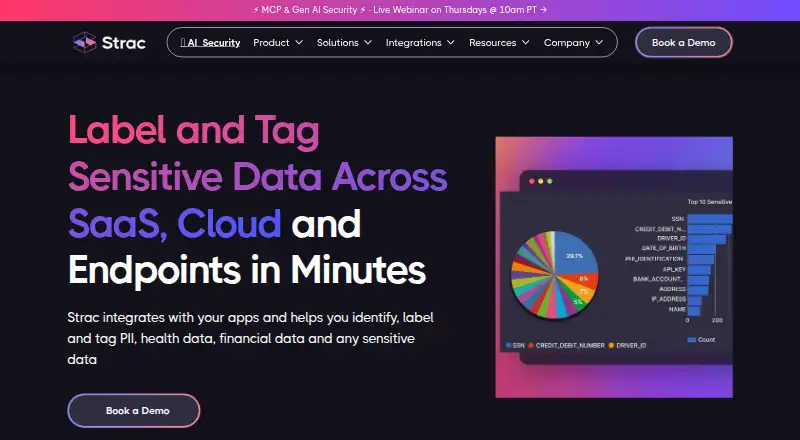
What Strac Data Classification is
Strac Data Classification identifies and classifies sensitive information across SaaS applications, cloud services, endpoints, databases, and other sources. Its machine-learning model scans text, attachments, and audio or video recordings. Listed categories include personal, health, and financial information, secrets, profanity, network details, vehicle data, and voice recordings. Organizations can define custom rules, including regex detection and examples drawn from uploaded documents.
Mapped policies can automatically apply Microsoft Purview Information Protection or Google Drive labels. Strac also lists actions including encryption, masking, redaction, alerts, deletion, blocking, and access revocation. Named integrations include Office 365, Google Drive, AWS, Azure, Snowflake, Microsoft AIP, Google Cloud DLP, and Google Workspace IRM. Reporting and analytics are intended to support compliance monitoring and audits. The classification solution is described as agentless. Pricing is scope-based and available by quote; the maker says an itemized quote follows a 30-minute scoping call. It also offers a proof of value in a customer's environment before commitment.
Good
- Scans text, attachments, and audio or video.
- Supports custom rules and document examples.
- Can apply mapped Microsoft Purview or Google Drive labels.
- Lists actions such as redaction and access revocation.
- Provides reporting and analytics for audits.
Watch out
- Pricing depends on scope and is available by quote.
- An itemized quote follows a 30-minute scoping call.
Who it suits
It suits organizations that need to classify sensitive information across cloud, SaaS, endpoint, and other data sources. Teams can define custom policies and use mapped labels or listed remediation actions.
Verdict
Strac combines discovery, policy-based labeling, and listed remediation actions across varied data sources. Its quote depends on scope, so organizations should clarify their requirements during the scoping process.
Plans and prices
From Strac Data Classification's own pricing page, checked 30 Sep 2026.
| Plan | Price | What it gives you |
|---|---|---|
| Strac Data Classification | Priced on request | Scope-based quote depends on surfaces, integrations, data volume, and in-scope employees |
The facts
Each one read from Strac Data Classification's own pages, with the date it was checked.
The company
- Company background
- Strac says its founder and CEO experienced identity theft in 2020, which inspired the company, but the opened About page does not state a founding year or headquarters.checked 30 Sep 2026
What it does
- Custom policies
- Organizations can define their own labeling rules, including regex-based detection and examples from uploaded documents.checked 30 Sep 2026
- Deployment
- The classification page describes the solution as agentless and says users can integrate in five minutes.checked 30 Sep 2026
- Detection
- Its machine-learning model scans text, attachments, and audio or video recordings across SaaS tools for sensitive data.checked 30 Sep 2026
- Integrations
- Examples named on the classification page include Office 365, Google Drive, AWS, Azure, Snowflake, Microsoft AIP, Google Cloud DLP, and Google Workspace IRM.checked 30 Sep 2026
- Labels
- Strac can automatically apply Microsoft Purview Information Protection or Google Drive labels based on mapped classification policies.checked 30 Sep 2026
- Pricing limits
- The maker provides an itemized quote within 24 hours after a 30-minute scoping call; historical discovery data volume is part of the quote, while real-time protection is not priced on data volume.checked 30 Sep 2026
- Purpose
- Strac identifies, classifies, labels, and helps protect sensitive data across SaaS, cloud, and endpoints.checked 30 Sep 2026
- Remediation
- The product page says Strac can encrypt, mask, or secure files, and its integrations overview lists labeling, redaction, alerts, deletion, blocking, and access revocation.checked 30 Sep 2026
- Reporting
- Strac provides reporting and analytics to help monitor regulatory compliance and support audits.checked 30 Sep 2026
- Security and compliance
- Strac’s site displays badges for HIPAA, PCI-DSS, ISO 27001, SOC 2, CCPA, and GDPR.checked 30 Sep 2026
- Sensitive data types
- The page lists PII, health and financial information, secrets, profanity, network details, vehicle data, and voice recordings as detectable categories.checked 30 Sep 2026
- Support/contact
- The classification page lists [email protected] as a contact email and offers a demo booking link.checked 30 Sep 2026
Money
- Trial or proof of value
- The pricing page says Strac runs a proof of value in the customer's environment before commitment but does not state a trial duration.checked 30 Sep 2026
The full review of Strac Data Classification
Strac Data Classification discovers and classifies sensitive information across SaaS, cloud services, endpoints, and other data sources, then applies labels and protective actions. It suits organizations managing sensitive data across multiple systems; buyers should weigh its broad detection and policy controls against a quote-based purchase that requires scoping.
Overview
Strac combines structured and unstructured data discovery with automated and custom classification. Its machine-learning model scans text, attachments, and audio or video recordings across SaaS tools, covering categories such as personal, health, and financial information, secrets, network details, vehicle data, profanity, and voice recordings.
The range of sources is a strength for organizations whose data spans SaaS applications, cloud services, endpoints, databases, file shares, logs, documents, email, chat, and AI tools. Strac describes deployment as agentless and says users can integrate in five minutes. That may make it a fit for teams seeking broad coverage without an endpoint-agent rollout, though the actual scope and effort will depend on the chosen integrations.
Key features
Classification and labels
Organizations can define custom labeling rules, including regex-based detection and examples taken from uploaded documents. Strac can map classification policies to Microsoft Purview Information Protection or Google Drive labels and apply them automatically. That pairing of custom rules and automated labels is useful when teams need classifications to drive consistent handling across those services.
Protection and oversight
Strac says it can encrypt, mask, or secure files. Its integrations overview also describes labeling, redaction, alerts, deletion, blocking, and access revocation. These actions give teams options beyond detection, but organizations should establish which actions suit their policies and systems before deployment. Reporting and analytics support compliance monitoring and audits. The site displays HIPAA, PCI-DSS, ISO 27001, SOC 2, CCPA, and GDPR badges.
Named integration examples include Office 365, Google Drive, AWS, Azure, Snowflake, Microsoft AIP, Google Cloud DLP, and Google Workspace IRM. API access is supported, which matters for organizations incorporating classification into broader systems.
Pricing
Strac Data Classification has custom pricing based on surfaces, integrations, data volume, and in-scope employees. The maker provides an itemized quote within 24 hours after a 30-minute scoping call. Historical discovery data volume contributes to the quote; real-time protection is not priced on data volume.
Strac runs a proof of value in the customer’s environment before commitment. No trial duration is stated, so buyers should treat this as a scoped evaluation rather than a time-defined free trial. The quote-based model may suit organizations that need a tailored deployment, but it makes direct price comparison difficult before scoping.
Platforms
Strac lists Linux, macOS, self-hosted, web, and Windows platforms. Its stated coverage across SaaS, cloud, and endpoints, plus databases and file shares, points to a cross-environment product rather than a single-platform tool.
Who it's for
Strac is best suited to organizations that need to discover sensitive data across varied systems, define their own classification policies, and connect findings to labels or remediation. Its reporting and compliance focus may also appeal to teams preparing for audits. Buyers with narrow discovery needs or a preference for a straightforward published price may find the scoping process and custom quote less suitable.
Pros and cons
- Broad detection scope: Scans text, attachments, and audio or video recordings and covers numerous sensitive-data categories, supporting use across varied data stores.
- Flexible policy controls: Custom rules can use regex and uploaded-document examples, while mapped policies can apply Microsoft Purview or Google Drive labels.
- Multiple protective actions: Encryption, masking, and other integration actions let teams respond to findings instead of stopping at discovery.
- Quote-based buying: Price depends on deployment scope and requires a 30-minute call, making early budget comparisons harder.
- Scope affects discovery cost: Historical discovery data volume contributes to the quote, so organizations should clarify expected volumes and coverage during scoping.
Alternatives
Consider Data Discovery and Classification Software to compare products across the category.
- Ground Labs Enterprise Recon may suit buyers focused on PCI data types; its PCI plan includes remediation and basic reporting, with target and data usage subject to license.
- Teleskope Understand is another paid, self-hosted or web option for buyers seeking a demo-led sales process.
- Varonis Data Discovery and Classification is a paid alternative with Linux, self-hosted, and web platforms, also sold by quote.
- OpenText Voltage Data Security Platform is another paid, web-platform option.
- BigID DSPM may suit buyers seeking a free trial; its DSPM bundle is quote-based, with cost depending on data sources, apps, connectors, deployment, and services and support.
- Transcend Data Discovery and Classification is another paid option, with Android, iOS, API, self-hosted, and web platforms.
- IRI DarkShield may suit buyers seeking a free trial and a perpetual-use license for standalone file or image sources; its first-hostname license fee ranges from USD $5K-50K.
- Concentric AI offers a custom quote tailored to the environment and data consumption, with pricing based on the amount of data scanned.
Verdict
Choose Strac if your organization needs policy-driven discovery, labeling, and remediation across a diverse data estate, and is prepared to scope a custom deployment. Its combination of broad detection and customizable labeling is the main draw; buyers who need predictable pricing before a sales discussion should look elsewhere.
Alternatives to Strac Data Classification
- 1
Microsoft Defender for Business
AndroidiOSAPImacOS7.5 - 2
GEODI DSPM
AndroidiOSWebAPI7.0 - 3
Google Cloud Secret Manager
Free planWeb6.5From $0.02 a month - 4
Transcend Data Discovery and Classification
AndroidiOSWebAPI6.4 - 5
IRI DarkShield
APILinuxmacOSSelf-hosted6.3 - 6
DataSunrise
WebLinuxSelf-hostedWindows6.1