
Mercury
Mercury is a web-based CRM, ATS, automation, AI, and analytics platform for staffing and recruitment businesses.
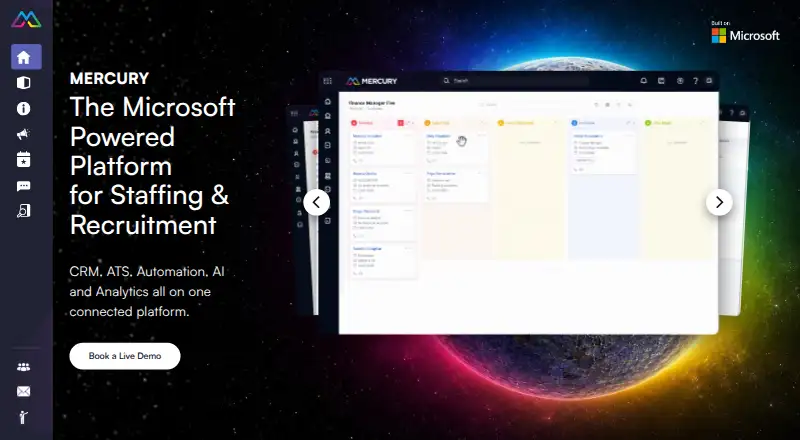
What Mercury is
Mercury is a web-based CRM, ATS, automation, AI, and analytics platform for staffing and recruitment businesses. Its Sales & Recruiting tools manage candidates, clients, vacancies, and placements together. Mercury AI can turn conversations and job briefs into structured records, adverts, candidate summaries, and follow-up actions; its search assistant accepts natural-language descriptions and expands searches with related job titles, employers, and industry terms. Automated workflows support follow-ups, activity tracking, candidate nurturing, and compliance steps. Middle & Back Office supports permanent, contract, and fixed-term placements, with onboarding, compliance, timesheets, expenses, invoicing, and payments. A placement must reach a Compliance Score of 100% before it can go live. Role-based analytics dashboards show pipeline, productivity, and revenue, with forecasting and performance tracking. Mercury integrates natively with Microsoft Teams and Microsoft 365, and lists Outlook, SharePoint, Teams Chat, LinkedIn Recruiter System Connect, and LinkedIn Sales Navigator. Pricing is on request; the listed plan has no price. Mercury was founded in 2014 and is headquartered in Coleshill, Warwickshire, United Kingdom.
Good
- Combines CRM and ATS recruitment workflows.
- AI can create structured records from conversations and briefs.
- Back-office tools cover timesheets, expenses, invoicing, and payments.
- Compliance Score must reach 100% before a placement goes live.
- Offers role-based dashboards with forecasting and performance tracking.
Watch out
- Pricing is available on request, not listed.
- Job board posting is limited.
- The platform is listed for web only.
Who it suits
Mercury suits staffing and recruitment businesses that want candidate, client, vacancy, and placement workflows in one platform. It also targets enterprise recruitment firms.
Verdict
Mercury brings recruitment workflows, back-office placement processes, automation, and analytics into one web platform. Buyers should note that pricing is on request and job board posting is limited.
Plans and prices
From Mercury's own pricing page, checked 3 Oct 2026.
| Plan | Price | What it gives you |
|---|---|---|
| Mercury | Priced on request | Pricing not shown; book a demo |
The facts
Each one read from Mercury's own pages, with the date it was checked.
What it does
- AI features
- Mercury AI can turn conversations and job briefs into structured records, job adverts, candidate summaries and follow-up actions.checked 3 Oct 2026
- Analytics
- Mercury Analytics provides role-based dashboards and live visibility into pipeline, productivity and revenue, with forecasting and performance tracking.checked 3 Oct 2026
- Automation
- Automated workflows handle tasks such as follow-ups, activity tracking, candidate nurturing and compliance steps.checked 3 Oct 2026
- Back office
- Middle & Back Office supports permanent, contract and fixed-term placements, including onboarding, compliance, timesheets, expenses, invoicing and payments.checked 3 Oct 2026
- Compliance controls
- A placement cannot go live until its Compliance Score reaches 100%.checked 3 Oct 2026
- Integrations
- Mercury integrates natively with Microsoft Teams and Microsoft 365, and its integration table lists Outlook, SharePoint, Teams Chat, LinkedIn Recruiter System Connect and LinkedIn Sales Navigator.checked 3 Oct 2026
- Intended customers
- Mercury describes its platform as built for staffing and recruitment businesses, including enterprise recruitment firms.checked 3 Oct 2026
- Purpose
- Mercury is a Microsoft-powered CRM, ATS, automation, AI and analytics platform for staffing and recruitment.checked 3 Oct 2026
- Recruitment workflow
- Sales & Recruiting manages candidates, clients, vacancies and placements in one CRM and ATS.checked 3 Oct 2026
- Search
- Its AI Search Assistant accepts natural-language descriptions and expands searches with relevant job titles, employers and industry keywords.checked 3 Oct 2026
- Security and data
- The company describes emails, documents, conversations, analytics, automation and AI as operating from the same secure data foundation.checked 3 Oct 2026
- Support and services
- Mercury lists data migration, implementation, role-based training and client success support, and directs existing customers to its Customer Portal or Customer Success Manager.checked 3 Oct 2026
The company
- Company history
- Mercury says it was founded in 2014 by Chris Kendrick and colleagues from a recruiting and technology company.checked 3 Oct 2026
- Founded
- 2014checked 23 Sep 2026
- Headquarters
- Coleshill, Warwickshire, United Kingdomchecked 23 Sep 2026
The full review of Mercury
Mercury is a Microsoft-powered recruitment CRM and ATS for staffing firms that want recruiting, placement administration and analytics in one platform. It is best suited to firms with complex workflows and compliance needs; its custom pricing and limited job board posting make it less compelling for buyers seeking a low-cost, self-serve tool.
Overview
Mercury brings sales and recruiting together in one system for candidates, clients, vacancies and placements. Its scope extends beyond the front office: teams can manage permanent, contract and fixed-term placements through onboarding, compliance, timesheets, expenses, invoicing and payments. That breadth can reduce handoffs between recruiting and back-office work, particularly for staffing businesses managing different placement types.
Mercury was founded in 2014 and is based in Coleshill, Warwickshire, United Kingdom. Its platform is built for staffing and recruitment businesses, including enterprise firms.
Key features
Recruiting, AI and automation
Mercury AI can turn conversations and job briefs into structured records, adverts, candidate summaries and follow-up actions. Its natural-language search assistant broadens searches with related job titles, employers and industry terms, which can help recruiters express a need without guessing every keyword. Automated workflows cover follow-ups, activity tracking, candidate nurturing and compliance steps. These capabilities address repetitive work, though firms should weigh that breadth against the effort of implementing a platform that spans multiple teams.
Placements, compliance and analytics
The back-office tools cover onboarding through payments. A placement cannot go live until its Compliance Score reaches 100%, a firm control that helps prevent incomplete placements from proceeding but makes compliance completion a hard operational gate. Role-based dashboards show pipeline, productivity and revenue, with forecasting and performance tracking for managers who need visibility beyond individual recruiter activity.
Microsoft ecosystem and data
Mercury integrates natively with Microsoft Teams and Microsoft 365, and its integration table includes Outlook, SharePoint, Teams Chat, LinkedIn Recruiter System Connect and LinkedIn Sales Navigator. The company describes email, documents, conversations, analytics, automation and AI as drawing on the same secure data foundation. This makes Mercury a natural candidate for Microsoft-oriented firms; buyers outside that ecosystem should compare its fit with their existing tools.
Pricing
Mercury is paid software with custom pricing; the Mercury plan has no published price and requires a demo. Buyers should request a quote that reflects their user count and required implementation and services. There is no free plan or trial stated for Mercury, so teams evaluating it should expect a sales-led purchase rather than a self-serve entry point.
The plan includes candidate database, client management, placement tracking, timesheet tracking, invoicing and a candidate portal. Job board posting is limited, which matters for agencies relying on broad, direct posting from their recruitment system. Mercury lists data migration, implementation, role-based training and client success support, useful for firms making a substantial process transition.
Platforms
Mercury runs on the web. It integrates with Microsoft collaboration and productivity products, but the listed platform is web rather than a set of separate desktop or mobile apps.
Who it's for
Mercury is a strong fit for staffing and recruitment firms that need recruiting, placement administration and compliance controls in a connected workflow, especially those already using Microsoft 365 and Teams. Its enterprise orientation and implementation services suit organizations prepared for a managed rollout. Smaller agencies prioritizing transparent pricing, extensive job board posting or a free starting tier should consider alternatives.
Pros and cons
- Pros: Recruiting CRM and ATS connect to back-office workflows for multiple placement types, reducing the need to split those processes across separate systems.
- Pros: AI-assisted record creation, search and follow-up automation target repetitive recruiter work.
- Pros: A 100% Compliance Score gate prevents placements from going live before compliance is complete.
- Cons: Custom pricing and demo-led access make cost and evaluation less straightforward for smaller buyers.
- Cons: Job board posting is limited, so firms that depend on broad posting from their ATS may need another workflow.
- Cons: The web platform may be a mismatch for teams that require dedicated mobile apps.
Alternatives
Recruitly is worth considering for buyers seeking a free plan and broad platform coverage; its free tier caps usage at 200 contacts, 1,000 candidates, 5 jobs, 5 users and 100 API calls per day. Choose it when those limits suit the agency better than Mercury's custom-priced model.
Dynamics ATS is another paid, web-based option for firms already using Dynamics 365 or Power Platform; its pricing varies with users, Microsoft licensing, support, services and implementation. Aqore offers customized pricing and web, Android and iOS platforms.
Bullhorn may suit buyers who want a published starting price: Starter is $99 a month, billed per user, and includes applicant tracking, resume parsing, client management and job posting with a career portal. Avionté, JobDiva and TempWorks are other paid, web-based recruitment options; JobDiva and TempWorks also list iOS and Android platforms.
Crelate is a web-based alternative with published plans: Essentials is $85 a month, billed annually, for 2 users, 20,000 contacts and unlimited jobs. Consider it when that defined seat and contact allowance is a better fit than Mercury's custom quote.
For a broader comparison, browse Recruitment Agency Software.
Verdict
Mercury is best for staffing firms that want recruiting, placements, compliance and back-office administration tied together, with Microsoft integrations and analytics supporting the same operation. Its breadth and compliance gate are the strongest reasons to choose it. Look elsewhere if published pricing, a free entry tier, extensive job board posting or dedicated mobile apps are priorities.