Loyalty Interchange Protocol
Loyalty Interchange Protocol (LIP) is a free, open-source loyalty platform and transaction protocol for restaurant technology teams.
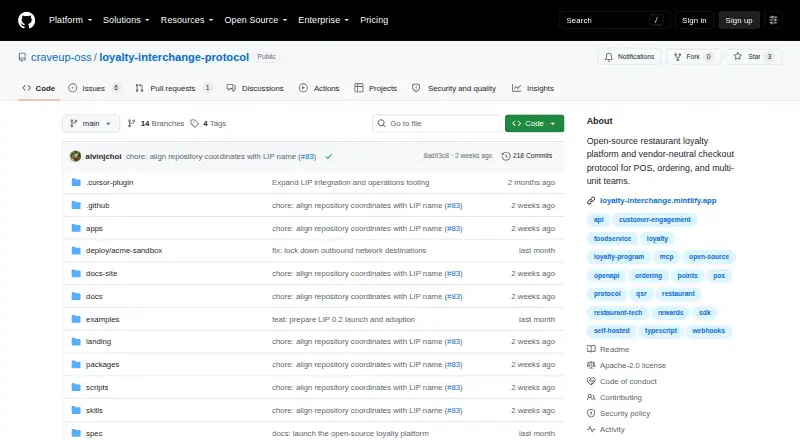
What Loyalty Interchange Protocol is
Loyalty Interchange Protocol (LIP) is a free, open-source loyalty platform and transaction protocol for restaurant technology teams. It supports the checkout lifecycle from member lookup and enrollment through balances, order evaluation, rewards accrual and redemption, reversals, and refund-safe adjustments. Its restaurant order model covers items, modifiers, discounts, fees, taxes, tips, tenders, and totals across channels such as drive-thru, kiosk, web, mobile, pickup, delivery, and catering. Loyalty programs can use points, visits or stamps, wallet credit, paid membership, or hybrid multi-account models. The `/platform/v1` API adds customer profiles, consent, behavioral events, segments, campaigns, connectors, imports, analytics, and attribution. The repository describes a Square Orders adapter with webhook signature verification. LIP is self-hosted under an Apache-2.0 reference stack, with Docker or Node.js 22 and newer deployment options. It has SQLite-backed local storage and tenant-scoped PostgreSQL for multi-instance use. Customer sign-in is external, and CSV member imports are limited to 1 MiB and 1,000 rows. The project is pre-1.0 infrastructure, not a turnkey no-code marketing service.
Good
- Covers enrollment, balances, accrual, redemption, reversals, and adjustments.
- Supports points, stamps, wallet credit, and paid membership.
- Order model spans restaurant channels and order details.
- Includes profiles, campaigns, connectors, analytics, and attribution.
- Free, Apache-2.0 reference stack can be self-hosted.
Watch out
- Pre-1.0 infrastructure; production SLOs are not established.
- Customer sign-in must be handled externally.
- CSV imports cap at 1 MiB and 1,000 rows.
- Requires an integration team; not a turnkey no-code service.
Who it suits
LIP suits POS and ordering products, restaurant integrators, and multi-unit technical teams able to own the integration and deployment work. It is not positioned as a no-code service for restaurants without an integration team.
Verdict
LIP provides a broad loyalty and transaction foundation for restaurant teams that can manage integrations and self-hosting. Its pre-1.0 status and external identity requirement are important considerations.
Plans and prices
From Loyalty Interchange Protocol's own pricing page, checked 8 Oct 2026.
| Plan | Price | What it gives you |
|---|---|---|
| Loyalty Interchange Protocol | Free | Apache-2.0 open-source stack; self-hosted |
The facts
Each one read from Loyalty Interchange Protocol's own pages, with the date it was checked.
What it does
- Checkout lifecycle
- It supports member lookup and enrollment, balances and ledger history, order evaluation, accrual, redemption, reversal, and refund-safe adjustments.checked 8 Oct 2026
- Deployment
- The maker documents self-hosting with Docker Compose or Node.js 22 and newer with npm.checked 8 Oct 2026
- Engagement
- The platform API supports customer profiles, marketing consent, behavioral events, imports, segments, campaigns, connectors, and attribution analytics.checked 8 Oct 2026
- Engagement tools
- The `/platform/v1` API covers customer profiles, consent, behavioral events, segments, campaigns, connectors, imports, analytics, and attribution.checked 8 Oct 2026
- Guest wallet
- The reference guest wallet is a responsive BFF using OIDC Authorization Code with PKCE, with access tokens and merchant credentials kept server-side.checked 8 Oct 2026
- Identity
- Customer sign-in remains external; a BFF validates OIDC and maps the identity to an opaque LIP member ID.checked 8 Oct 2026
- Integration
- The repository describes a typed Square Orders adapter with webhook signature verification and synthetic certification fixtures.checked 8 Oct 2026
- Intended users
- The maker describes the product for POS and ordering platforms, restaurant integrators, and multi-unit technical teams.checked 8 Oct 2026
- Limits
- Platform API CSV member imports are limited to 1 MiB and 1,000 rows.checked 8 Oct 2026
- Loyalty lifecycle
- It supports member lookup and enrollment, balances and ledger history, order evaluation, accrual, redemption, reversal, and refund-safe adjustments.checked 8 Oct 2026
- Maturity
- The maker describes LIP 0.2.0 as pre-1.0 infrastructure and says repository tests and fixtures do not establish independent adoption or production SLO attainment.checked 8 Oct 2026
- Maturity limit
- The README says LIP is not yet a turnkey no-code marketing service for restaurants without an integration team.checked 8 Oct 2026
- Order model
- Its foodservice order model includes items, modifiers, discounts, fees, taxes, tips, tenders, totals, and rules for restaurant ordering channels.checked 8 Oct 2026
- Product
- LIP is an open-source loyalty platform and vendor-neutral transaction protocol for restaurant technology teams.checked 8 Oct 2026
- Program types
- Supported program models include points, visits or stamps, wallet credit, paid membership, and hybrid multi-account programs.checked 8 Oct 2026
- Purpose
- LIP is an open-source loyalty platform and vendor-neutral transaction protocol for restaurant technology teams.checked 8 Oct 2026
- Restaurant orders
- Its foodservice order model covers items, modifiers, discounts, fees, taxes, tips, tenders, and totals across channels including drive-thru, kiosk, web, mobile, pickup, delivery, and catering.checked 8 Oct 2026
- Security
- The security policy says implementations must use TLS, authenticate non-health endpoints, avoid direct customer identifiers in logs or idempotency keys, and encrypt sensitive identity claims at rest.checked 8 Oct 2026
- Security requirements
- The security policy says implementations must use TLS, authenticate non-health endpoints, avoid direct customer identifiers in logs or idempotency keys, and encrypt sensitive identity claims at rest.checked 8 Oct 2026
- Self-hosting
- The maker offers an Apache-2.0 reference stack that can be started with Docker or Node.js 22 and newer.checked 8 Oct 2026
- Storage
- The repository describes SQLite-backed local storage and normalized, tenant-scoped PostgreSQL storage for multi-instance use.checked 8 Oct 2026
- Support
- The repository directs users to its support guidance and asks security vulnerability reports to be sent privately to maintainers.checked 8 Oct 2026
The full review of Loyalty Interchange Protocol
Loyalty Interchange Protocol (LIP) is an open-source loyalty platform and transaction protocol for restaurant technology teams. It suits teams that can own POS and ordering integrations and self-host the software; restaurants seeking a turnkey marketing service should look elsewhere.
Overview
LIP covers the loyalty transaction lifecycle, from member lookup and enrollment through earning, redemption, reversals, and refund adjustments. Its vendor-neutral approach and restaurant-specific order model make it a foundation for teams building loyalty into their own systems, rather than a ready-made campaign tool for nontechnical operators.
The order model accounts for items, modifiers, discounts, fees, taxes, tips, tenders, and totals across drive-thru, kiosk, web, mobile, pickup, delivery, and catering. That breadth matters when a restaurant needs loyalty calculations to follow orders across channels, though the integration work remains with the team adopting it.
Key features
Programs can use points, visits or stamps, wallet credit, paid membership, or hybrid multi-account structures. The checkout lifecycle includes balances and ledger history alongside accrual, redemption, reversal, and refund-safe adjustments, supporting more than a simple points balance.
The /platform/v1 API also covers customer profiles, consent, behavioral events, segments, campaigns, connectors, imports, analytics, and attribution. A typed Square Orders adapter includes webhook signature verification and synthetic certification fixtures. These capabilities give integrators useful building blocks, but they do not turn LIP into a no-code marketing product.
The reference guest wallet uses OIDC Authorization Code with PKCE and keeps access tokens and merchant credentials server-side. Customer sign-in itself is external: a backend-for-frontend validates OIDC and maps identities to opaque LIP member IDs. Implementations must use TLS, authenticate non-health endpoints, avoid direct customer identifiers in logs or idempotency keys, and encrypt sensitive identity claims at rest. Teams should treat these as implementation requirements, not security work done on their behalf.
The Apache-2.0 reference stack can run with Docker Compose or Node.js 22 and newer. Storage options include SQLite for local use and normalized, tenant-scoped PostgreSQL for multi-instance deployments. CSV member imports through the platform API are capped at 1 MiB and 1,000 rows.
Pricing
Loyalty Interchange Protocol: free. The free plan is the Apache-2.0 open-source stack, self-hosted, and includes tiered rewards, lifecycle automation, a customer portal, and API access. It avoids a software subscription, but the team must provide the integration work and operate its own deployment. The import limit of 1,000 rows and 1 MiB is relevant for larger migrations.
Platforms
LIP is available as an API, for Linux, as self-hosted software, and on the web. Its documented Docker and Node.js deployment paths suit technical teams that want control over the runtime; it is not positioned as a plug-and-play hosted service.
Who it's for
LIP is aimed at POS and ordering products, restaurant integrators, and multi-unit technical teams that can own identity, deployment, and system integration. Its pre-1.0 status—LIP 0.2.0—and the maker’s warning that repository tests and fixtures do not establish independent adoption or production SLO attainment make it a cautious choice for teams needing proven production reliability. It is a poor fit for restaurants without an integration team seeking turnkey marketing automation.
Pros and cons
- Pros: The restaurant-focused order model spans major ordering channels and accounts for transaction details that can affect loyalty outcomes.
- Pros: Multiple program types and a broad engagement API let integrators shape loyalty around their own products.
- Pros: The Apache-2.0 self-hosted stack and SQLite/PostgreSQL options give technical teams deployment choices without a software subscription.
- Cons: Customer authentication is external, and teams must implement the stated security controls and identity mapping.
- Cons: It is pre-1.0 infrastructure, not a turnkey restaurant marketing service, and production reliability is not established by its tests and fixtures.
- Cons: CSV imports stop at 1,000 rows and 1 MiB per import.
Alternatives
For an open-source, self-hosted restaurant loyalty foundation, LIP is the specialized option. Consider meed instead if a freemium product across Android, iOS, and web with a free allowance of up to 50 members better suits your needs. LoyaltyLion offers a free plan for stores processing 400 orders or fewer per month and a free trial, making it an option for web/API stores assessing a freemium service.
Smile.io may suit web/API users who want a free plan capped at 200 monthly orders with points, referrals, and discounts or free-shipping rewards. Yotpo Loyalty is another freemium web/API option, with a free basic points campaign and referrals. For a web-based product centered on Facebook Pages and subscriber limits, compare ChatWhale; its Everything You Need plan is $29 a month for up to 500 subscribers and three Facebook Pages.
Oracle Retail Xstore Point-of-Service is a paid alternative spanning Android, iOS, Linux, self-hosted, web, and Windows. Comarch Accounts Payable Automation is a paid Android, API, iOS, and web option with custom pricing. Como is another paid option across Android, API, iOS, and web.
For category browsing, see Loyalty Program Software and Restaurant Loyalty Software.
Verdict
Choose LIP if your restaurant technology team wants an open-source foundation for cross-channel loyalty and can own identity, integrations, and self-hosting. Its transaction model and program flexibility are the main reasons to choose it; its pre-1.0 maturity and lack of turnkey operation are the reasons to look elsewhere when reliability evidence or a ready-to-run marketing service matters more.
Getting started
- Open the project website on GitHub.
- Choose self-hosting with the Apache-2.0 reference stack.
- Start the stack with Docker Compose or Node.js 22 and newer with npm.
- Configure external customer sign-in through an OIDC-validating BFF that maps identities to LIP member IDs.
- Choose SQLite for local storage or tenant-scoped PostgreSQL for multi-instance use.
Limits worth knowing
The free Apache-2.0 stack is self-hosted. Platform API CSV member imports are limited to 1 MiB and 1,000 rows.
Questions
Is Loyalty Interchange Protocol free?
Yes. The listed plan is free, and the reference stack is Apache-2.0 open source and self-hosted.
Which platforms does LIP support?
It is listed for API, Linux, self-hosted, and web.
Can customers sign in directly through LIP?
Customer sign-in remains external. A BFF validates OIDC and maps the identity to an opaque LIP member ID.
What does LIP integrate with?
The repository describes a typed Square Orders adapter with webhook signature verification and synthetic certification fixtures.
What storage options are described?
The repository describes SQLite-backed local storage and normalized, tenant-scoped PostgreSQL storage for multi-instance use.
Alternatives to Loyalty Interchange Protocol
- 1

LoyaltyLion
Free planAndroidiOSWebAPI8.1From $199 a month - 2

meed
Free planAndroidiOSWebmacOS8.1From $590 a year - 3

bLoyal
AndroidiOSWebAPI7.5From $16 a month - 4

Loopy Loyalty
AndroidiOSWebAPI7.5From $250 a year - 5

Yotpo Loyalty
Free planWebAPI7.5From $199 a month - 6
Annex Cloud Loyalty Experience Platform
AndroidiOSWebAPI7.3From $15,000 a year