Locust
Locust is a free, open-source tool for performance and load testing HTTP services and other protocols.
What Locust is
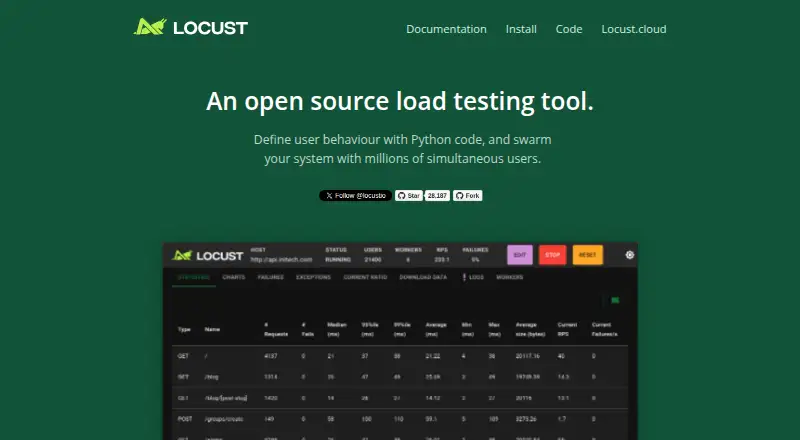
Locust is a free, open-source tool for performance and load testing HTTP services and other protocols. Test scenarios are written in Python, so you can use regular Python libraries in them. Run a test from the command line or web interface, where throughput, response times, errors, and progress appear in real time. The interface also lets you adjust load while a test is running, and results can be exported for later analysis. Locust can distribute tests across multiple machines and says it can support hundreds of thousands of concurrent users. You can extend it to cover other systems and protocols by adding a client; its documentation also lists community extensions for protocols and reporting. Optional OpenTelemetry support exports traces, metrics, and logs to compatible backends such as OTLP, Prometheus, Jaeger, and Tempo. Automatic instrumentation currently covers the requests library. Installation is documented with pip install locust, with uvx as an alternative. Locust uses the MIT license and is available through command-line and web interfaces.
Good
- Free and MIT-licensed
- Write scenarios in regular Python
- Adjust load during a running test
- Distribute tests across multiple machines
- Export OpenTelemetry data to compatible backends
Watch out
- Automatic instrumentation currently covers requests only
- Other protocols require adding a client
Who it suits
Locust suits teams that want to write load-test scenarios in Python and monitor results while tests run. Its distributed execution and protocol extensions may suit testing across multiple machines or systems.
Verdict
Locust combines Python-authored scenarios with live results and distributed execution. Check whether its requests-only automatic instrumentation covers your needs before relying on telemetry without additional setup.
Plans and prices
From Locust's own pricing page, checked 30 Sep 2026.
| Plan | Price | What it gives you |
|---|---|---|
| Locust | Free | Open source · MIT license |
The facts
Each one read from Locust's own pages, with the date it was checked.
What it does
- Execution and reporting
- Tests run from the command line or web interface, which displays throughput, response times, and errors in real time; results can also be exported for later analysis.checked 30 Sep 2026
- Hosted option
- Locust documentation describes hosted load testing through Azure Load Testing, with built-in reporting, Azure Application Insights integration, and CI/CD support for Azure DevOps and GitHub Actions.checked 30 Sep 2026
- Installation
- The documented installation method is pip install locust, with uvx also offered as an alternative.checked 30 Sep 2026
- Integrations
- Optional OpenTelemetry support exports traces, metrics, and logs to compatible backends, including OTLP, Prometheus, Jaeger, and Tempo.checked 30 Sep 2026
- License
- Locust is licensed under the MIT license.checked 30 Sep 2026
- Load adjustment
- The web interface shows test progress in real time and allows load to be changed while a test is running.checked 30 Sep 2026
- OpenTelemetry limit
- Automatic instrumentation currently covers the requests library, so HttpUser requests generate spans and metrics without additional configuration.checked 30 Sep 2026
- Protocol extensibility
- Locust can test other systems and protocols by adding a client, and its documentation lists community extensions for protocols and reporting.checked 30 Sep 2026
- Purpose
- Locust is an open-source performance and load testing tool for HTTP and other protocols.checked 30 Sep 2026
- Scale
- Locust supports distributed tests across multiple machines and says it can support hundreds of thousands of concurrent users.checked 30 Sep 2026
- Support
- The project README directs support questions to Stack Overflow and discussion to Discord, while locust.io says Locust.cloud provides dedicated commercial support.checked 30 Sep 2026
- Test authoring
- Users define test scenarios in regular Python code and can use regular Python libraries in their tests.checked 30 Sep 2026
The full review of Locust
Locust is a free, open-source load and performance testing tool built around Python-authored scenarios. It best suits engineering teams that want programmable tests, distributed execution, and a live control panel; teams seeking no-code authoring or broad automatic telemetry should look elsewhere.
Overview
Locust targets HTTP services and other protocols, with scenarios written as ordinary Python code. You can use standard Python libraries inside a test, making complex behavior easier to express for developers already working in that ecosystem. The trade-off is clear: teams that do not want to write code will find the approach less approachable than interface-first test builders.
The project is released under the MIT license and its core plan costs nothing, so licensing does not constrain adoption. Installation is documented through pip install locust, with uvx as an alternative. Support questions are directed to Stack Overflow, community discussion to Discord, and Locust.cloud provides dedicated commercial support.
Key features
Runs can start from the command line or web interface. The web view reports throughput, response times, and errors as they happen, then lets you change the load while the test continues. That is valuable when an observed bottleneck calls for a higher or lower arrival rate immediately, rather than waiting for a new run. Exportable results support analysis after the live session.
Locust distributes tests across multiple machines and says it can support hundreds of thousands of concurrent users. This makes it suitable for large performance and stress exercises, provided you can provision and coordinate the machines required for distributed execution. It also supports browser-based and API testing.
HTTP is not the boundary of the tool. Adding a client enables testing of other systems and protocols, while community extensions cover additional protocols and reporting. This extensibility rewards teams willing to maintain code, but it also places more implementation responsibility on them than a narrowly packaged protocol tool would.
Optional OpenTelemetry integration can export traces, metrics, and logs to compatible backends including OTLP, Prometheus, Jaeger, and Tempo. Automatic instrumentation currently covers the requests library: HttpUser requests produce spans and metrics without extra configuration. Other client paths need additional setup, so teams expecting comprehensive telemetry by default should plan integration work.
For hosted execution, the documentation describes Azure Load Testing with built-in reporting, Azure Application Insights integration, and CI/CD support for Azure DevOps and GitHub Actions. That option is relevant to Azure-centered delivery pipelines; self-managed Locust remains the straightforward choice when you want control over deployment.
Pricing
Locust — free. The plan is open source under the MIT license and includes the core load-testing tool. There are no seat, usage, or trial terms attached to this free plan in the published offer. Its cost advantage is strongest for teams able to run and operate their own infrastructure; hosted Azure execution and dedicated commercial support are separate service choices rather than a richer paid Locust license.
Platforms
Locust is available across API, Linux, macOS, self-hosted, web, and Windows environments. Its hybrid deployment model fits teams that want a local or self-managed controller while integrating web-based operation and hosted services where appropriate.
Who it's for
Choose Locust if your developers are comfortable with Python and need scenarios that can call regular Python libraries, adapt load during a run, and scale across multiple machines. It is particularly compelling for API and service teams planning repeatable performance or stress exercises without licensing costs.
Look elsewhere if test authors need a no-code workflow, if your protocol is not worth implementing a custom client, or if automatic OpenTelemetry coverage must extend beyond the requests library without engineering effort.
Pros and cons
Pros
- Python-based scenarios: ordinary code and Python libraries allow precise, reusable test behavior.
- Live control and reporting: throughput, latency, errors, and adjustable load make an ongoing run actionable.
- Distributed scale: multi-machine execution targets very large concurrency exercises.
- Open-source cost: the MIT-licensed core is free to deploy and modify.
- Extensible protocols: custom clients and community extensions broaden testing beyond HTTP.
Cons
- Code is required: teams without Python capability face a steeper authoring path.
- Distributed operations are yours: large tests require multiple machines and their associated coordination.
- Telemetry is limited automatically: requests-library instrumentation does not cover every client or protocol.
- Support is split: community channels are standard, while dedicated help comes through Locust.cloud.
Alternatives
Artillery is the better fit when a freemium product with a paid Team tier is preferable; that tier costs $199 a month and includes 1,000 reports, six months of data retention, eight team members, and up to 25 workers per distributed test.
Speedscale suits teams focused on local traffic mocking, with a free plan offering unlimited local mocking, basic traffic recording, community support, and a desktop CLI.
Taurus is a free, Apache 2.0 open-source alternative for teams wanting a different toolchain.
Tricentis Testim is preferable for mobile and web testing with a free allowance of up to 1,000 runs per month and customized paid plans.
Fortio is a free open-source option for a simpler project centered on its source repository and releases.
Vegeta is a free open-source HTTP load-testing tool and Go library.
Apache JMeter is a free open-source alternative when a Java 8 or newer environment is acceptable.
HammerDB is the better match for database benchmarking, with free GPL software, Windows and Linux builds, and a Docker image.
Verdict
Locust is an excellent choice for Python-capable teams that want free, programmable, distributed load testing with live operational feedback. Choose it for control and scale; choose another tool when no-code authoring or broader automatic telemetry matters more than Python flexibility.
Alternatives to Locust
- 1
Keysight Eggplant Test
AndroidiOSWebAPI7.9$9,999 one-time - 2
Loadster Synthetic Monitoring
Free planWebAPIExtensionLinux7.8From $29 a month - 3
Avidemux
Free planOpen sourceWebLinuxmacOSWindows7.3Free plan - 4
LoadFocus
Free planWebAPIExtension7.3Free plan - 5
LoadView
Free planWebAPISelf-hosted7.3From $199 a month - 6

Artillery
Free planWebAPILinuxmacOS7.1From $199 a month