
Artillery
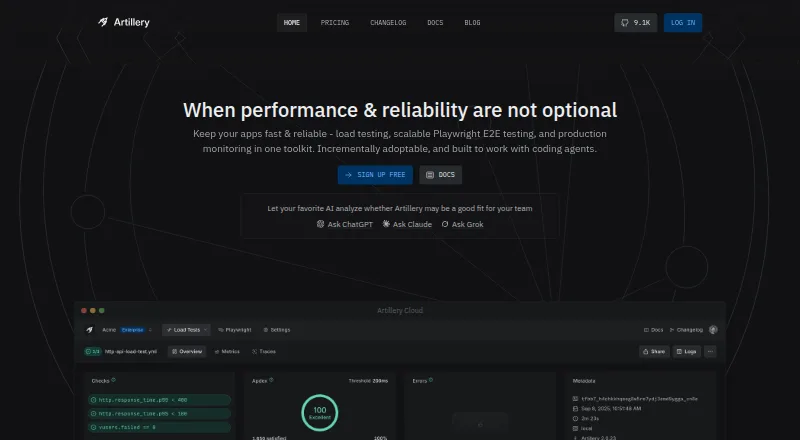
Artillery combines load testing, scalable Playwright end-to-end testing, and production monitoring in one toolkit.
What Artillery is
Artillery combines load testing, scalable Playwright end-to-end testing, and production monitoring in one toolkit. It supports load, stress, and soak tests, including distributed testing across AWS Lambda, AWS Fargate, and Azure Container Instances. HTTP, WebSocket, and Socket.IO are built-in protocols; additional protocols are available through plugins. Playwright scripts can run as load tests or synthetic checks, and the homepage describes a Turbo runner beta for sharding and parallelizing large Playwright suites. Listed integrations include Datadog, OpenTelemetry, New Relic, Splunk, Honeycomb, AWS CloudWatch, GitHub Actions, GitLab CI/CD, Jenkins, CircleCI, and Azure DevOps. Artillery says its typical users include application developers, test and QA engineers, and operations or SRE teams responsible for production backend systems. Cloud reporting is optional for each test run, and tests run in the user's own environment even when reports go to Artillery Cloud. The Free plan lists 30 reports per month. The Team plan is $199 a month and includes 1,000 reports per month. Continued overages may degrade service or lead to read-only mode.
Good
- Supports load, stress, and soak testing.
- Distributed runs can use AWS Lambda, Fargate, or Azure Container Instances.
- Playwright scripts can run as load tests or synthetic checks.
- Cloud reporting is opt-in per test run.
Watch out
- Free plan is limited to 30 reports per month.
- Team plan costs $199 a month.
- Continued overages may degrade service or trigger read-only mode.
- Team tests are limited to 25 workers per distributed test.
Who it suits
Artillery suits developers, test and QA engineers, and operations or SRE teams working on production backend systems. It is relevant for teams needing load tests, Playwright checks, or distributed test runs.
Verdict
Artillery combines performance testing with Playwright checks and production monitoring, with a Free plan and paid tiers that specify report and test limits. Review the overage terms and plan caps if your workload may exceed them.
Plans and prices
From Artillery's own pricing page, checked 29 Sep 2026.
| Plan | Price | What it gives you |
|---|---|---|
| Team | $199 a month | 1000 reports/month · 6 months data retention · 8 team members · up to 25 workers per distributed test · tests up to 2 hours · 50 E2E test cases per report |
| Business | $499 a month | 2500 reports/month · 18 months data retention · no team member limit · no worker limit · no test duration limit · no E2E test case limit |
| Enterprise add-ons | $1,199 a month | Enterprise SSO (OIDC & SAML) · audit logs · custom MSA · support SLAs · Starting at $1199/month |
| Free | — | 30 reports/month · 1 month data retention · 2 team members · up to 5 workers per distributed test · tests up to 30 minutes · 25 E2E test cases per report |
The facts
Each one read from Artillery's own pages, with the date it was checked.
Where it runs
- Browser testing
- Artillery can run Playwright scripts as load tests or synthetic checks, and its homepage describes a Turbo runner beta for sharding and parallelizing large Playwright suites.checked 29 Sep 2026
What it does
- Cloud reporting
- Cloud reporting is opt-in per test run, and load tests run within the user's own environment even when reports are sent to Artillery Cloud.checked 29 Sep 2026
- Data residency
- The security overview states that Artillery Cloud customer data resides in AWS eu-west-1 and is not transferred to another region or third-party services.checked 29 Sep 2026
- Integrations
- Listed integrations include Datadog, OpenTelemetry, New Relic, Splunk, Honeycomb, AWS CloudWatch, GitHub Actions, GitLab CI/CD, Jenkins, CircleCI, and Azure DevOps.checked 29 Sep 2026
- Limits
- The pricing page says continued overages may degrade service and can place an account in read-only mode.checked 29 Sep 2026
- Load testing
- It supports load, stress, and soak testing, including distributed testing across AWS Lambda, AWS Fargate, and Azure Container Instances.checked 29 Sep 2026
- Product
- Artillery combines load testing, scalable Playwright end-to-end testing, and production monitoring in one toolkit.checked 29 Sep 2026
- Protocols
- Built-in protocol support includes HTTP, WebSocket, and Socket.IO, with other protocols available through plugins.checked 29 Sep 2026
- Security
- Artillery Cloud reports that it uses third-party penetration tests, MFA and SSO, audit logging, least-privilege access controls, and encryption at rest.checked 29 Sep 2026
- Security disclosure
- The security policy says reports sent to [email protected] are acknowledged within 24 hours and receive a more detailed response within two business days.checked 29 Sep 2026
- Self-hosted data
- For its self-hosted CLI, Artillery says its employees and contractors do not have access to test targets, test data, scripts, or test metadata.checked 29 Sep 2026
- Support
- The pricing page lists email support and Slack Connect, with Slack Connect available with an annual subscription.checked 29 Sep 2026
- Use cases
- Artillery says it is typically used by application developers, test and QA engineers, and operations or SRE teams responsible for production backend systems.checked 29 Sep 2026
The company
- Headquarters
- New York, New York, United Stateschecked 28 Sep 2026
The full review of Artillery
Overview
Artillery brings load testing, Playwright-based end-to-end testing, and production monitoring into one toolkit for backend systems. Its hybrid deployment model supports a self-hosted command-line workflow alongside Artillery Cloud reporting. Cloud reporting is optional for each test run, and load tests run in your own environment even when you send reports to Artillery Cloud.
Its performance testing covers load, stress, and soak scenarios, with distributed execution across AWS Lambda, AWS Fargate, and Azure Container Instances. HTTP, WebSocket, and Socket.IO are supported directly; plugins can add other protocols. Artillery also supports API testing. For more options in the category, browse Performance Testing Software.
Key features
Distributed load testing
Distributed tests can use workers across AWS Lambda, AWS Fargate, or Azure Container Instances. Worker capacity varies by plan: Free allows up to 5 workers per distributed test, Team up to 25, and Business has no worker limit. Tests can last up to 30 minutes on Free and two hours on Team; Business has no test-duration limit.
Artillery supports HTTP, WebSocket, and Socket.IO without requiring plugins. Additional protocols are available through plugins, giving teams a way to extend protocol coverage beyond the built-in options.
Playwright and browser checks
Playwright scripts can run as load tests or synthetic checks. That lets teams include browser flows in performance work as well as use them for synthetic monitoring. The homepage describes a Turbo runner beta for sharding and parallelizing large Playwright suites. E2E test cases per report are limited by plan: 25 on Free, 50 on Team, and unlimited on Business.
Integrations and monitoring
Listed integrations include Datadog, OpenTelemetry, New Relic, Splunk, Honeycomb, and AWS CloudWatch for monitoring and observability workflows. For delivery pipelines, Artillery lists GitHub Actions, GitLab CI/CD, Jenkins, CircleCI, and Azure DevOps.
Security and data handling
Artillery Cloud reports third-party penetration tests, MFA and SSO, audit logging, least-privilege access controls, and encryption at rest. Its security overview says Cloud customer data resides in AWS eu-west-1 and is not transferred to another region or third-party services.
For the self-hosted CLI, Artillery says its employees and contractors cannot access test targets, test data, scripts, or test metadata. Cloud reporting is opt-in for each run, and the test itself remains in the user's environment when reports are sent to Cloud. The security policy says reports sent to [email protected] are acknowledged within 24 hours, with a more detailed response within two business days.
Pricing
Artillery uses a freemium model with a free plan and a free trial. The listed paid plans start at $199 a month.
| Plan | Price | Included limits and features |
|---|---|---|
| Free | Price not listed | 30 reports/month, 1 month data retention, 2 team members, up to 5 workers per distributed test, tests up to 30 minutes, and 25 E2E test cases per report. |
| Team | $199 a month | 1000 reports/month, 6 months data retention, 8 team members, up to 25 workers per distributed test, tests up to 2 hours, and 50 E2E test cases per report. |
| Business | $499 a month | 2500 reports/month, 18 months data retention, no team member, worker, test duration, or E2E test case limits. |
| Enterprise add-ons | $1,199 a month | Enterprise SSO (OIDC & SAML), audit logs, custom MSA, and support SLAs. |
The pricing page lists email support and Slack Connect; Slack Connect is available with an annual subscription. It also warns that continued overages may degrade service and can put an account in read-only mode, so report volume and test requirements are worth matching to plan limits.
Platforms
Artillery lists support for API, Linux, macOS, self-hosted, web, and Windows. The combination of local execution and optional cloud reporting supports a hybrid setup, rather than requiring every load test to run in Artillery Cloud.
Who it's for
Artillery identifies application developers, test and QA engineers, and operations or SRE teams responsible for production backend systems as its typical users. It suits teams that need performance testing across APIs and protocols, want to include Playwright scenarios, or need to connect test activity with monitoring and CI/CD tools.
Pros and cons
Pros
- Combines load, stress, and soak testing with Playwright end-to-end testing and production monitoring.
- Supports distributed tests on AWS Lambda, AWS Fargate, and Azure Container Instances.
- Offers built-in HTTP, WebSocket, and Socket.IO support, with plugins for additional protocols.
- Cloud reporting is optional per run, while load tests run in the user's own environment.
- Free and paid plans have stated limits for reports, retention, team size, workers, test duration, and E2E cases.
Cons
- The Free plan is limited to 30 reports per month, 2 team members, up to 5 workers, and tests up to 30 minutes.
- Team and Free cap the number of E2E test cases per report; Business is the first plan listed without that limit.
- Continued overages may degrade service or result in read-only account access.
- The listed Artillery Cloud data residency is AWS eu-west-1, which may not suit organizations requiring another region.
Alternatives
Teams comparing load and performance testing tools can also consider Gatling, Taurus, BlazeMeter, Locust, Apache JMeter, LoadFocus, Grafana k6, and OctoPerf.
Verdict
Artillery's defining strength is its breadth: load, stress, and soak testing, distributed execution, Playwright scenarios, and production monitoring share one toolkit. Its protocol coverage and listed integrations make it relevant to teams working across backend services and established observability or CI/CD systems. The plan limits are important, especially for report volume, worker count, duration, and browser-test cases; organizations should also account for the stated eu-west-1 Cloud data residency and the consequences of sustained overages. For teams comfortable with those constraints and seeking both self-hosted execution and optional cloud reporting, Artillery offers a broad performance-testing setup.
Getting started
- Visit the Artillery website.
- Choose a listed platform or deployment model that suits your use.
- Start with the free plan or use the available free trial.
- Select a paid plan if you need higher limits than the free plan provides.
- Connect Artillery with listed observability or CI integrations as needed.
- Choose whether to send reports to Artillery Cloud for each test run.
Limits worth knowing
The free plan allows 30 reports per month, one month of retention, two team members, up to five workers per distributed test, tests up to 30 minutes, and 25 E2E test cases per report. Team at $199 a month allows 1,000 reports per month, six months of retention, eight team members, up to 25 workers, tests up to two hours, and 50 E2E test cases per report.
Questions
Does Artillery have a free plan?
Yes. The free plan includes 30 reports per month, one month of data retention, two team members, up to five workers per distributed test, and tests up to 30 minutes.
How much does Artillery cost?
The Team plan costs $199 a month.
Which protocols does it support?
HTTP, WebSocket, and Socket.IO are built in. Other protocols are available through plugins.
Which integrations are available?
Listed integrations include Datadog, OpenTelemetry, New Relic, Splunk, Honeycomb, AWS CloudWatch, GitHub Actions, GitLab CI/CD, Jenkins, CircleCI, and Azure DevOps.
Where do tests run when using Cloud reporting?
Load tests run within the user's own environment. Sending reports to Artillery Cloud is optional for each test run.
What are the limits of the Team plan?
Team includes 1,000 reports per month, six months of data retention, eight team members, up to 25 workers per distributed test, tests up to two hours, and 50 E2E test cases per report.
Alternatives to Artillery
- 1
Keysight Eggplant Test
AndroidiOSWebAPI7.9$9,999 one-time - 2
Loadster Synthetic Monitoring
Free planWebAPIExtensionLinux7.8From $29 a month - 3
Avidemux
Free planOpen sourceWebLinuxmacOSWindows7.3Free plan - 4
LoadFocus
Free planWebAPIExtension7.3Free plan - 5
LoadView
Free planWebAPISelf-hosted7.3From $199 a month - 6

Gatling
WebAPILinuxmacOS6.8From €1,068 a year