LocationAPI
LocationAPI is a geolocation API for locating connected devices without GPS, using visible cell towers and WiFi networks.
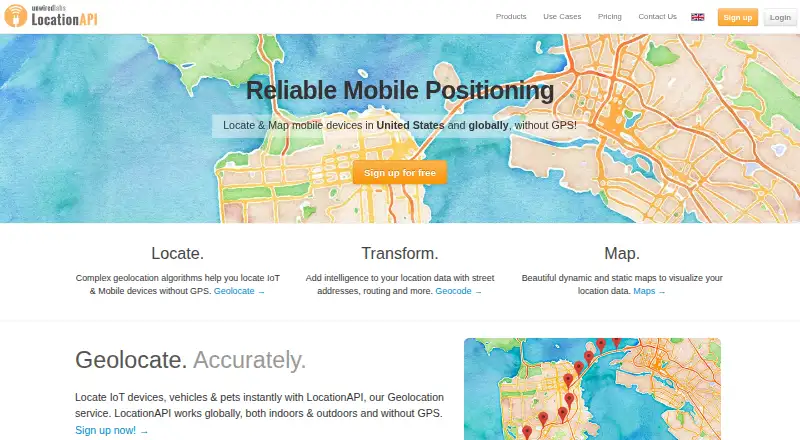
What LocationAPI is
LocationAPI is a geolocation API for locating connected devices without GPS, using visible cell towers and WiFi networks. Its data, datasets, and algorithms support location requests for IoT, M2M, and other connected devices around the world. Requests are sent as JSON POSTs to a regional endpoint, and the documentation includes cURL, PHP, Python, and JavaScript examples plus an interactive sandbox. Each request can include up to 7 cells and 15 WiFi objects. WiFi positioning is enabled for deployments that qualify based on region and intended use. Accuracy depends on the source and location: the FAQ gives approximate cell-based results of 450 metres in urban areas and 1500 metres in rural areas, compared with 25–50 metres and 50–150 metres respectively for WiFi. The free Developer plan has daily and monthly request limits and is marked “no commerical use.” Business offers usage options based on project needs, with listed pricing of $0.10 per contact. Documentation recommends scoped access tokens, stored server-side and rotated regularly. Geocoding, Timezone, Maps, and Static Maps are being phased out, with new integrations directed to LocationIQ.
Good
- Uses cell and WiFi data without GPS.
- Worldwide reach for IoT and M2M devices.
- Includes four code-language examples and a sandbox.
- Supports up to 7 cells and 15 WiFi objects.
Watch out
- Free Developer plan has daily and monthly request limits.
- Developer plan is marked “no commerical use.”
- Geocoding, Timezone, Maps, and Static Maps are being phased out.
Who it suits
LocationAPI suits developers and teams locating connected devices when GPS is not needed or available. Its free Developer plan excludes commercial use, while Business offers flexible usage options.
Verdict
LocationAPI provides a defined API workflow for estimating connected-device locations from cell and WiFi data. Check WiFi eligibility, plan limits, and the retirement of other products before choosing it.
Plans and prices
From LocationAPI's own pricing page, checked 8 Oct 2026.
| Plan | Price | What it gives you |
|---|---|---|
| Developer | Free | limited requests · no commercial use · email support |
| Business | Priced on request | scale to millions of requests · custom SLA & Contracts · as low as $0.10 /device |
The facts
Each one read from LocationAPI's own pages, with the date it was checked.
What it does
- Accuracy guidance
- The FAQ says typical accuracy varies by data source and location, with cell-based results around 450 metres in urban areas and 1500 metres in rural areas, and WiFi-based results around 25–50 metres in urban areas and 50–150 metres in rural areas.checked 8 Oct 2026
- API integration
- Requests to the Geolocation API are sent as JSON POST requests to a regional endpoint.checked 8 Oct 2026
- Code examples
- The documentation provides ready-made cURL, PHP, Python, and JavaScript examples and an interactive sandbox.checked 8 Oct 2026
- Commercial use
- The Developer plan is labeled “no commerical use.”checked 8 Oct 2026
- Global reach
- The Geolocation API is described as locating IoT, M2M, and other connected devices anywhere in the world.checked 8 Oct 2026
- Location sources
- The Geolocation API uses cellular and WiFi data, datasets, and algorithms to calculate device locations.checked 8 Oct 2026
- Pricing limits
- Free Developer Plans have daily and monthly request limits; Business Plans offer flexible usage options based on project needs.checked 8 Oct 2026
- Purpose
- LocationAPI locates connected devices from visible cell towers and WiFi networks without needing GPS.checked 8 Oct 2026
- Request limits
- A request can include up to 7 cells and 15 WiFi objects.checked 8 Oct 2026
- Security
- The documentation recommends scoped access tokens, keeping tokens server-side, and rotating them regularly.checked 8 Oct 2026
- Sunsetting products
- Geocoding, Timezone, Maps, and Static Maps are being phased out on this platform, and new integrations are directed to LocationIQ.checked 8 Oct 2026
- Support
- The FAQ says the company aims to reply to every query within one business day and offers dedicated support plans for enterprise customers.checked 8 Oct 2026
- WiFi eligibility
- WiFi positioning is enabled for eligible deployments based on region and intended use.checked 8 Oct 2026
The company
- Headquarters
- The contact page lists an address in Jubilee Hills, Hyderabad, Telangana, India.checked 8 Oct 2026
The full review of LocationAPI
Overview
LocationAPI estimates connected-device positions from cell towers and WiFi, making it a focused option for developers working on IoT or M2M services where GPS is unavailable. Its JSON API and practical code examples are useful; commercial use requires a paid plan, and WiFi positioning is conditional.
Requests go to a regional endpoint as JSON POSTs and can include up to seven cells and 15 WiFi objects. The service combines cellular and WiFi data with datasets and algorithms, and is described as reaching connected devices worldwide. Coverage does not guarantee consistent precision: typical cell-based estimates are around 450 metres in urban areas and 1,500 metres in rural areas. WiFi estimates are around 25–50 metres in urban areas and 50–150 metres in rural areas. That makes WiFi eligibility a key consideration for deployments that need more precise results.
Key features
The documentation offers ready-made cURL, PHP, Python, and JavaScript examples, plus an interactive sandbox. Those resources help teams working in the supported languages get started, while the request cap gives integrations a clear input boundary. LocationAPI remains a location lookup API; it does not provide drive-time analysis, territory planning, or demographic data.
WiFi positioning is available only to deployments eligible by region and intended use. Teams should establish eligibility before depending on WiFi’s tighter typical accuracy. The documentation also recommends scoped access tokens, keeping tokens on the server, and rotating them regularly, sensible practices for an API that can return device locations.
The platform is phasing out Geocoding, Timezone, Maps, and Static Maps, with new integrations for those products directed to LocationIQ. That limits its appeal to teams seeking a broader set of location services from the same platform.
Pricing
The Developer plan is free and includes limited requests and email support, but prohibits commercial use. Daily and monthly request limits make it suited to evaluation or non-commercial development, not a production commercial service.
The Business plan is $0.10 per contact, billed as low as $0.10 /device. It supports usage scaling to millions of requests and includes custom SLAs and contracts, making it the relevant option for commercial projects that need negotiated terms. The price basis is per contact or device, so teams should match that unit to their deployment when estimating cost. A free plan and free trial are offered; the stated request limits apply to Free Developer Plans.
Platforms
LocationAPI supports Android, API, and web. Its central offering is the API, so the platform labels are most useful to teams integrating location estimates into an application or service.
Who it's for
LocationAPI is best for developers who need to estimate connected-device locations from cellular or WiFi signals without GPS, particularly in IoT and M2M projects. The free Developer plan can suit non-commercial evaluation within its request caps. Commercial teams should consider Business and confirm WiFi eligibility, expected accuracy, and per-device pricing before committing. It is a poor fit for users who need mapping products that are being phased out, drive-time tools, territory planning, or demographic data.
Pros and cons
- Pros: JSON POST requests, code examples in four languages, and an interactive sandbox provide a concrete path for API integration.
- Pros: Cellular positioning offers a GPS-free option, and WiFi estimates have tighter typical ranges where the deployment qualifies.
- Cons: The free Developer plan bars commercial use and carries daily and monthly request limits.
- Cons: WiFi positioning depends on region and intended use, and cell-based estimates can be much less precise than WiFi estimates.
- Cons: Geocoding, Timezone, Maps, and Static Maps are being phased out on this platform.
Alternatives
For a comparison of category options, see Location Intelligence Software.
Choose Crowd Connected when a free forever plan with one floorplan, unlimited area, and unlimited MAUs better matches a venue or audience mapping need. Consider Sitewise Analytics for its free Market Grid plan with 70 curated geospatial variables and eight preset trade-area options, which requires a Sitewise account. Mapbox Studio is another free entry point for Mapbox users, though related API and custom tileset usage may be billed separately.
Foursquare, Locus, Mapline, Maptive, and NIQ are also alternatives to compare.
Verdict
Choose LocationAPI if your project needs GPS-free location estimates for connected devices and can work within the API’s input limits and conditional WiFi access. Its strongest case is a focused integration path with useful code examples and a non-commercial free plan. Look elsewhere if you need commercial access without a paid plan, guaranteed WiFi eligibility, or the platform’s retiring mapping and geocoding products.
Getting started
- Open the LocationAPI website
- Choose the free Developer plan or Business plan
- Use the interactive sandbox or a documented code example
- Send a JSON POST request to a regional endpoint
- Include up to seven cells and 15 WiFi objects
- Keep access tokens server-side and rotate them regularly
Limits worth knowing
The free Developer plan has daily and monthly request limits and no commercial use. Business offers flexible usage based on project needs, with pricing listed at $0.10 per contact.
Questions
Does LocationAPI require GPS?
No. It estimates locations from visible cellular towers and WiFi networks.
What platforms are supported?
The listed platforms are Android, API, and web.
How many location sources can one request include?
A request can include up to seven cells and 15 WiFi objects.
Is there a free plan?
Yes. The Developer plan is free, with limited requests, no commercial use, and email support.
Which products are being phased out?
Geocoding, Timezone, Maps, and Static Maps are being phased out, and new integrations are directed to LocationIQ.
Alternatives to LocationAPI
- 1
Foursquare
Free planAndroidiOSWebAPI8.2From $25 a month - 2
Crowd Connected
Free planAndroidiOSWebAPI7.9Free plan - 3

Maptitude
AndroidiOSWebAPI7.8From $795 a year - 4
Mapbox Studio
Free planAndroidiOSWebAPI7.7Free plan - 5
Maptive
AndroidiOSWebAPI7.2From $110 a month - 6

eSpatial
AndroidiOSWebAPI7.1From $499 a year