LitigationDeadline
LitigationDeadline provides free, browser-based tools for counting litigation deadlines and business days.
What LitigationDeadline is
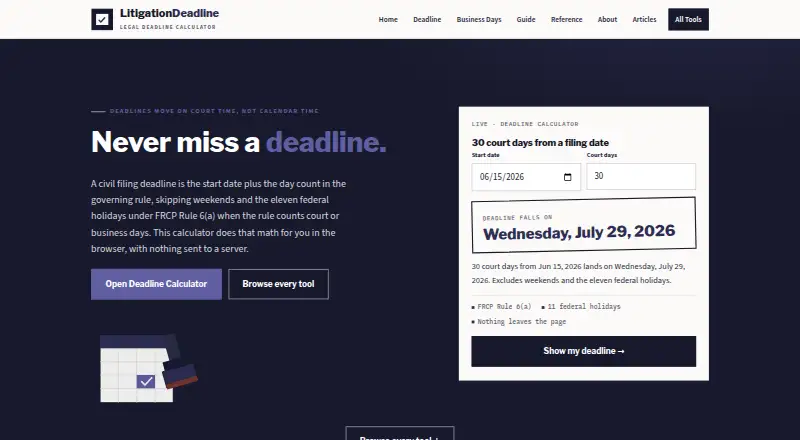
LitigationDeadline provides free, browser-based tools for counting litigation deadlines and business days. Its Deadline Calculator adds or subtracts calendar days or court days from a date. The Business Days Calculator counts inclusively between two dates and reports calendar days, weekends, and federal holidays separately. For court or business day counts, the calculators skip weekends and the eleven U.S. federal holidays. The site also offers a 2026 civil litigation deadline reference with FRCP and FRAP citations and a downloadable CSV, plus a Florida calculator covering nine listed deadlines, including answer, discovery, appeal, and proposal for settlement periods. Calculator dates, counts, and results run locally in JavaScript and are not sent to the site or third parties. The calculations do not account for additional state, county, or court-specific closures. The site describes its tools as reference material, not legal advice or a substitute for checking the governing rule. It is a web service, with no account or charge required.
Good
- Calculates calendar and court days.
- Counts business days inclusively between dates.
- Separates weekends and federal holidays in results.
- Includes a cited 2026 reference and downloadable CSV.
- Calculator results run locally in JavaScript.
Watch out
- Does not account for state, county, or court-specific closures.
- Not legal advice or a substitute for checking rules.
- Google Analytics collects visit data; the site serves display ads.
Who it suits
It suits people who need a reference tool for civil litigation date calculations, including users checking federal or listed Florida deadlines. Users should verify the governing rule and any local court closures independently.
Verdict
LitigationDeadline offers useful date-counting tools and reference material for civil litigation, with calculations processed locally. Its federal holiday defaults and reference-only status mean users need to check the rules and closures that apply to their matter.
Plans and prices
From LitigationDeadline's own pricing page, checked 15 Oct 2001.
| Plan | Price | What it gives you |
|---|---|---|
| LitigationDeadline calculators | Free | No account · Federal defaults only |
The facts
Each one read from LitigationDeadline's own pages, with the date it was checked.
What it does
- Advertising
- The privacy policy says Google AdSense displays ads and may set personalization cookies.checked 15 Oct 2001
- Analytics
- The privacy policy says Google Analytics collects page, approximate IP-location, browser and referrer data in aggregate.checked 15 Oct 2001
- API or SDK
- No public API, SDK or developer documentation is described on the reviewed official pages.checked 15 Oct 2001
- Business day calculator
- The Business Days Calculator counts business days between two dates, inclusively, and reports calendar days, weekend days, and federal holidays separately.checked 4 Oct 2001
- Business-day calculator
- The business-day tool counts inclusively between two dates and reports business, calendar, weekend and federal-holiday totals.checked 15 Oct 2001
- Contact processor
- The contact form uses Web3Forms to transmit submitted name, email and message details.checked 15 Oct 2001
- CSV export
- The 2026 reference page provides a downloadable CSV of its deadline table.checked 15 Oct 2001
- Data collection
- The site says Google Analytics collects visit data including pages viewed, approximate IP location, browser type, and referring site, while Google AdSense serves display ads.checked 4 Oct 2001
- Deadline calculator
- The main calculator adds or subtracts calendar or court days from a chosen date.checked 15 Oct 2001
- Editorial authorship
- Encore Editorial says every published piece carries a named author with an identifiable online presence.checked 15 Oct 2001
- Federal holiday handling
- Court and business-day calculations omit weekends and eleven U.S. federal holidays listed under FRCP Rule 6(a)(6).checked 15 Oct 2001
- Federal reference
- The 2026 reference table covers federal answer, discovery-response and appeal periods with FRCP and FRAP citations.checked 15 Oct 2001
- Florida answer period
- The Florida calculator lists 20 days for a private defendant to answer a complaint and 40 days for the state or its agencies, subject to stated exceptions.checked 15 Oct 2001
- Florida calculator
- A separate Florida tool models nine listed deadlines, including injury limitation, answer, discovery, appeal and settlement-proposal periods.checked 15 Oct 2001
- Florida coverage
- The Florida calculator covers nine listed Florida deadlines, including answer, discovery, appeal, and proposal for settlement periods.checked 4 Oct 2001
- Florida injury limit
- The Florida page states that negligence claims accruing from March 24, 2023 generally have a two-year limitation period.checked 15 Oct 2001
- Independent publisher profile
- Encore Editorial describes itself as a small independent editorial shop without a data-science team or lobbyist.checked 15 Oct 2001
- Integrations
- The privacy policy names Google Analytics, Google AdSense and Web3Forms as site services; it does not describe calendar or case-management integrations.checked 15 Oct 2001
- Intended users
- The site describes its tools as reference tools for counting civil litigation dates and says they are not legal advice or a substitute for checking the governing rule.checked 4 Oct 2001
- Licence
- The reviewed official pages do not state an open-source licence for the calculators or site code.checked 15 Oct 2001
- Limit: jurisdiction coverage
- The Florida tool covers nine selected deadlines rather than every Florida rule or claim-specific period.checked 15 Oct 2001
- Limit: legal advice
- The site states that its calculators and articles are informational references, not legal advice or case review.checked 15 Oct 2001
- Limit: local closures
- The calculators do not include additional state, county or court-specific closure days beyond their federal assumptions.checked 15 Oct 2001
- Limits
- The calculators use federal holidays and do not account for additional state, county, or court specific closures.checked 4 Oct 2001
The full review of LitigationDeadline
LitigationDeadline is a free, browser-based set of civil-litigation date calculators and deadline references. It suits legal professionals and staff who need a quick federal-default count or a focused Florida deadline reference without creating an account. Its tools are useful for routine checks, but local closures and governing rules still require attention.
Overview
Two calculators address common counting tasks: adding or subtracting calendar or court days from a date, and counting business days inclusively between two dates. For court or business-day counts, both skip weekends and the eleven U.S. federal holidays. That makes the defaults clear and practical, but it can produce a misleading date if a state, county, or court observes additional closures.
The site also offers a 2026 civil-litigation deadline reference with FRCP and FRAP citations and a downloadable CSV. Its Florida calculator covers nine deadlines, including answer, discovery, appeal, and proposal-for-settlement periods. Those focused references can help orient a reader, but the site describes them as reference tools, not legal advice or a substitute for checking the rule that governs a particular matter.
Key features
Deadline and business-day calculations
The Deadline Calculator handles additions and subtractions in either calendar days or court days. The separate Business Days Calculator counts inclusively between two dates and reports calendar days, weekend days, and federal holidays separately. The breakdown helps explain the count rather than presenting only an endpoint. Neither calculator accounts for extra state, county, or court-specific closures, so users must verify those independently before relying on a result for a filing or other deadline.
Deadline references and Florida coverage
The 2026 reference brings together civil-litigation deadlines with FRCP and FRAP citations, while the CSV download makes the reference usable outside the site. The Florida calculator is narrower, covering nine listed deadlines across areas such as answers, discovery, appeals, and proposals for settlement. These are useful complements to date arithmetic, but they are not a court-rule library and do not remove the need to confirm the applicable rule.
Privacy and responsibility
Calculator dates, day counts, and results run locally in JavaScript and are not sent to LitigationDeadline or third parties. That is a meaningful privacy advantage for the matter-specific inputs entered into the calculators. The site does use Google Analytics, which collects visit data including pages viewed, approximate IP location, browser type, and referring site; Google AdSense serves display ads. Its privacy policy also identifies Web3Forms among third-party services. The operator, Chris Terry through Encore Editorial, says the site is not a law firm, court-affiliated service, or bar-association service, and does not review individual cases. Users can submit corrections to rule citations, deadlines, or calculators through the contact form for review.
Pricing
LitigationDeadline calculators cost nothing, with no account required and no cost. The free offering includes both deadline calculation and statute-limitations support, but it uses federal defaults only. There is no free trial because the service is already free, and no paid tier is needed to use the calculators. The trade-off is scope: users who need a court-rule library or jurisdiction-specific closure handling should look elsewhere or verify those details separately.
Platforms
LitigationDeadline runs on the web. Its browser-based format avoids a separate desktop or mobile app, but the supported platform is web rather than a dedicated native application.
Who it's for
LitigationDeadline is a sensible choice for lawyers, legal assistants, and other readers who want no-cost date arithmetic, a federal-holiday-based business-day count, or a quick reference to selected federal and Florida civil deadlines. Its no-account access and local calculator processing suit occasional checks where users can verify the governing rules and local calendar themselves.
It is not the right standalone choice for matters where state, county, or court-specific closures determine the deadline, or for users who need a comprehensive court-rule library, case review, or legal advice. The site expressly leaves those responsibilities with the user.
Pros and cons
- Pro: Both calculators are free and require no account, removing signup and cost barriers for occasional deadline checks.
- Pro: The business-day result separates calendar days, weekends, and federal holidays, making the count easier to interpret.
- Pro: Calculator inputs and results stay local in JavaScript rather than being sent to the site or third parties.
- Con: Federal holidays are the only closure defaults; additional state, county, or court closures must be checked separately.
- Con: The Florida calculator covers nine listed deadlines, and the federal reference is specific to 2026, so this is focused reference material rather than broad rule coverage.
- Con: Google Analytics collects visit data and display ads are served through Google AdSense, despite calculator data remaining local.
Alternatives
For a broader comparison of this category, browse Legal Calendaring Software. Choose Dockets.ca if you need an option spanning Android, iOS, Linux, macOS, web, and Windows and are prepared for paid software. Deadline Engine is another web option: its free calculator includes citations and calculation steps without an account, while its Evidence Record is $19.99, paid once.
ClockOrbit Court Deadline Calculator is a free web alternative with no payment required to use any tool. JudgeCalc offers a free web calculator without signup or login and has a free trial; its Pro plan is per seat, billed monthly or yearly, with custom pricing. Pick Case Calendar if you want a free option across Linux, macOS, self-hosted, web, and Windows.
Court Deadline Calculator is a free web alternative for basic deadline calculations. Docket Enterprise is an on-premise paid option across Android, iOS, self-hosted, and Windows, with custom pricing and a demo by inquiry. CourtAlert Case Management is a paid choice for self-hosted, web, and Windows use, with pricing by inquiry; cloud service adds a hosting fee to the software license cost.
Verdict
Choose LitigationDeadline for free, no-account civil deadline arithmetic, particularly when federal-holiday defaults and its selected references fit the task and you can verify local rules. Its local calculation processing and transparent day breakdown are practical strengths. Look elsewhere if you need broader court-calendar coverage, a rule library, or a system that takes responsibility for the governing deadline.
Alternatives to LitigationDeadline
- 1
JudgeCalc
Free planWeb6.7Free plan - 2

ClockOrbit Court Deadline Calculator
Free planWeb6.6Free plan - 3

Deadline Engine
Free planWeb6.6From $25 a month - 4
Deadlines.com
iOSWebmacOSWindows6.6From $20 a month - 5
eLaw Case Tracking
iOSWebAPI6.5From $3.50 a month - 6

MatterAlert
Web6.4From $1,545 a month