Case Calendar
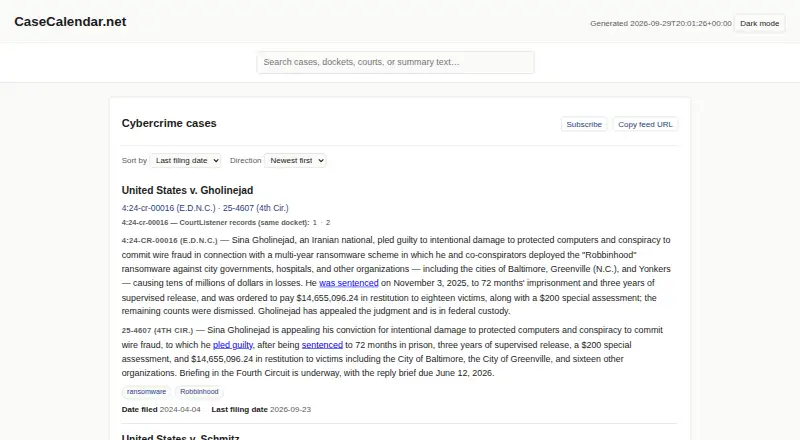
Case Calendar turns federal court docket information from CourtListener into per-case calendar feeds for hearings and filing deadlines.
What Case Calendar is
Case Calendar turns federal court docket information from CourtListener into per-case calendar feeds for hearings and filing deadlines. The feeds use ICS, so they can be subscribed to from calendar apps that support iCalendar; events retain the court’s local timezone through daylight-saving changes. The tool can optionally send events one way to Google Calendar or Microsoft 365 or Outlook after a one-time OAuth setup. It classifies filing deadlines, sending only major ones to subscriber calendars while keeping procedural filings in an audit trail. Optional AI summaries use primary documents and dispositions, link action phrases to court documents, and refresh when certain records or event statuses change. Case Calendar is a Python command-line tool installed from its public GitHub repository, and its static index can be hosted behind an HTTP server. It is open source under Apache-2.0 and supports Linux, macOS, and Windows via WSL2. Hosted AI use can incur API costs, and CourtListener quota limits apply; local Ollama models are also supported. The project warns that docket data may lag, date extraction may be wrong, and the tool is not a substitute for attorney calendaring software or the authoritative record.
Good
- Creates separate ICS feeds for each case.
- Preserves court-local time through daylight-saving changes.
- Can send events to Google Calendar or Microsoft 365.
- Local Ollama processing keeps docket text on the host.
- Open source under Apache-2.0.
Watch out
- CourtListener docket updates can be delayed.
- Date extraction can miss or misread dates.
- Hosted AI use may incur API costs.
- Not a replacement for attorney calendaring software.
Who it suits
It suits journalists, researchers, and others tracking public-interest cases who want docket events in calendar apps. Users handling consequential dates should verify them against the source docket.
Verdict
Case Calendar offers docket-based feeds, deadline filtering, and optional summaries for people following public-interest cases. Its own limitations make source-docket checks important when dates matter.
The facts
Each one read from Case Calendar's own pages, with the date it was checked.
What it does
- AI providers
- Installation supports hosted APIs from Anthropic, Google Gemini, or OpenAI, or local models through Ollama.checked 7 Oct 2001
- AI summaries
- Opt-in AI summaries use primary documents and dispositions, link action phrases to source court documents, and refresh when certain documents or event statuses change.checked 7 Oct 2001
- Calendar feeds
- It writes per-case ICS feeds that can be subscribed to from calendar apps supporting iCalendar.checked 7 Oct 2001
- Calendar integrations
- It can optionally push events to Google Calendar and Microsoft 365 or Outlook after a one-time OAuth setup.checked 7 Oct 2001
- Data limitations
- Updates depend on docket entries reaching CourtListener through PACER and RECAP, and unmonitored dockets may have delays of months or longer.checked 7 Oct 2001
- Deadline tracking
- It tracks filing deadlines and sends only those classified as major to subscriber calendars, while procedural filings remain in the audit trail.checked 7 Oct 2001
- Deployment
- Case Calendar is a Python command-line tool installed from its public GitHub repository, and its generated static index can be hosted behind an HTTP server.checked 7 Oct 2001
- Feeds
- It writes per-case calendars in standard ICS format for subscription from calendar apps that support iCalendar.checked 7 Oct 2001
- Intended users
- The project describes its intended users as journalists, researchers, and others tracking public-interest cases.checked 7 Oct 2001
- Legal-use limit
- The maker says Case Calendar is a convenience layer over public dockets, not a replacement for attorney calendaring software or the authoritative record.checked 7 Oct 2001
- License
- The public GitHub repository lists an Apache-2.0 license.checked 7 Oct 2001
- License and maintainer
- The public repository identifies the project as open source under the Apache-2.0 license and names seanthegeek as maintainer.checked 7 Oct 2001
- Limitations
- The documentation warns that CourtListener data can lag PACER filings and event extraction can miss or misread dates, and says the tool is not a replacement for attorney calendaring software.checked 7 Oct 2001
- Local processing
- The documentation says local Ollama models need no API key or per-token cost and keep docket text on the user's machine.checked 7 Oct 2001
- Purpose
- Case Calendar turns federal court dockets from CourtListener into calendar feeds of hearings and filing deadlines.checked 7 Oct 2001
- Reliability limits
- The documentation warns that extraction can miss or misread dates and says to check the source docket before relying on consequential dates.checked 7 Oct 2001
- Security and privacy
- With a local Ollama model, docket text and PDF contents stay on the host, according to the documentation.checked 7 Oct 2001
- Self-hosting
- Case Calendar is a Python CLI installed from its source repository and configured with docket information and API credentials.checked 7 Oct 2001
- Support
- The documentation directs users to report extraction, summarization, or other bugs through the project’s GitHub repository.checked 7 Oct 2001
- Timezone handling
- Calendar events preserve the court’s timezone so hearing times remain tied to local court time through daylight-saving changes.checked 7 Oct 2001
- Time zones
- Calendar events preserve court-local time zones, including across daylight saving time changes.checked 7 Oct 2001
- Updates
- A real-time webhook receiver can accept CourtListener updates and bypass the daily polling quota.checked 7 Oct 2001
Money
- Operating costs
- The documentation says use can incur LLM API costs and CourtListener API quota limits; local Ollama models are also supported without per-token API costs.checked 7 Oct 2001
The full review of Case Calendar
Overview
Case Calendar converts federal court docket activity from CourtListener into calendar feeds for hearings and filing deadlines. It is best suited to journalists, researchers, and public-interest case watchers who can run a Python command-line tool and maintain their own deployment. The main attraction is focused, docket-linked monitoring; the main caution is that neither CourtListener’s coverage nor automated date extraction is authoritative.
Key features
Each case receives its own standard ICS feed, which can be subscribed to in calendar applications supporting iCalendar. Subscriber calendars receive hearings and deadlines classified as major, while procedural filings stay in an audit trail. That keeps day-to-day calendars readable, but anyone needing a complete chronology must consult the audit trail and source docket rather than the calendar alone.
One-way synchronization can push events to Google Calendar and Microsoft 365 or Outlook after a one-time OAuth setup. Court-local time zones are preserved, including through daylight-saving changes, so a hearing remains anchored to the court’s local clock. A real-time CourtListener webhook can bypass the daily polling quota; otherwise, updates depend on polling and on entries reaching CourtListener through PACER and RECAP. Dockets that are not monitored upstream may be delayed by months or longer.
Opt-in AI summaries use primary documents and dispositions, connect action phrases to the underlying court documents, and refresh when qualifying documents or event statuses change. Installation supports hosted Anthropic, Google Gemini, and OpenAI APIs, or local Ollama models. Ollama avoids per-token API charges and keeps docket text and PDF contents on the host, a meaningful choice for privacy-conscious users. Hosted models introduce potential LLM costs, while all configurations remain subject to CourtListener API quotas.
Automated deadline calculation and popup or email reminders make the feeds useful as an awareness layer. They do not turn the application into legal calendaring: extraction can miss or misread dates, and the project explicitly says consequential dates should be checked against the source docket.
Pricing
Case Calendar is free and open source under the Apache-2.0 license. There are no paid tiers or seat charges. The practical cost is operational: hosted AI providers may bill for LLM usage, and CourtListener API limits can constrain polling. A local Ollama model removes per-token API costs but requires you to operate the model and host yourself. Because the software is a Python CLI installed from its public GitHub repository, setup and maintenance are part of the ownership burden rather than a paid support service.
Platforms
The tool supports Linux, macOS, and Windows through WSL2, with self-hosted and web deployment options. You configure docket information and API credentials in the command-line installation, then can place its generated static index behind an HTTP server. Calendar consumption depends on an iCalendar-compatible application, while direct pushes target Google Calendar and Microsoft 365 or Outlook.
Who it's for
Choose Case Calendar if you track public-interest federal cases across jurisdictions and want per-case feeds, major-deadline filtering, and optional document-grounded summaries without licensing fees. It fits technically comfortable individuals, newsroom researchers, and small projects able to run Python, manage credentials, and monitor updates. It is not the right primary system for attorneys or teams that require guaranteed, authoritative deadline management, turnkey administration, or complete docket freshness.
Pros and cons
- Pros: Free Apache-2.0 software avoids subscription and seat costs.
- Pros: Per-case ICS feeds work with ordinary calendar subscriptions and keep monitoring separated by matter.
- Pros: Major-deadline filtering reduces procedural noise while retaining those filings in an audit trail.
- Pros: Court-local time-zone handling remains correct across daylight-saving changes.
- Pros: Webhooks can bypass the daily polling quota, and Ollama keeps docket text and PDFs local.
- Cons: CourtListener can lag PACER filings, with unmonitored dockets sometimes delayed months or longer.
- Cons: Automated extraction may miss or misread dates, so consequential deadlines require source-docket verification.
- Cons: Command-line installation, API credentials, hosting, and model operations demand technical ownership.
- Cons: One-way calendar sync does not provide a reciprocal case-management workflow.
Alternatives
For a broader shortlist, see Legal Calendaring Software. Pick Dockets.ca instead if you want a paid service spanning Android, iOS, Linux, macOS, web, and Windows rather than self-hosting.
Deadline Engine suits readers who need citation-backed deadline calculations: its free calculator costs 0.00 USD and requires no account, while the one-off Evidence Record plan is 19.99 USD. ClockOrbit Court Deadline Calculator is a free web tool with no payment required for any tool.
JudgeCalc offers a no-login free calculator and a Pro plan billed per seat monthly or yearly at custom pricing. LitigationDeadline provides no-cost, no-account federal-default calculators. Court Deadline Calculator is another free web option for basic deadline calculations.
Organizations seeking managed deployments should consider Docket Enterprise, an on-premise application with pricing by inquiry, or CourtAlert Case Management, which offers cloud and on-premise deployment with pricing by inquiry and an additional cloud hosting fee.
Verdict
Case Calendar is a strong choice for technically capable journalists, researchers, and advocates who want free, case-specific calendar feeds from federal dockets, with useful filtering and optional private AI processing. Look elsewhere when a missed or stale date carries legal consequences, when you need authoritative attorney-grade calendaring, or when a managed cross-platform service is worth paying for.
Alternatives to Case Calendar
- 1
JudgeCalc
Free planWeb6.7Free plan - 2
ClockOrbit Court Deadline Calculator
Free planWeb6.6Free plan - 3
Deadline Engine
Free planWeb6.6From $25 a month - 4
Deadlines.com
iOSWebmacOSWindows6.6From $20 a month - 5
LitigationDeadline
Free planWeb6.6Free plan - 6
eLaw Case Tracking
iOSWebAPI6.5From $3.50 a month