Ledgy
Ledgy is a platform for managing equity and executive compensation, serving finance, legal, and people teams at private and public companies from incorporati…
What Ledgy is
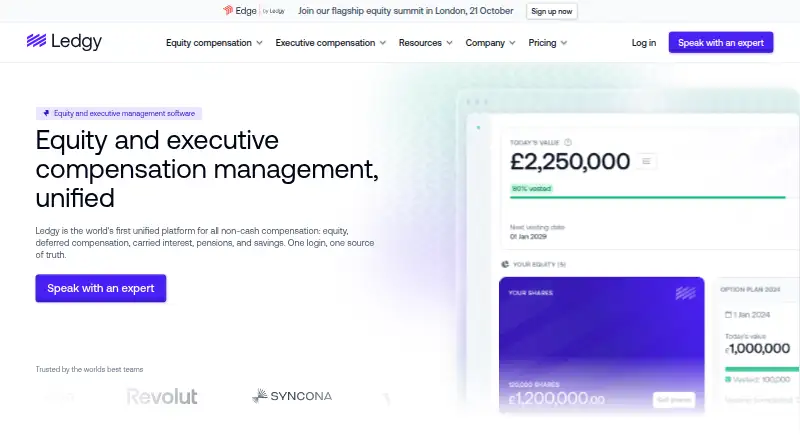
Ledgy is a platform for managing equity and executive compensation, serving finance, legal, and people teams at private and public companies from incorporation through post-IPO. Its tools cover cap tables, share plans, employee communications, compliance, financial reporting, trading and settlement, and executive compensation. Ledgy automates country-specific compliance reports, global mobility reporting, custom vesting, and IFRS 2 expensing. It supports more than 70 HRIS integrations for synchronized data and grant workflows, plus automated grants, bulk document creation and signing, exercising, and offboarding. Employees can view grants, vesting schedules, and award updates, and can exercise and trade shares through the platform. Ledgy says it is ISO 27001:2022 certified and lists controls including TLS 1.3 encryption, SAML SSO with SCIM provisioning, and role-based access. Its GraphQL API uses OAuth 2.0 service accounts and is limited to 20 requests every 5 seconds per company. The free Launch plan is limited to 50 stakeholders.
Good
- Automates equity grants, documents, exercising, and offboarding.
- Supports more than 70 HRIS integrations.
- Employees can view awards and exercise or trade shares.
- Provides country-specific compliance and global mobility reporting.
- Free Launch plan supports up to 50 stakeholders.
Watch out
- Launch is limited to 50 stakeholders.
- GraphQL API is limited to 20 requests every 5 seconds per company.
- Public plan pricing is custom.
Who it suits
Ledgy suits finance, legal, and people teams managing equity compensation at private or public companies. Its range of plans and tools spans organizations from incorporation through post-IPO.
Verdict
Ledgy brings equity administration, employee access, reporting, and compliance workflows together for company teams. The free tier has a 50-stakeholder ceiling, and the GraphQL API has a per-company rate limit to consider.
Plans and prices
From Ledgy's own pricing page, checked 15 Oct 2026.
| Plan | Price | What it gives you |
|---|---|---|
| Launch | Free | Max 50 stakeholders · equity plans and grants · simple vesting · stakeholder dashboards · employee scenarios · self-serve support · Free |
| Essentials | €3,000 a year | Tranche-level expensing · Black Scholes valuations · Custom accounting · Locked report history · Disclosures report · Starts at €3k/year |
| Advanced | €5,000 a year | All Essentials features · Cost centre movements · Performance conditions · Journal entries · Multi-currency conversion coming soon · Starts at €5k/year |
| Scale | €5,000 a year | 50+ stakeholders · 70+ HRIS integrations · DocuSign · up to two offboarding workflows · automated granting · unlimited collaborators · Starts at €5k/year |
| Enterprise | €18,000 a year | 200+ stakeholders · GraphQL API · unlimited performance conditions · global mobility reporting · SAML SSO · role-based access · Starts at €18k/year |
| Public | Priced on request | Share-plan administration · trading and settlement · broker and paying-agent integration · nominee services · tax-rate integrations · financial reporting · Custom pricing |
The facts
Each one read from Ledgy's own pages, with the date it was checked.
What it does
- AI features
- Ledgy Agent can draft equity-administration actions for approval, while Ledgy MCP provides read-only connections to Claude, Cursor, Codex and ChatGPT.checked 15 Oct 2026
- API
- Ledgy exposes a GraphQL API at app.ledgy.com/graphql with OAuth 2.0 service-account authentication and a rate limit of 20 requests per five seconds per company.checked 15 Oct 2026
- API access tier
- GraphQL API access is listed as an Enterprise-plan feature.checked 15 Oct 2026
- API capabilities
- The API documents companyTransactions and companyCaptable queries with pagination, incremental-sync timestamps and grouping options.checked 15 Oct 2026
- API limit
- The GraphQL API is rate-limited to 20 requests every 5 seconds per company.checked 1 Oct 2026
- Cap tables
- The cap-table module records historical transactions with attached documents and supports customizable views, grouping, share classes, diluted and non-diluted percentages, and exports.checked 15 Oct 2026
- Compliance
- The platform advertises country-specific compliance reporting, global-mobility reporting, IFRS 2 expensing and IPO-readiness support.checked 15 Oct 2026
- Core features
- The platform includes equity and share plan automation, cap table management, employee communications, equity compliance, financial reporting, trading and settlement, and executive compensation management.checked 1 Oct 2026
- Deployment
- SoftwareWorld lists deployment as cloud hosted and web based.checked 15 Oct 2026
- Documentation and support
- SoftwareWorld lists email, phone, chat, knowledge-base, FAQ/forum and 24x7 support, plus documentation, videos, webinars, live online and in-person training.checked 15 Oct 2026
- Employee access
- Employees receive dashboards showing grants, vesting schedules and real-time award updates, and can exercise and trade shares through Ledgy.checked 1 Oct 2026
- Employee communications
- Employees and shareholders receive dashboards showing holdings, vesting and scenario information.checked 15 Oct 2026
- Financial reporting
- Ledgy provides financial reports and valuation support, including Black-Scholes and Monte Carlo valuations for public-company customers.checked 15 Oct 2026
- Funding
- Ledgy's company history reports a €1.2 million seed round, a $10 million Series A led by Sequoia Capital and a $22 million Series B led by New Enterprise Associates.checked 15 Oct 2026
- Global compliance
- Ledgy automates country-specific compliance reports, global mobility reporting, custom vesting and IFRS 2 expensing.checked 1 Oct 2026
- HR integrations
- Ledgy supports more than 70 HRIS integrations for data synchronization and granting workflow automation.checked 1 Oct 2026
- Integrations
- The product supports more than 70 HRIS integrations, including BambooHR, Personio, HiBob, Humaans, Lucca, CharlieHR, Workday and Deel.checked 15 Oct 2026
The company
- Company founding
- Ledgy AG's entity creation date is July 7, 2017, and Ledgy's own history says it was founded by ETH Zürich physicists.checked 15 Oct 2026
- Company headquarters
- The legal-entity record gives a Zurich, Switzerland headquarters address; LinkedIn lists London, England as headquarters and 51–200 employees.checked 15 Oct 2026
- Company history
- Ledgy was founded in 2017 by physicists who met at ETH Zürich.checked 1 Oct 2026
- Company legal name
- The registered legal entity is Ledgy AG, also shown with the alternative names Ledgy Ltd and Ledgy SA.checked 15 Oct 2026
- Founded
- 2017checked 28 Sep 2026
- Headquarters
- Zurich, Switzerlandchecked 28 Sep 2026
Money
- Equity-plan automation
- Ledgy automates grants, vesting, exercising, document workflows, and onboarding and offboarding processes.checked 15 Oct 2026
The full review of Ledgy
Overview
Ledgy is an equity and executive compensation platform for companies managing non-cash awards. It is best suited to finance, legal and people teams coordinating compensation across a growing or international workforce. Its broad administration toolkit is a strong fit for complex programs, but Launch’s 50-stakeholder cap makes the move to paid plans an early consideration.
Key features
Ledgy combines cap table management and share-plan automation with employee communications, compliance, financial reporting, trading and settlement, and executive compensation management. It supports awards including ESOP, VSOP, LTIP, EMI, CSOP, RSUs, options, warrants, growth or hurdle shares, BSPCE, SARs and STAK. Advanced vesting, tax reporting and valuation support make it more capable than a basic grant tracker for companies managing varied compensation programs.
International teams get automated country-specific compliance reports, global mobility reporting, custom vesting and IFRS 2 expensing. More than 70 HRIS integrations support employee-data synchronization and grant workflows. Automated granting, bulk document creation and signing, exercising and offboarding can reduce repetitive administration; Scale allows up to two offboarding workflows, while Enterprise offers unlimited workflows.
Employees can view grants, vesting schedules and award updates in dashboards, then exercise and trade shares through Ledgy. That employee access complements the administrative tools, though teams should account for the GraphQL API’s limit of 20 requests every 5 seconds per company when planning integrations. Ledgy is certified to ISO 27001:2022 and states that it uses TLS 1.3, annual penetration tests, role-based access controls, SAML SSO with SCIM provisioning and GDPR compliance. Its Trust Centre includes ISO 27001, SOC 1 Type 2 and SOC 2 Type 2 documentation.
Pricing
Launch is free and supports up to 50 stakeholders, a flexible multi-entry cap table, equity plans and grants, and simple vesting, with self-serve support. It is a useful starting point for smaller programs, but does not include the paid tiers’ more specialized reporting and workflow capabilities.
Essentials starts at €3k/year and adds tranche-level expensing, Black Scholes valuations, custom accounting, locked report history and a disclosures report. It suits teams prioritizing accounting and reporting. Scale starts at €5k/year, includes 50+ stakeholders and more than 70 HRIS integrations, and adds up to two offboarding workflows, up to five performance conditions and email support. It is the more relevant step for teams connecting HR data and grants, but the workflow and performance-condition limits matter.
Advanced starts at €5k/year and includes all Essentials features, cost centre movements, performance conditions and journal entries; multi-currency conversion is coming soon. Enterprise starts at €18k/year and includes 200+ stakeholders, unlimited performance conditions and offboarding workflows, GraphQL API access, SCIM provisioning and 2FA enforcement. Its dedicated capabilities suit larger or more security-conscious organizations, though the starting price is a substantial commitment. Public has custom pricing and includes automated share-plan administration, trading and settlement, financial reporting, and email and chat support.
Platforms
Ledgy is available on the web and through its API. Its GraphQL API uses OAuth 2.0 service accounts; API access is included with Enterprise, and the company-level rate limit is 20 requests per 5 seconds.
Who it's for
Ledgy fits private and public companies that need equity administration alongside employee access, compliance and financial reporting, particularly when teams work across countries or use HRIS integrations. It is less suited to a small company seeking only a basic cap table or to a team that needs more than 50 stakeholders without a paid plan.
Pros and cons
- Pro: Broad support for award types, advanced vesting, tax reporting and valuation makes it useful for varied compensation programs.
- Pro: International compliance reporting and more than 70 HRIS integrations can connect recurring finance, legal and people-team work.
- Pro: Employee dashboards include award updates and support exercising and trading shares.
- Con: Launch is capped at 50 stakeholders, while Scale’s starting price is €5k/year for teams needing its HRIS integrations.
- Con: Scale limits offboarding workflows and performance conditions; the unlimited versions require Enterprise at €18k/year.
- Con: API access is an Enterprise feature and is subject to a per-company rate limit.
Alternatives
For a simpler or lower-cost entry point, Cake Equity offers a free plan for five stakeholders with cap table, stock options and SAFE notes, while Ledgy’s free tier covers up to 50 stakeholders. Eqvista is another free option, with a cap table and ESOP management, vesting schedules and stakeholder accounts for fewer than 20 stakeholders.
EquityList is web-only and offers a free tier for 10 stakeholders and 1,000 lifetime AI credits; it may suit teams comfortable with that smaller cap. Vquity offers a free plan for one company and up to 10 stakeholders, with all modules included, so it is an option for smaller teams wanting access to its full module set without an initial payment. Fidelity Private Shares has a free Launch plan for up to 25 stakeholders and companies with less than $1M raised, including cap table management, equity plan generation and scenario modeling.
Empower Health and Welfare Benefits Administration is a paid alternative for benefits administration. Computershare BoardWorks is a paid board-management alternative with all modules included and additional users charged. Astrella is a paid alternative with a free trial and an Early Stage plan at $1,200 per year for 0–25 stakeholders.
For broader category comparisons, see Equity Compensation Management Software and Cap Table Management Software.
Verdict
Choose Ledgy if your company needs equity administration that links grants, employee access, international compliance and financial reporting in one platform. Its strongest case is the combination of broad plan support and workflow automation; the main reason to look elsewhere is cost, especially if your team outgrows the 50-stakeholder free tier or needs Enterprise-only API and provisioning capabilities.
Alternatives to Ledgy
- 1

LivePlan
AndroidiOSWebmacOS7.6From $15 a month - 2
Cake Equity
Free planAndroidiOSWeb7.5From $1,000 a year - 3
Eqvista
Free planAndroidiOSWeb7.4From $2 a month - 4
IdeaBuddy
Free planAndroidiOSWeb6.9Free plan - 5
CAPLINK CRM
Free planWeb6.7From €999 a year - 6
Capmatter
Free planWeb6.7From ₹2,999 a month