Kotest
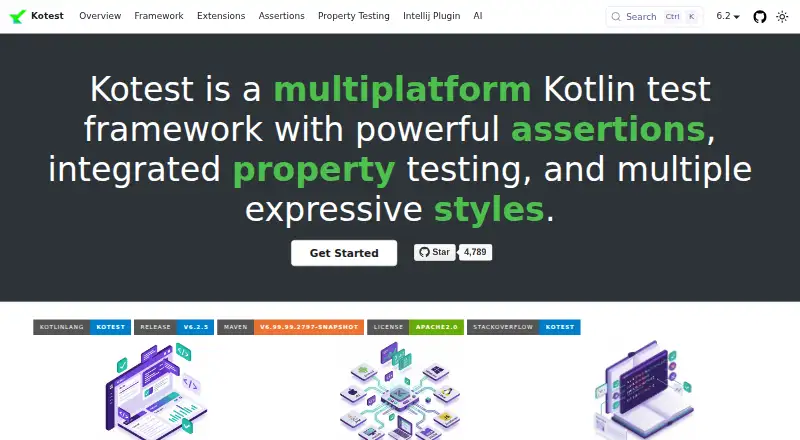
Kotest is a free, multiplatform testing framework for Kotlin projects, combining assertions, property testing, and expressive ways to define tests.
What Kotest is
Kotest is a free, multiplatform testing framework for Kotlin projects, combining assertions, property testing, and expressive ways to define tests. Its test styles include natural-language names and unlimited nesting. The DSL supports parameterized and data-driven tests, conditional evaluation, lifecycle callbacks, and parallel execution. Kotest provides over 350 matchers, along with collection inspectors, soft assertions, and utilities for non-deterministic code. Property tests can generate hundreds or thousands of inputs, and the property-testing framework is supported across all targets. Listed platforms include JVM, JavaScript, Native targets such as Linux, Windows, iOS, and macOS, Wasm, and Android unit and instrumented tests. Setup guidance covers Gradle, Maven, and Kotlin Multiplatform projects. Documented integrations include Spring, Koin, Ktor, Allure, Testcontainers, WireMock, and Micronaut. Its IntelliJ plugin offers test run icons, editor results, a test explorer, structure highlighting, and breadcrumbs. The assertions library can also be used with another testing framework, such as JUnit or Spock. Community support links include Slack, GitHub, and Stack Overflow.
Good
- Free testing framework and assertions library.
- Supports property tests across all targets.
- Offers over 350 matchers.
- Parallel test execution is supported.
- Integrates with Gradle, Maven, and Kotlin Multiplatform projects.
Watch out
- Built-in mocks are not available.
- No free trial is listed.
- Security certifications or compliance claims are not stated.
Who it suits
Kotest suits Kotlin projects that need tests across JVM or Kotlin Multiplatform targets. Teams can use its assertions library independently or with another test framework.
Verdict
Kotest combines broad Kotlin platform support with multiple test styles and property testing. Its assertions can also be used outside Kotest, including with JUnit or Spock.
Plans and prices
From Kotest's own pricing page, checked 2 Oct 2026.
| Plan | Price | What it gives you |
|---|---|---|
| Kotest | Free | Test framework, assertions library and property testing are standalone projects that can be used independently |
The facts
Each one read from Kotest's own pages, with the date it was checked.
What it does
- Assertions
- Kotest provides over 350 matchers, plus collection inspectors, soft assertions and utilities for non-deterministic code.checked 2 Oct 2026
- Audience
- Kotest is intended for Kotlin projects that need testing on JVM and Kotlin Multiplatform targets.checked 2 Oct 2026
- Build support
- The quick start gives setup instructions for Gradle, Maven and Kotlin Multiplatform projects.checked 2 Oct 2026
- IDE support
- The Kotest IntelliJ plugin provides test run icons, results in the editor, a test explorer, structure highlighting and breadcrumbs.checked 2 Oct 2026
- Integrations
- Documented integrations include Spring, Koin, Ktor, Allure, Testcontainers, WireMock and Micronaut.checked 2 Oct 2026
- Property testing
- Property tests can generate hundreds or thousands of inputs, and the property testing framework is supported on all targets.checked 2 Oct 2026
- Security and compliance
- The opened Kotest pages do not state security certifications or compliance claims.checked 2 Oct 2026
- Support
- The project links to community support on Slack, GitHub and Stack Overflow.checked 2 Oct 2026
- Test execution
- Its DSL supports parameterized and data driven tests, conditional evaluation, lifecycle callbacks and parallelism.checked 2 Oct 2026
- Test styles
- The framework offers multiple test styles, including natural language test names and unlimited nesting.checked 2 Oct 2026
- Use with other frameworks
- The assertions library can be used with Kotest or another test framework such as JUnit or Spock.checked 2 Oct 2026
- What it does
- Kotest is a multiplatform Kotlin testing framework with assertions, property testing and expressive test styles.checked 2 Oct 2026
Where it runs
- Platform support
- The site lists JVM, JavaScript, Native targets including Linux, Windows, iOS and macOS, Wasm, and Android unit and instrumented tests.checked 2 Oct 2026
The full review of Kotest
Overview
Kotest is a testing framework for Kotlin, aimed at projects that need tests across JVM and Kotlin Multiplatform targets. It suits Kotlin developers who want expressive test structures and property-based checks in one toolkit, though teams working in other languages should choose a framework built for their stack.
Its scope goes beyond a test runner: the framework, assertions library and property-testing tools are separate projects that can be used independently. That modularity is useful if you want Kotest-style assertions in an existing JUnit or Spock setup rather than a wholesale framework change.
For a wider category comparison, see Unit Testing Frameworks.
Key features
Test styles and execution
Multiple test styles include natural-language names and unlimited nesting, letting teams organize cases around readable descriptions or hierarchies. Parameterized and data-driven tests reduce repeated case setup when the same behavior needs checking against different inputs. Conditional evaluation and lifecycle callbacks add control over execution and setup, while parallel execution can help when suites contain independent work.
Assertions and property testing
More than 350 matchers, collection inspectors and soft assertions give tests several ways to express expected results and report issues. Utilities for non-deterministic code address cases where outcomes are not fully predictable. The assertions library also works with other frameworks, including JUnit and Spock, so teams can adopt that part without replacing their existing test structure.
Property tests generate hundreds or thousands of inputs to check a property across a wider range than a short hand-written list of examples. Support spans all targets, making this particularly relevant to Kotlin Multiplatform projects. Kotest also supports snapshot testing, but it has no built-in mocks, so projects needing mocks must use another approach.
Builds, integrations and IDE
Setup instructions cover Gradle, Maven and Kotlin Multiplatform projects. Documented integrations include Spring, Koin, Ktor, Allure, Testcontainers, WireMock and Micronaut, a useful range for Kotlin applications using those tools. The IntelliJ plugin adds test-run icons, editor results, a test explorer, structure highlighting and breadcrumbs, helping developers navigate and run tests from the IDE.
Pricing
Kotest is free, with a free plan at no cost. The plan includes the test framework, assertions library and property testing; these are standalone projects and can be used independently. There is no free trial because the software is already free, and no paid tier or seat-based plan is involved.
The free offering has no stated usage cap, so it is suitable for individual Kotlin developers as well as teams that want to standardize on Kotest without a software license charge. The trade-off is that it is a Kotlin testing toolkit, not a language-neutral option.
Platforms
Kotest supports JVM, JavaScript, Wasm, Android unit and instrumented tests, and Native targets including Linux, Windows, iOS and macOS. That breadth makes it a strong fit when one Kotlin codebase spans mobile, desktop or web targets. Kotlin is its supported language; the listed device and operating-system coverage should not be read as support for writing tests in other languages.
Who it's for
Kotest is best for Kotlin projects that need a choice of test styles, parameterized cases, parallel execution or property checks across JVM and multiplatform targets. It is also a practical incremental choice for teams that want its matchers while retaining JUnit or Spock. It is less suitable when a project is written in another language or requires built-in mocking.
Pros and cons
- Broad Kotlin target coverage: JVM, Android, JavaScript, Wasm and Native targets accommodate multiplatform testing.
- Flexible test organization: Natural-language names, nesting, data-driven cases, lifecycle callbacks and parallelism cover varied suite structures.
- Substantial assertion and property-testing toolkit: Over 350 matchers and generated inputs support checks beyond fixed examples.
- Composable adoption: The assertions library can be used with JUnit or Spock rather than requiring an immediate framework switch.
- No built-in mocks: Projects that depend on mocking need an additional solution.
- Kotlin-only language support: It does not address teams seeking a common test framework across different languages.
Alternatives
Choose Vitest instead for JavaScript projects: it is free and supports Linux, macOS, web and Windows. GoogleTest is a free option for teams seeking a BSD 3-clause-licensed framework across Linux, macOS and Windows. For PHP, PHPUnit is free and can be downloaded as a PHAR or installed per project with Composer.
Mocha is a free open-source JavaScript test framework for Linux and web. Python projects can choose pytest, a free open-source framework for Linux. Jest is another free option for self-hosted use, while JUnit is free under the Eclipse Public License v2.0. Pest is a free alternative for Windows, macOS and Linux.
Verdict
Choose Kotest for Kotlin work that benefits from multiplatform coverage, flexible test organization and property testing, especially when reusable assertions matter as much as the test runner. Look elsewhere if you need support for another language or built-in mocks; Kotest's strengths are specific to Kotlin testing rather than broad, mixed-language use.
Getting started
- Visit https://kotest.io/.
- Follow the setup instructions for Gradle, Maven or a Kotlin Multiplatform project.
- Choose the Kotest framework, assertions library or property-testing project; they can be used independently.
- Use the IntelliJ plugin for its listed test-running and editor features if working in IntelliJ.
Questions
How much does Kotest cost?
Kotest is free; its listed plan costs nothing.
Does Kotest have a free trial?
No. Kotest is listed as free, with no free trial.
Which platforms does Kotest support?
Listed targets include JVM, JavaScript, Native platforms including Linux, Windows, iOS and macOS, Wasm, and Android unit and instrumented tests.
Can I use Kotest assertions with another framework?
Yes. The assertions library can be used with Kotest or another test framework such as JUnit or Spock.
Does Kotest include built-in mocks?
No, built-in mocks are not included.
What integrations are documented?
Integrations include Spring, Koin, Ktor, Allure, Testcontainers, WireMock and Micronaut.
Alternatives to Kotest
- 1

QUnit
Free planAndroidiOSWebAPI7.4Free plan - 2

NUnit
Free planAndroidiOSAPILinux6.8Free plan - 3
PHPUnit
Free planLinuxmacOSSelf-hostedWindows6.6Free plan - 4
ScalaCheck
Free planLinuxmacOSWindows6.6Free plan - 5

Vitest
Free planWebLinuxmacOSWindows6.6Free plan - 6

Boost.Test
Free planLinuxWindows6.5Free plan