
Vitest
Vitest is a testing framework powered by Vite, though it can also run without Vite.
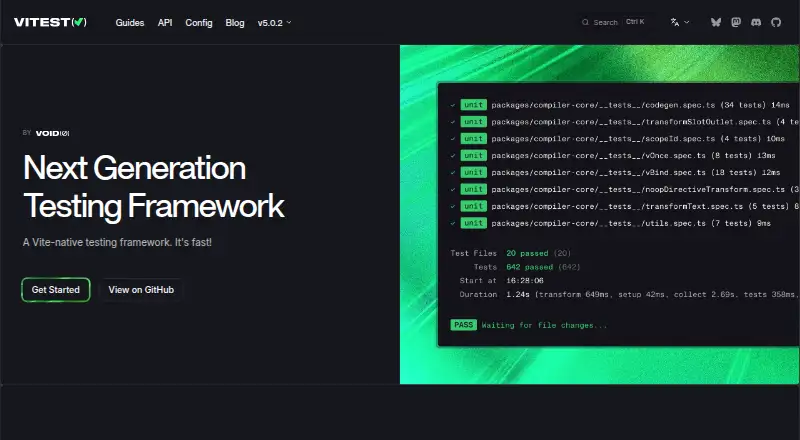
What Vitest is
Vitest is a testing framework powered by Vite, though it can also run without Vite. It can reuse Vite configuration, plugins, resolvers and transform pipelines, and its Jest-compatible APIs cover assertions, snapshots and mocking. These APIs can support migration from Jest. Watch mode reruns tests related to changed source or test files, and Vitest supports TypeScript, JSX and ES modules out of the box.
Browser Mode runs tests natively in a browser and supports Playwright and WebdriverIO providers. The feature set includes component testing for Vue, React, Svelte, Lit, Marko and other frameworks, plus coverage through V8 or Istanbul and benchmarking powered by Tinybench. Vitest provides an official Visual Studio Code extension and can be tried in a browser through StackBlitz without a local installation. It is free and open source. The getting started guide lists Vite 6.4.0 or later and Node 22.12.0 or later as requirements. Users needing help can turn to the Vitest Discord community or GitHub Discussions.
Good
- Reuses Vite configuration and plugins.
- Jest-compatible APIs cover assertions, snapshots and mocking.
- Watch mode reruns tests related to changed files.
- Browser Mode supports Playwright and WebdriverIO.
- Free and open source.
Watch out
- Requires Vite 6.4.0 or later when using Vite.
- Requires Node 22.12.0 or later.
- No plan limits are stated.
Who it suits
Vitest suits JavaScript and TypeScript developers who want a Vite-integrated testing framework, or a framework that can run without Vite. Its Jest-compatible APIs may help teams moving from Jest.
Verdict
Vitest combines Vite integration with Jest-compatible APIs, browser testing and coverage tools. Check the listed Vite and Node requirements before getting started.
Plans and prices
From Vitest's own pricing page, checked 30 Sep 2026.
| Plan | Price | What it gives you |
|---|---|---|
| Free and open source | Free | No plan limits stated |
The facts
Each one read from Vitest's own pages, with the date it was checked.
What it does
- Benchmarking
- Vitest lists benchmarking support powered by Tinybench.checked 30 Sep 2026
- Component testing
- The features guide lists component testing for Vue, React, Svelte, Lit, Marko, and other frameworks.checked 30 Sep 2026
- Coverage
- Vitest supports code coverage through V8 or Istanbul.checked 30 Sep 2026
- IDE integration
- The getting started guide says Vitest provides an official Visual Studio Code extension.checked 30 Sep 2026
- Jest compatibility
- Vitest offers Jest-compatible APIs for assertions, snapshots, and mocking to support migration from Jest.checked 30 Sep 2026
- Languages
- Vitest provides out-of-the-box support for TypeScript, JSX, and ES modules.checked 30 Sep 2026
- Maintainer
- VoidZero's About page identifies Evan You as Founder and CEO.checked 30 Sep 2026
- Product
- Vitest is a Vite-powered testing framework.checked 30 Sep 2026
- Requirements
- The getting started guide says Vitest requires Vite 6.4.0 or later and Node 22.12.0 or later.checked 30 Sep 2026
- Security
- The maker's announcement says it plans an enterprise JavaScript tooling solution designed for scale and security requirements; it does not state a Vitest security certification.checked 30 Sep 2026
- Support
- The guide directs users needing help to the Vitest Discord community and GitHub Discussions.checked 30 Sep 2026
- Try online
- Vitest can be tried in the browser through StackBlitz without installing it locally.checked 30 Sep 2026
- Vite integration
- Vitest can reuse Vite configuration, plugins, resolvers, and transform pipelines, and can also run without Vite.checked 30 Sep 2026
- Watch mode
- Watch mode reruns tests related to changed source or test files.checked 30 Sep 2026
Where it runs
- Browser testing
- Browser Mode runs tests natively in a browser and supports Playwright and WebdriverIO providers.checked 30 Sep 2026
The full review of Vitest
Overview
Vitest is a Vite-powered testing framework for JavaScript and TypeScript projects. It suits developers who want Vite-aware testing or Jest-compatible APIs, especially teams moving from Jest. Its broad testing toolkit and free, open-source plan make it a strong choice when the project meets its current Vite and Node requirements.
Key features
Vitest can reuse a project's Vite configuration, plugins, resolvers and transform pipeline, reducing the gap between development and test environments. It can also run without Vite, so the framework is not limited to Vite-based projects. For teams already invested in Jest, compatible assertion, snapshot and mocking APIs can ease migration, though compatibility alone does not establish that every project will move without adjustment.
Watch mode reruns tests related to changed source or test files, keeping feedback focused during development. Out-of-the-box support for TypeScript, JSX and ES modules makes it relevant to modern JavaScript projects, while built-in mocks, parameterized cases, property-based checks, snapshots and parallel execution cover common testing needs.
Browser Mode runs tests in a browser and supports Playwright and WebdriverIO providers. Component testing covers Vue, React, Svelte, Lit, Marko and other frameworks, giving teams a route to test components in addition to other code. Coverage is available through V8 or Istanbul, and benchmarking is powered by Tinybench. These additions make Vitest more than a basic unit-test runner, although teams should choose tools and workflows suited to their specific testing needs.
An official Visual Studio Code extension supports IDE integration, and StackBlitz lets developers try Vitest in a browser without a local installation. For help, the project directs users to its Discord community and GitHub Discussions.
Pricing
Free and open source: free. The plan has no stated limits, making it suitable for individual developers and teams that want to use Vitest without a software subscription. No paid tier or separate paid capability is part of the pricing model.
Platforms
Vitest is listed for Linux, macOS, Windows and the web. Browser-based trial access through StackBlitz is useful for a quick evaluation, while local use requires Vite 6.4.0 or later and Node 22.12.0 or later. Those version requirements are an important fit check for teams with older toolchains.
Who it's for
Vitest is a good fit for JavaScript and TypeScript developers who use Vite, want a test runner that can share its configuration, or value Jest-compatible APIs during a migration. Its browser and component testing support also suits projects that need to test beyond isolated modules. It is less compelling for teams unable or unwilling to meet the Vite and Node requirements, or those seeking a stated security certification: none is identified for Vitest. VoidZero's founder and CEO is Evan You; the company has announced plans for an enterprise JavaScript tooling solution designed for scale and security requirements.
Pros and cons
- Pro: Reusing Vite's configuration and transforms can keep tests aligned with the project's development setup.
- Pro: Jest-compatible assertions, snapshots and mocks give existing Jest users a familiar migration path.
- Pro: Browser Mode, component testing, coverage and benchmarking extend its reach beyond basic unit testing.
- Pro: The free, open-source plan has no stated limits, and StackBlitz offers a way to try it without local installation.
- Con: Local use requires Vite 6.4.0 or later and Node 22.12.0 or later, which can rule it out for projects on older versions.
- Con: No Vitest security certification is identified, a consideration for organizations that require one.
Alternatives
Jest is a natural alternative for teams that want to stay with the framework whose APIs Vitest aims to support; it is free, with no paid plans or usage limits stated on its official pages. Karma is free and open source, but it is deprecated and receives no new features or general bug fixes, so that status weighs against choosing it for ongoing development. Web Test Runner may suit developers interested in Modern Web's browser-focused approach and its guides and tools for modern web development.
Rstest is another free and open-source JavaScript/TypeScript testing framework. Mocha is a free open-source JavaScript test framework installed as a development dependency. Intern, created by SitePen, is another free option. Testem is also free and supports Windows, macOS and Linux. Poku is a free, open-source option with Node.js, Bun and Deno support.
Explore more options in JavaScript Testing Frameworks and Unit Testing Frameworks.
Verdict
Choose Vitest if you want a free testing framework that fits naturally with Vite or offers a familiar Jest-style API, with browser, component and coverage capabilities available as your needs grow. Look elsewhere if your project cannot meet the Vite and Node version requirements or your organization requires a stated security certification.