
NUnit
NUnit is a unit-testing framework for .NET languages, with support listed for C#, VB.NET, F#, and C++.
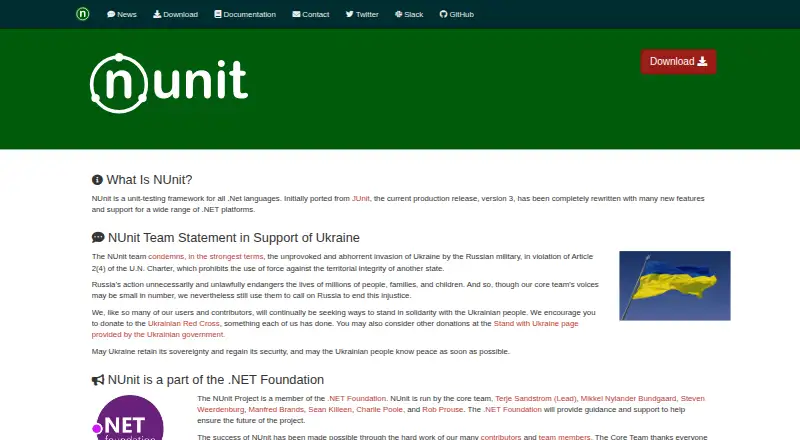
What NUnit is
NUnit is a unit-testing framework for .NET languages, with support listed for C#, VB.NET, F#, and C++. NUnit 3 and later are released under the MIT license, which permits free use in commercial and noncommercial applications and libraries. NUnit 5 adds attributes for expressing dependencies between tests and fixtures. Its Repeat feature can set a required pass percentage from 1 to 100 and can stop once the outcome is determined. NUnit 5 ships builds targeting net462, net8.0, and net10.0. Installation options include project templates for Visual Studio, Visual Studio Code, and Rider, as well as the dotnet new nunit command; release packages are available through NuGet and GitHub. The Visual Studio template includes references to a test adapter, analyzer, Microsoft Test SDK, and a code coverage package. Documentation describes automated runs on clean machines, including Azure DevOps and GitHub Actions build agents. The NUnit Project is part of the .NET Foundation and is maintained by a core team and community contributors.
Good
- MIT license permits commercial and noncommercial use.
- NUnit 5 supports test and fixture dependencies.
- Repeat can require a pass percentage.
- Documentation describes CI test automation.
Watch out
- NUnit 5 builds target specific .NET versions.
- No security certifications or compliance attestations are stated.
Who it suits
It suits developers writing and running unit tests for .NET projects. Teams using Visual Studio, Visual Studio Code, Rider, or CI build agents have documented setup paths to consider.
Verdict
NUnit offers a free, open-source framework for .NET unit testing, with NUnit 5 features for dependencies and repeat conditions. Its documented templates and CI support provide several setup options.
Plans and prices
From NUnit's own pricing page, checked 4 Oct 2026.
| Plan | Price | What it gives you |
|---|---|---|
| NUnit Framework | Free | Open source · MIT license · free for commercial and noncommercial use |
The facts
Each one read from NUnit's own pages, with the date it was checked.
What it does
- CI
- The documentation says the NUnit3TestAdapter can automate test runs on clean machines, including Azure DevOps and GitHub Actions build agents.checked 4 Oct 2026
- Community
- The project is run by a core team and community contributors; its packages had passed 600 million NuGet downloads at the time stated on the site.checked 4 Oct 2026
- Development tools
- The installation guide describes NUnit project templates for Visual Studio, Visual Studio Code, and Rider, plus the dotnet new nunit command.checked 4 Oct 2026
- Install options
- The project recommends installing NUnit using its installation approaches and makes release packages available through NuGet and GitHub.checked 4 Oct 2026
- .NET versions
- NUnit 5 ships builds targeting net462, net8.0, and net10.0.checked 4 Oct 2026
- Open source
- NUnit 3 and higher is released under the MIT license, which permits free use in commercial and noncommercial applications and libraries.checked 4 Oct 2026
- Pre-release builds
- Developer alpha versions are published when pull requests are merged into the main branch and are available through a MyGet NuGet feed.checked 4 Oct 2026
- Project backing
- The NUnit Project is a member of the .NET Foundation, which provides guidance and support for the project.checked 4 Oct 2026
- Purpose
- NUnit is a unit-testing framework for .NET languages.checked 4 Oct 2026
- Repeated tests
- NUnit 5 lets Repeat set a required pass percentage from 1 to 100 and optionally stop once the outcome is determined.checked 4 Oct 2026
- Security and compliance
- The pages reviewed state the MIT license and project governance, but do not state security certifications or compliance attestations.checked 4 Oct 2026
- Test adapters and analyzers
- The Visual Studio project template includes references to the NUnit Test Adapter, NUnit Analyzer, Microsoft Test SDK, and coverlet code coverage package.checked 4 Oct 2026
- Test dependencies
- NUnit 5 adds DependsOnTest and DependsOnFixture attributes for expressing test and fixture dependencies.checked 4 Oct 2026
The full review of NUnit
NUnit is a free unit-testing framework for .NET developers who want to define parameterized tests and run them in .NET workflows. It is a strong fit for C#, VB.NET, F#, and C++ projects; teams working outside those ecosystems should look elsewhere.
Overview
NUnit 3 and later are released under the MIT license, so commercial and noncommercial applications and libraries can use the framework without a licensing fee. The NUnit Project is part of the .NET Foundation and is maintained by a core team and community contributors. Its packages had passed 600 million NuGet downloads at the time stated on the site, a substantial footprint for teams weighing adoption. The stated governance and license do not amount to security certifications or compliance attestations.
Key features
NUnit 5 adds DependsOnTest and DependsOnFixture attributes to express dependencies between tests and fixtures. They can make relationships explicit in suites that need them, though teams that design tests to stand alone may have little use for dependency controls.
Its Repeat feature supports a required pass percentage from 1 to 100 and can stop once the outcome is determined. That gives teams a way to set a success threshold for repeated tests rather than rely on an unspecified pass criterion. NUnit 5 ships builds targeting net462, net8.0, and net10.0.
Parameterized cases and parallel execution support broader test organization and concurrency. Setup routes include project templates for Visual Studio, Visual Studio Code, and Rider, as well as the dotnet new nunit command. The Visual Studio template references the NUnit Test Adapter, NUnit Analyzer, Microsoft Test SDK, and coverlet code coverage package, making it a practical starting point for a configured project. The NUnit3TestAdapter can automate runs on clean machines, including Azure DevOps and GitHub Actions build agents. Release packages are available through NuGet and GitHub; developer alpha versions are published to a MyGet NuGet feed when pull requests are merged into the main branch.
Pricing
NUnit Framework — free. The free plan is open source under the MIT license and permits commercial and noncommercial use. There is no paid tier or trial to weigh against it, and no seat or usage cap is stated. That makes it suitable for individual developers and teams alike, though it remains a framework to integrate into a .NET project rather than a paid, bundled testing service.
Platforms
NUnit supports Android, iOS, Linux, macOS, self-hosted environments, and Windows, with builds targeting net462, net8.0, and net10.0. Supported languages are C#, VB.NET, F#, and C++. The breadth is useful for .NET work across varied environments, but it does not make NUnit a general-purpose framework for unrelated language stacks.
Who it's for
NUnit suits developers and teams building .NET applications who want a no-cost, MIT-licensed framework, especially those who value parameterized cases, parallel execution, or NUnit 5's dependency and repeat controls. Its templates and adapter documentation also give teams conventional routes into IDE and CI workflows. It is a less natural choice for teams whose main work is in another language.
Pros and cons
- Pro: The MIT license allows free commercial and noncommercial use, so there is no license charge to budget for adoption.
- Pro: NUnit 5's dependency attributes and configurable Repeat threshold offer specific controls for suites that need them.
- Pro: Templates, adapter references, and documented clean-machine CI runs support several established .NET setup paths.
- Con: Its focus on .NET languages makes it a poor fit as a shared testing framework for teams working primarily in other ecosystems.
- Con: The stated project governance does not provide security certifications or compliance attestations for organizations that require them.
Alternatives
For another free .NET framework, xUnit.net is a direct option; choose it if you want a free, open-source unit-testing tool with no paid plans stated. MSTest is also free and open source, distributed as NuGet packages, and is worth considering if that packaging model suits your .NET project.
For Kotlin, Kotest combines a test framework, assertions library, and property testing as standalone projects that can be used independently. For PHP, PHPUnit offers a free testing framework available as a PHAR or through per-project Composer installation. Vitest is a free, open-source option for JavaScript projects, while GoogleTest is free and open source under the BSD 3-clause license. JavaScript teams can also consider Mocha, a free open-source framework installed as a development dependency; Python teams can consider the free, open-source pytest.
Browse more options in Unit Testing Frameworks.
Verdict
Choose NUnit if you need a free, MIT-licensed framework for .NET and want its parameterized and parallel test support plus NUnit 5's explicit dependency and repeat controls. Its documented IDE templates and CI adapter paths add practical setup choices. Look elsewhere if your team needs a framework centered on another language or requires security certifications or compliance attestations.
Getting started
- Visit https://nunit.org/.
- Choose an installation approach from the NUnit installation guide.
- Start a project with a template for Visual Studio, Visual Studio Code, or Rider, or run dotnet new nunit.
- Install NUnit through the recommended approach, or obtain a release package through NuGet or GitHub.
- For automated runs on clean build agents, use NUnit3TestAdapter as described in the documentation.
Questions
How much does NUnit cost?
NUnit is free. The NUnit Framework plan is free.
Is NUnit open source?
NUnit 3 and later releases use the MIT license, which permits free commercial and noncommercial use.
Which languages does NUnit support?
Supported languages are C#, VB.NET, F#, and C++.
Which .NET versions does NUnit 5 target?
NUnit 5 ships builds targeting net462, net8.0, and net10.0.
How can I start a NUnit project?
Use a project template for Visual Studio, Visual Studio Code, or Rider, or run dotnet new nunit.
Can NUnit automate tests in CI?
Documentation describes using NUnit3TestAdapter to automate runs on clean machines, including Azure DevOps and GitHub Actions build agents.
Alternatives to NUnit
- 1

QUnit
Free planAndroidiOSWebAPI7.4Free plan - 2
Kotest
Free planAndroidiOSWebLinux6.7Free plan - 3

PHPUnit
Free planLinuxmacOSSelf-hostedWindows6.6Free plan - 4
ScalaCheck
Free planLinuxmacOSWindows6.6Free plan - 5

Vitest
Free planWebLinuxmacOSWindows6.6Free plan - 6

Boost.Test
Free planLinuxWindows6.5Free plan