GoogleTest
GoogleTest is Google’s C++ framework for testing and mocking.
What GoogleTest is
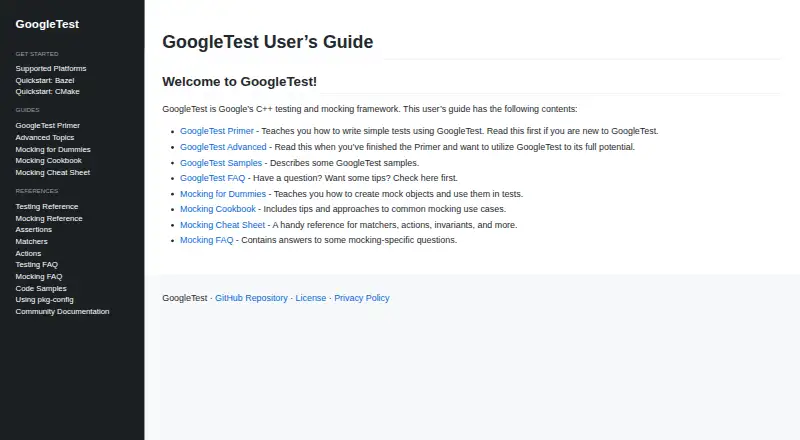
GoogleTest is Google’s C++ framework for testing and mocking. Based on the xUnit architecture, it supports many kinds of C++ tests rather than only unit tests, and discovers and runs tests without manual registration. Its assertions cover equality, inequality, exceptions and other conditions, with support for custom assertions. The framework offers fatal and non-fatal failure handling, death tests, and value- or type-parameterized cases. Developers can run selected tests, set their order or run them in parallel. GoogleTest provides quickstarts for Bazel and CMake, plus pkg-config files for compiling and linking GoogleTest and GoogleMock. Its guide includes introductory and advanced material, mocking guidance, FAQs, references, examples and community documentation. The project follows Google’s Foundational C++ Support Policy and publishes supported compiler, platform and build-tool versions. The 1.18.x branch requires at least C++17. GoogleTest is free and uses the BSD-3-Clause license, which permits redistribution subject to its terms.
Good
- Automatically discovers tests
- Supports fatal and non-fatal failures
- Includes value- and type-parameterized tests
- Can run tests in parallel
- Free under the BSD-3-Clause license
Watch out
- The 1.18.x branch requires C++17
- Supported compiler and tool versions vary
Who it suits
It suits C++ developers who need testing and mocking across different kinds of tests. Teams using Bazel or CMake can refer to its quickstarts.
Verdict
GoogleTest covers test discovery, assertions, mocking and several ways to organize or run C++ tests. Check the published support policy and the C++17 requirement for the 1.18.x branch against your development setup.
Plans and prices
From GoogleTest's own pricing page, checked 1 Oct 2026.
| Plan | Price | What it gives you |
|---|---|---|
| GoogleTest | Free | free and open-source software · BSD 3-clause license |
The facts
Each one read from GoogleTest's own pages, with the date it was checked.
What it does
- Adoption
- The project lists Chromium, LLVM, Protocol Buffers, and OpenCV among notable users.checked 1 Oct 2026
- Architecture
- GoogleTest is based on the xUnit testing framework architecture.checked 1 Oct 2026
- Assertions
- GoogleTest provides assertions for equality, inequality, exceptions, and other conditions, and supports user-defined assertions.checked 1 Oct 2026
- Build integration
- GoogleTest provides quickstarts for Bazel and CMake.checked 1 Oct 2026
- C++ requirement
- The 1.18.x branch requires at least C++17.checked 1 Oct 2026
- Documentation support
- The user guide includes primer, advanced topics, mocking guides, FAQs, references, samples, and community documentation.checked 1 Oct 2026
- Failure handling
- GoogleTest supports death tests plus fatal and non-fatal test failures.checked 1 Oct 2026
- License
- The repository uses the BSD-3-Clause license, permitting source and binary redistribution subject to its conditions and disclaimer.checked 1 Oct 2026
- Parameterized tests
- GoogleTest supports value-parameterized and type-parameterized tests.checked 1 Oct 2026
- pkg-config
- GoogleTest includes pkg-config files for compiling and linking GoogleTest and GoogleMock.checked 1 Oct 2026
- Purpose
- GoogleTest is Google’s C++ testing and mocking framework.checked 1 Oct 2026
- Run options
- GoogleTest can run individual tests, tests in a specific order, and tests in parallel.checked 1 Oct 2026
- Test discovery
- GoogleTest automatically discovers and runs tests without requiring manual registration.checked 1 Oct 2026
- Testing scope
- GoogleTest supports any kind of C++ tests, not just unit tests.checked 1 Oct 2026
Where it runs
- Supported platforms
- GoogleTest follows Google’s Foundational C++ Support Policy and publishes supported compiler, platform, and build-tool versions.checked 1 Oct 2026
The full review of GoogleTest
Overview
GoogleTest is a free C++ framework for testing and mocking, best suited to teams building and maintaining C++ software. Its broad test scope and flexible execution options make it a strong fit for established C++ workflows; the main caveat is that the 1.18.x branch requires C++17.
Key features
Automatic test discovery removes the need to register each test manually, while an xUnit-style architecture provides a familiar structure for organizing test cases. GoogleTest supports any kind of C++ test, not only unit tests, so it can serve projects that need a wider testing scope without changing frameworks.
Assertions cover equality, inequality, exceptions and other conditions, and developers can create user-defined assertions. Fatal and non-fatal failures offer different ways to handle a failed check, while death tests cover code expected to terminate the process. These options make the framework adaptable to different test behaviors, though teams still need to decide which checks and failure styles suit their code.
Value-parameterized and type-parameterized tests let teams apply test logic across different inputs or types. GoogleTest can run individual tests, impose a specific order, or execute tests in parallel, giving developers useful control over test selection and execution.
Quickstarts cover Bazel and CMake, and pkg-config files support compiling and linking GoogleTest and GoogleMock. The user guide spans introductory and advanced topics, mocking, FAQs, references, samples and community documentation. GoogleTest follows Google's Foundational C++ Support Policy, with supported compiler, platform and build-tool versions published; the 1.18.x branch requires at least C++17.
Pricing
GoogleTest costs nothing. It is free and open-source software under the BSD-3-Clause license, which permits source and binary redistribution subject to its conditions and disclaimer. There is no paid tier or trial to weigh against the free plan; it includes the framework's C++ testing and mocking capabilities.
Platforms
GoogleTest supports Linux, macOS and Windows. Its platform and toolchain support follows Google's published Foundational C++ Support Policy, so teams should check that policy against their compiler, platform and build-tool versions. The C++17 minimum for version 1.18.x may rule out projects that cannot meet that language requirement.
Who it's for
GoogleTest suits C++ developers who want one framework for varied test types, built-in mocking, parameterized cases and flexible test execution. It is particularly compelling for teams already using Bazel or CMake, or those that can link through pkg-config. It is not the right fit for projects written in another language or C++ codebases that cannot move to C++17 when using the 1.18.x branch.
Chromium, LLVM, Protocol Buffers and OpenCV are among the projects Google identifies as users. That range shows GoogleTest in use across several notable C++ projects, though each team still needs to check its own compatibility and workflow requirements.
Pros and cons
- Pros: Automatic discovery avoids manual test registration, reducing setup overhead as test suites grow.
- Pros: Assertions, death tests, parameterized tests and built-in mocking cover a wide range of C++ test needs in one framework.
- Pros: Individual, ordered and parallel execution gives teams multiple ways to run tests.
- Pros: Free use and BSD-3-Clause redistribution terms make it practical to adopt in open or commercial projects, subject to the license conditions.
- Cons: It is C++-specific; teams working in other languages need a different framework.
- Cons: Version 1.18.x requires C++17, which can exclude older codebases or toolchains that cannot meet that baseline.
Alternatives
For a broader comparison, browse Unit Testing Frameworks.
- NUnit is a free alternative for teams targeting Android, iOS, Linux, macOS, Windows or self-hosted environments; NUnit 3 and higher uses the MIT license.
- pytest is a free Linux option if your project uses Python rather than C++.
- xUnit.net is a free alternative for Linux, macOS, Windows or self-hosted environments.
- Vitest is a free choice for Linux, macOS, Windows or web projects.
- PHPUnit is a free option for PHP projects, installable as a PHAR or per-project through Composer.
- JUnit is a free alternative for self-hosted environments.
- Kotest offers a free option across Android, iOS, Linux, macOS, web and Windows, with its test framework, assertions and property-testing components usable independently.
- Jest is a free alternative for self-hosted environments.
Verdict
Choose GoogleTest if you need a capable, no-cost testing and mocking framework for C++ and can meet its platform and language requirements. Its combination of broad test support, parameterization and execution controls is the main reason to choose it; look elsewhere if your project uses another language or cannot satisfy the 1.18.x C++17 requirement.