
JUnit
JUnit is a free, programmer-friendly testing framework for Java and the JVM.
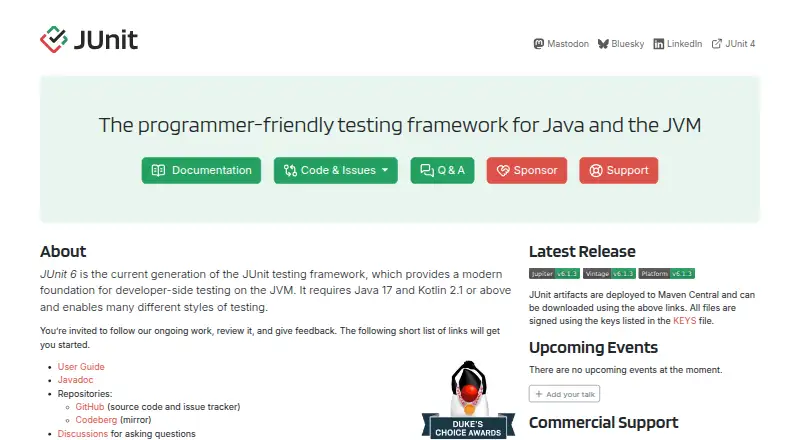
What JUnit is
JUnit is a free, programmer-friendly testing framework for Java and the JVM. The current generation, JUnit 6.1.3, consists of JUnit Platform, JUnit Jupiter, and JUnit Vintage. JUnit Platform provides tools for launching JVM testing frameworks and has first-class support in IntelliJ IDEA, Eclipse, NetBeans, Visual Studio Code, Gradle, Maven, Ant, Bazel, and sbt. Jupiter combines the programming and extension models for writing tests and extensions. JUnit 6 requires Java 17 or higher at runtime, and Kotlin 2.1 or higher when using Kotlin. JUnit Vintage runs JUnit 3 and 4 tests for temporary migration use; it requires JUnit 4.12 or later and is deprecated. JUnit supports Java, Kotlin, and Groovy, with parameterized cases and parallel execution. Its artifacts are available through Maven Central, and the project directs users to Stack Overflow and GitHub Discussions for community support.
Good
- Free under Eclipse Public License v2.0.
- Supports Java, Kotlin, and Groovy.
- Provides parameterized cases and parallel execution.
- Integrates with listed IDEs and build tools.
Watch out
- JUnit 6 requires Java 17 or higher.
- JUnit 6 requires Kotlin 2.1 or higher.
- JUnit Vintage is deprecated for temporary migration use.
Who it suits
JUnit suits developers writing tests for Java and JVM projects, including projects using Kotlin or Groovy. It is also relevant to teams migrating JUnit 3 or 4 tests or using the listed IDE and build integrations.
Verdict
JUnit offers a free testing framework with established IDE and build integrations. Check the Java or Kotlin version requirements, especially if relying on JUnit 6.
Plans and prices
From JUnit's own pricing page, checked 30 Sep 2026.
| Plan | Price | What it gives you |
|---|---|---|
| JUnit | Free | Eclipse Public License v2.0 · released for everyone |
The facts
Each one read from JUnit's own pages, with the date it was checked.
What it does
- Architecture
- JUnit 6.1.3 consists of JUnit Platform, JUnit Jupiter, and JUnit Vintage.checked 30 Sep 2026
- Build integrations
- The JUnit Platform has first-class support in Gradle, Maven, Ant, Bazel, and sbt.checked 30 Sep 2026
- Commercial support
- Core JUnit team members offer commercial support through OpenElements, including 4–8 hours of support per month, guaranteed response time, quarterly expert webinars, and a monthly newsletter.checked 30 Sep 2026
- Community support
- JUnit directs users to Stack Overflow and GitHub Discussions for questions.checked 30 Sep 2026
- Current generation
- JUnit 6.1.3 is the current generation and requires Java 17 or higher at runtime.checked 30 Sep 2026
- Distribution
- JUnit artifacts are deployed to Maven Central and the released files are signed with keys listed in the KEYS file.checked 30 Sep 2026
- IDE integrations
- The JUnit Platform has first-class support in IntelliJ IDEA, Eclipse, NetBeans, and Visual Studio Code.checked 30 Sep 2026
- Jupiter
- JUnit Jupiter combines the programming model and extension model for writing JUnit tests and extensions.checked 30 Sep 2026
- Kotlin requirement
- JUnit 6 requires Kotlin 2.1 or above.checked 30 Sep 2026
- Purpose
- JUnit is a programmer-friendly testing framework for Java and the JVM.checked 30 Sep 2026
- Security policy
- JUnit JARs released on Maven Central are signed; versions 6.1.x and 5.14.x are supported, while versions below 5.14 are unsupported.checked 30 Sep 2026
- Vintage engine
- JUnit Vintage runs JUnit 3 and JUnit 4 tests, requires JUnit 4.12 or later, and is deprecated for temporary migration use.checked 30 Sep 2026
- Vulnerability reporting
- Security vulnerabilities can be reported privately on GitHub or by email to [email protected] using the published OpenPGP key.checked 30 Sep 2026
Where it runs
- Platform
- JUnit Platform provides the TestEngine API, Console Launcher, and Suite Engine for launching testing frameworks on the JVM.checked 30 Sep 2026