
Kokoro TTS
Kokoro TTS is a free, open-weight text-to-speech model with 82 million parameters and Apache-licensed weights.
What Kokoro TTS is
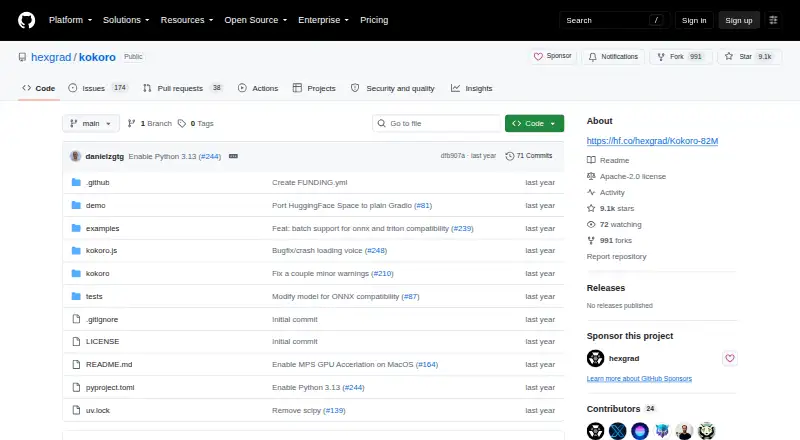
Kokoro TTS is a free, open-weight text-to-speech model with 82 million parameters and Apache-licensed weights. It uses StyleTTS 2 and ISTFTNet in a decoder-only architecture, and supports eight languages. The maker describes it as lightweight and more efficient than larger models while offering comparable quality. A Python pipeline example lets users choose a voice and adjust speech speed, then generates 24 kHz audio saved as WAV. The kokoro.js library can run the model locally in a browser through Transformers.js, with Node CPU use also documented; it also supports streaming speech as text is added. The model is presented for personal or production deployment, and commercial use is listed as permitted. Python setup uses the kokoro package, soundfile, and espeak-ng, with Misaki handling grapheme-to-phoneme processing. The README includes Windows setup guidance for espeak-ng and Apple Silicon GPU instructions for macOS M1 through M4. Examples point to Google Colab and a Hugging Face demo, while the repository links to a Discord community.
Good
- Apache-licensed weights permit commercial use.
- Supports eight languages.
- Python example includes voice and speed controls.
- JavaScript library supports local browser inference and streaming.
- Generates 24 kHz WAV audio.
Watch out
- Voice cloning is not supported.
- Python setup uses kokoro, soundfile, and espeak-ng.
- Audio export is listed as WAV.
Who it suits
Kokoro TTS suits developers who want an open-weight speech model for personal or commercial projects, with Python or JavaScript options. It may fit teams seeking local browser inference or streaming generated speech.
Verdict
Kokoro TTS offers an open-weight route to multilingual speech generation, including Python workflows and local browser inference. Consider its dependency requirements and lack of voice cloning before choosing it.
Plans and prices
From Kokoro TTS's own pricing page, checked 5 Oct 2026.
| Plan | Price | What it gives you |
|---|---|---|
| Kokoro open-weight model | Free | 82 million parameters · Apache-licensed weights |
The facts
Each one read from Kokoro TTS's own pages, with the date it was checked.
What it does
- API access
- Yeschecked 20 Sep 2026
- Architecture
- The model uses StyleTTS 2 and ISTFTNet and is decoder-only.checked 5 Oct 2026
- Audio output
- The Python example generates audio at 24 kHz and saves it as WAV files.checked 5 Oct 2026
- Commercial use
- Yeschecked 20 Sep 2026
- Dependencies
- The documented Python installation uses the kokoro package, soundfile, and espeak-ng; Kokoro uses Misaki for grapheme-to-phoneme processing.checked 5 Oct 2026
- Efficiency
- The maker describes Kokoro as lightweight, faster, and more cost-efficient than larger models while delivering comparable quality.checked 5 Oct 2026
- Export formats
- WAVchecked 20 Sep 2026
- Integrations
- The maker provides examples using Google Colab and points to a Hugging Face demo; the model page also lists inference providers and notebooks.checked 5 Oct 2026
- JavaScript library
- The kokoro.js library runs the model locally in a browser through Transformers.js and also documents Node CPU use.checked 5 Oct 2026
- Languages
- The usage documentation lists American English, British English, Spanish, French, Hindi, Italian, Japanese, Brazilian Portuguese, and Mandarin Chinese.checked 5 Oct 2026
- License
- The model weights are Apache-licensed, and the maker says Kokoro can be deployed in production or personal projects.checked 5 Oct 2026
- Purpose
- Kokoro is an open-weight text-to-speech model with 82 million parameters.checked 5 Oct 2026
- Streaming
- The JavaScript library documents streaming generated speech as text is added over time.checked 5 Oct 2026
- Support
- The repository links to a Discord community for Kokoro users and contributors.checked 5 Oct 2026
- Training data
- The model card says Kokoro was trained on permissive or non-copyrighted audio data and IPA phoneme labels, with a dataset of a few hundred audio hours.checked 5 Oct 2026
- Voice and speed controls
- The Python example selects a voice and sets speech speed through the pipeline.checked 5 Oct 2026
- Voice cloning
- Nochecked 20 Sep 2026
Money
- Free plan
- Yeschecked 20 Sep 2026
Where it runs
- Platform guidance
- The README gives Windows installation guidance for espeak-ng and Apple Silicon GPU acceleration instructions for macOS M1 through M4.checked 5 Oct 2026
- Platforms
- web,windows,macos,linux,api,self_hostedchecked 20 Sep 2026
The full review of Kokoro TTS
Kokoro TTS is an open-weight text-to-speech model for developers who want to generate speech through Python or run inference locally in a browser. It is a strong fit for cost-conscious projects that can manage its dependencies, but it does not offer voice cloning.
Overview
Kokoro pairs an 82-million-parameter, decoder-only model with StyleTTS 2 and ISTFTNet. Its maker describes it as lighter and more cost-efficient than larger models while delivering comparable quality. That makes it appealing where deployment cost and control matter, though those claims do not remove the practical work of setting up an inference environment.
The weights are Apache-licensed, and the maker says they can be used in personal or production projects. The model was trained on permissive or non-copyrighted audio and IPA phoneme labels, using a dataset of a few hundred audio hours. Commercial use is supported.
Key features
- Speech generation: Python examples let developers choose a voice and adjust speech speed, then generate 24 kHz WAV files. WAV output is straightforward for common audio workflows, but it is the only export format given.
- Browser and Node inference: The kokoro.js library runs the model locally in a browser through Transformers.js and documents CPU use in Node. This gives developers a route beyond hosted inference, although local deployment still depends on a suitable environment.
- Streaming: The JavaScript library documents streaming as text arrives, which suits applications that need to begin speaking before the full input is ready.
- Language and phoneme support: Kokoro supports 8 languages and uses Misaki for grapheme-to-phoneme processing. That breadth can serve multilingual projects, but it is narrower than some commercial services.
- Developer resources: Examples cover Google Colab, and the project points to a Hugging Face demo, inference providers, notebooks, and a Discord community. These options help developers explore the model and find peer support.
Python setup requires the kokoro package, soundfile, and espeak-ng. Windows installation guidance is provided, as are Apple Silicon GPU acceleration instructions for macOS M1 through M4. These specifics are useful, but the dependency stack makes Kokoro less attractive to anyone seeking a ready-made consumer app.
Pricing
Kokoro open-weight model costs nothing. The free plan includes the 82-million-parameter model and Apache-licensed weights, with no paid tier or usage quota described. Its value is strongest for developers who can host or integrate inference themselves; the trade-off is taking responsibility for setup and deployment rather than buying a turnkey service.
Platforms
Kokoro is available for API, Linux, macOS, self-hosted, web, and Windows workflows. The JavaScript library enables local browser inference and documents Node CPU use. macOS guidance specifically covers Apple Silicon M1 through M4 GPU acceleration, while Windows guidance addresses espeak-ng installation.
Who it's for
Choose Kokoro if you are building a speech feature, want open-weight software for commercial or personal deployment, and are comfortable working with Python or JavaScript dependencies. It is also a sensible candidate for browser-based prototypes that benefit from local inference and streaming.
Look elsewhere if you need voice cloning, a broad consumer-facing app, or a larger language selection. Kokoro's 8 languages and single WAV export format may also be limiting for projects requiring more output choices.
Pros and cons
- Pro: Apache-licensed weights and commercial-use permission make it viable for production projects without a model license fee.
- Pro: Local browser inference, Node CPU guidance, and streaming support give developers several integration paths.
- Pro: Voice selection and speed controls in Python examples make basic speech customization accessible within a code workflow.
- Con: Python use requires multiple dependencies, including espeak-ng, so setup is more involved than using a hosted speech service.
- Con: There is no voice cloning, which rules it out for projects that need speech in a cloned voice.
- Con: Eight languages and WAV-only export leave fewer language and format options than some users may need.
Alternatives
Speechify is a better fit for readers who want an app spanning Android, iOS, desktop, web, and API platforms, or who value its free plan's 10 voices and 1.5x maximum speed. Its free tier is limited to those stated features, while Kokoro favors open-weight deployment and local inference.
Altered Studio is worth considering when voice cloning is central: its free plan includes local voice cloning, though it is limited to 3 minutes per month of Voice Morphing, 10,000 AI Tokens, and an attribution license for noncommercial use.
Google Cloud Text-to-Speech suits API users who prefer cloud voice services with usage-based billing; its Standard voices plan includes 0 to 4 million characters free, then charges US$0.000004 per character.
LOVO AI is another option for web or API workflows, with a free plan limited to 5 projects and a Pro+ plan offering 20 voice generation hours per month and unlimited projects.
AnnoMotion offers a free tier with 15 credits after email verification, 8 daily credits, and access to all generators.
Cartesia Sonic may suit users who want a hosted API with monthly credits: its free plan includes 20K credits per month and $1 in prepaid agents, while Pro costs $5 a month for 100K credits.
Fish Speech is another free option across API, Linux, self-hosted, and web, with a free tier that includes 8,000 monthly credits and up to 7 minutes of generation.
Inworld AI is an alternative for API, self-hosted, or web use with usage-based rates and up to 70 minutes of TTS included on its On-Demand plan.
For more options, browse Text-to-Speech Software, AI Voice Generators, or Game Voice Generators.
Verdict
Kokoro TTS is a compelling free choice for developers who want commercially usable open weights, local inference options, and control over voice and speed. Its main drawback is the engineering overhead: choose it when you can manage the dependencies, and look elsewhere when voice cloning, a turnkey app, or broader language and export support matters more.
Getting started
- Open the project repository.
- For Python use, install kokoro, soundfile, and espeak-ng.
- Use the documented Python pipeline to select a voice and speech speed.
- Save generated audio as WAV files.
- For browser JavaScript use, follow the kokoro.js instructions for local Transformers.js use.
Questions
Is Kokoro TTS free?
Yes. The open-weight model is listed as free.
Can it be used commercially?
Yes. Commercial use is permitted, and the weights are Apache-licensed.
How many languages does it support?
It supports eight languages.
What audio format does it export?
The documented output format is WAV. The Python example generates audio at 24 kHz.
Does it support voice cloning?
No. Voice cloning is not supported.
Can it run in a browser?
The kokoro.js library runs the model locally in a browser through Transformers.js. Node CPU use is also documented.
Alternatives to Kokoro TTS
- 1

Voicebox
Free planOpen sourceAndroidiOSWebAPI9.3From $12 a year - 2

Speechify
Free planAndroidiOSWebAPI9.0From $10 a month - 3

Resemble AI
Free planAndroidiOSWebAPI9.0From $280 a month - 4
iSpeech
Free planOpen sourceAndroidiOSWebAPI9.0Free plan - 5

Fliki
Free planAndroidiOSWebAPI8.8From $28 a month - 6
Voice.ai
Free planAndroidiOSWebAPI8.8From $5 a month