Google Cloud Text-to-Speech
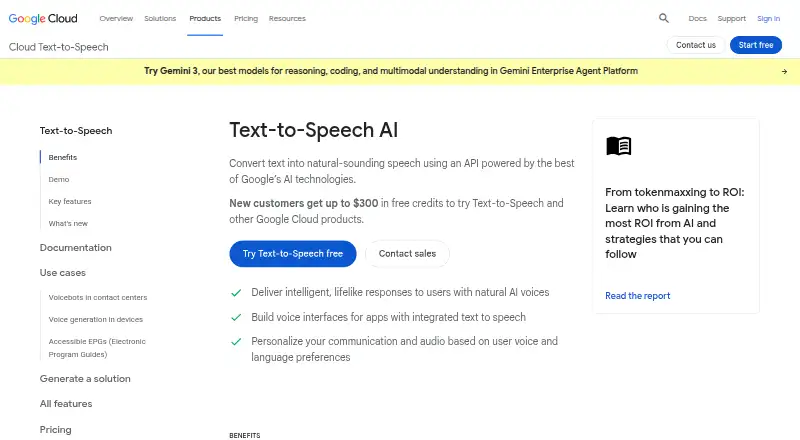
Google Cloud Text-to-Speech is an API for turning text or SSML into speech audio for applications.
What Google Cloud Text-to-Speech is
Google Cloud Text-to-Speech is an API for turning text or SSML into speech audio for applications. It offers more than 380 voices across more than 75 languages and variants, with requests sent through REST or gRPC and audio available in formats including MP3, LINEAR16, OGG_OPUS, MULAW, and ALAW. Gemini-TTS can produce single- or multispeaker speech, with natural-language prompts to guide style, accent, pace, tone, and emotional expression. Chirp 3 instant custom voice can make personalized voice models from as little as 10 seconds of audio and is available in more than 30 locales. Streaming supports low-latency conversations, while long-audio synthesis accepts up to 1 million bytes of input. The API also offers pitch, speaking-rate, and volume controls. Use cases listed include contact-center voicebots, device voice generation, and accessible electronic program guides. Billing must be enabled and counts input characters, including spaces, newlines, and SSML tags other than the mark tag. Pricing varies by voice model; Standard and WaveNet voices cost US$4 per 1 million characters, with 0 to 4 million characters free.
Good
- More than 380 voices across 75+ languages and variants
- REST and gRPC integration
- Streaming supports low-latency conversations
- Chirp 3 custom voices use as little as 10 seconds of audio
Watch out
- Billing must be enabled to use the service
- Billing counts spaces, newlines, and most SSML tags
- Rates and free usage limits vary by voice model
Who it suits
It suits developers and businesses adding generated speech to applications through an API. Its voice choices, speech controls, streaming, and custom-voice options serve a range of speech-generation needs.
Verdict
Google Cloud Text-to-Speech combines a broad voice catalog with controls for speech style and delivery. Check the billing rules and the rate for the voice model you plan to use.
Plans and prices
From Google Cloud Text-to-Speech's own pricing page, checked 15 Oct 2026.
| Plan | Price | What it gives you |
|---|---|---|
| Standard voices | $4 a month | 0–4 million characters free · per 1 million characters after 4 million free characters |
| WaveNet voices | $4 a month | 0–4 million characters free · per 1 million characters after 4 million free characters |
| Neural2 voices | $16 a month | 0–1 million characters free · per 1 million characters after 1 million free characters |
| Polyglot voices | $16 a month | 1 million characters free usage · Price after free usage limit is reached |
| Chirp 3: HD voices | $30 a month | 0–1 million characters free · low-latency streaming · expressive conversational voices · per 1 million characters after 1 million free characters |
| Studio voices | $160 a month | 0–1 million characters free · per 1 million characters after 1 million free characters |
| Instant custom voice | $60 a month | no free usage · personalized voice models · per 1 million characters |
| Gemini 2.5 Flash TTS and Gemini 2.5 Flash-Lite Preview TTS | — | Input: $0.50 per 1 million text tokens · Output: $10.00 per 1 million audio tokens · No free usage limit listed |
| Gemini 3.1 Flash TTS | — | Preview · Input: $1.00 per 1 million text tokens · Output: $20.00 per 1 million audio tokens · No free usage limit listed |
| Gemini 3.1 Flash TTS (Preview) | — | No free usage limit · Input tokens: $1.00 per 1 million text tokens; output tokens: $20.00 per 1 million audio tokens |
| Gemini 2.5 Pro TTS | — | No free usage limit · Input tokens: $1.00 per 1 million text tokens; output tokens: $20.00 per 1 million audio tokens |
| Gemini 2.5 Flash TTS / Gemini 2.5 Flash-Lite Preview TTS | — | No free usage limit · Input tokens: $0.50 per 1 million text tokens; output tokens: $10.00 per 1 million audio tokens |
| Gemini 3.8 Flash TTS (Preview), through Dec 31, 2026 | — | No free usage limit · Input tokens: $0.50 per 1 million text tokens; output tokens: $9.00 per 1 million audio tokens |
| Gemini 3.8 Flash-Lite TTS (Preview), through Dec 31, 2026 | — | No free usage limit · Input tokens: $0.50 per 1 million text tokens; output tokens: $6.00 per 1 million audio tokens |
The facts
Each one read from Google Cloud Text-to-Speech's own pages, with the date it was checked.
What it does
- API access
- Yeschecked 20 Sep 2026
- API positioning
- The product is an API powered by Google AI technologies for generating natural-sounding speech.checked 15 Oct 2026
- Audio formats
- The service can return formats including MP3, Linear16 and OGG Opus.checked 15 Oct 2026
- Authentication
- Client libraries support Application Default Credentials for programmatic authentication.checked 15 Oct 2026
- Chirp 3 HD
- Chirp 3 HD voices provide low-latency streaming, expressive intonation and human disfluencies for conversational agents.checked 15 Oct 2026
- Commercial use
- Yeschecked 20 Sep 2026
- Compliance
- Google Cloud describes ISO 27001/27017/27018/27701, SOC 1/2/3, PCI DSS and FedRAMP offerings plus GDPR and HIPAA alignment.checked 15 Oct 2026
- Custom voices
- Chirp 3 instant custom voice can create personalized voice models with as little as 10 seconds of audio input and is available in more than 30 locales.checked 4 Oct 2026
- Developer APIs
- Google documents REST v1 and v1beta1 APIs, gRPC APIs, authentication guidance and client libraries.checked 15 Oct 2026
- Documentation depth
- Documentation includes product basics, quickstarts, SSML tutorials, voice catalogs, API references, authentication, samples and release notes.checked 15 Oct 2026
- Export formats
- MP3,LINEAR16,OGG_OPUS,MULAW,ALAWchecked 20 Sep 2026
- Gemini-TTS
- Gemini-TTS supports single- and multispeaker synthesis with natural-language control of style, accent, pace, tone and emotion.checked 15 Oct 2026
- Instant custom voice
- Instant custom voice can create a personalized voice model from as little as 10 seconds of audio in more than 30 locales.checked 15 Oct 2026
- Integrations
- GetApp lists integrations including Cloud Vision API, YouTube, Unity and Studio.checked 15 Oct 2026
- Interfaces and formats
- Applications can integrate through REST or gRPC requests, and output formats include MP3, Linear16, and OGG Opus.checked 4 Oct 2026
- Latest release
- On December 30, 2025, Chirp 3 HD added preview synthesis for Chinese Hong Kong (yue-HK).checked 15 Oct 2026
- License
- The public Google API protocol definition is licensed under Apache License 2.0; the hosted synthesis service itself is proprietary.checked 15 Oct 2026
Money
- Billing limit
- Billing counts input characters including spaces, newlines, and SSML tags except the mark tag, and billing must be enabled to use the service.checked 4 Oct 2026
- Free plan
- Nochecked 20 Sep 2026
The company
- Company founded
- Google's official history dates the company's beginnings to 1998.checked 15 Oct 2026
- Company headquarters
- Google's official history identifies the Googleplex in Mountain View, California as its headquarters.checked 15 Oct 2026
- Company legal name
- Google's terms identify the provider as Google LLC.checked 15 Oct 2026
- Company size
- LinkedIn lists Google as a public software-development company with 10,001-plus employees and headquarters in Mountain View, California.checked 15 Oct 2026
Where it runs
- GetApp feature ratings
- GetApp reports AI voices 4.8/5, custom voices 5.0/5, multilingual support 5.0/5, API 5.0/5 and SSML 5.0/5 from small review subsets.checked 15 Oct 2026
The full review of Google Cloud Text-to-Speech
Google Cloud Text-to-Speech turns text or SSML into audio through an API, with both conventional voice options and newer prompted speech models. It suits developers building speech into apps, devices, or voicebots, especially when they need flexible voice controls and output formats.
Overview
The service spans more than 380 voices across more than 75 languages and variants, with REST and gRPC integration and streaming synthesis for real-time conversations. Its range is a practical advantage for products serving different markets or needing responsive spoken interaction; it is less compelling for someone who simply wants a ready-made listening app rather than an API.
There are several distinct billing approaches, from per-character voice rates to token-priced Gemini models. Billing must be enabled, and input character counts include spaces, newlines, and SSML tags other than the mark tag, so the effective cost depends on both the chosen model and how the text is formatted.
Key features
Voice choice and direction
Gemini-TTS can generate single- or multispeaker speech and accept natural-language direction for style, accent, pace, tone, and emotional expression. That gives developers more control over delivery than a voice choice alone, though the best fit depends on the model and its separate pricing. Chirp 3 instant custom voice can create a personalized voice model from as little as 10 seconds of audio and is available in more than 30 locales.
Generation controls and integration
The API supports streaming for low-latency conversations and long-audio synthesis for inputs up to 1 million bytes. Pitch can shift by up to 20 semitones, speaking rate can range from four times slower to four times faster than normal, and volume gain spans -96 dB to +16 dB. Output formats include MP3, Linear16, OGG Opus, MULAW, and ALAW, giving developers options for different delivery needs.
Security and support
Google Cloud maps security, privacy, and compliance controls to standards and uses independent certifications, attestations, and audit reports for verification. Documentation includes guides, API references, quotas and limits, release notes, and a support resource. These are useful foundations for production integration, but they do not remove the need to check quotas and billing against a particular workload.
Pricing
The service is usage-priced rather than a conventional seat-based subscription. Standard and WaveNet voices each show free, with 0 to 4 million characters free and a rate of US$4 per 1 million characters thereafter. Those are the lowest stated per-character rates and suit high-volume speech where those voice tiers meet the quality and control needs.
Chirp 3: HD voices show free, with 0 to 1 million characters free, then US$30 per 1 million characters. Studio voices also show free and 0 to 1 million characters free, then US$160 per 1 million characters. Instant custom voice shows free at US$60 per 1 million characters, with no free usage limit. These rates make the voice choice a significant cost decision: higher-end and personalized options cost more per character, and custom voice has no stated free allowance.
Gemini model billing is token-based and has no free usage limit stated. Gemini 2.5 Flash TTS and Gemini 2.5 Flash-Lite Preview TTS are priced at $0.50 per 1 million text tokens and $10.00 per 1 million audio tokens; Gemini 3.1 Flash TTS (Preview) at $1.00 and $20.00, respectively; Gemini 2.5 Pro TTS at $1.00 and $20.00; and Gemini 3.8 Flash TTS (Preview), through Dec 31, 2026, at $0.50 and $9.00. New customers can receive $300 in Google Cloud credits to try Text-to-Speech and other Google Cloud products. The credit is a trial opportunity, not a recurring allowance.
Platforms
Google Cloud Text-to-Speech is available through API and web access. Its REST and gRPC requests make it suited to software integration, while the documented voicebot, device speech, and accessible electronic program guide uses show the range of applications it can serve. Commercial use is supported.
Who it's for
Choose it if you are building an application or service that needs broad language and voice coverage, controllable speech delivery, streaming, or an API-based custom voice option. It is also a strong fit when audio format and integration choices matter. Look elsewhere if you want a consumer-focused reader or a simple fixed subscription: the model-specific usage rates and character-count billing require cost planning.
Pros and cons
- Pros: More than 380 voices across more than 75 languages and variants give developers wide coverage.
- Pros: Gemini-TTS prompting, extensive speech controls, streaming, and long-audio support suit varied and interactive applications.
- Pros: Multiple export formats and REST or gRPC integration offer implementation flexibility.
- Cons: Billing varies by voice or model, and input characters such as spaces and SSML tags count toward usage.
- Cons: The API-centered offering is not aimed at people seeking a standalone text-to-speech listening app.
Alternatives
ElevenLabs is worth considering for a freemium API-and-web option with a free tier of 10,000 credits per month and three Studio projects; its Starter plan is $6 a month.
Typecast may suit users who want Android or iOS access alongside web and API support, with a free tier offering three projects, 3,000 lifetime credits, 1 GB storage, and 720p video exports.
Amazon Polly is another paid API-and-web service with a free plan; its Standard plan is $4 a month for Standard voices and speech or Speech Marks requests.
Fish Audio is an alternative with a free tier offering 8,000 monthly credits, up to seven minutes of generation, and up to 500 characters per generation, as well as self-hosted and desktop platform options.
Murf AI may be preferable for a web, API, or Windows workflow organized around projects: its free tier includes 10 projects and 10 minutes of voice generation, but no downloads.
Azure AI Speech offers a free tier of 500,000 characters per month and pay-as-you-go text-to-speech billed per character, making it a comparable API-and-web option for usage-priced deployment.
Speechify is an option for people who want Android, iOS, desktop, or web access; its free tier includes 10 voices and a maximum speed of 1.5x.
Inworld TTS is another freemium API-and-web alternative, with on-demand TTS-2 priced at $25 per 1M characters and TTS-2 Flash at $15 per 1M characters, plus free evaluation and prototyping.
For a broader comparison, browse AI Voice Generators, Text-to-Speech Software, or Game Voice Generators.
Verdict
Google Cloud Text-to-Speech is best for developers who need broad voice coverage, fine-grained delivery controls, and API-based speech generation. Its strongest reason to choose it is the combination of voice range, streaming, and flexible synthesis; its strongest reason to look elsewhere is the varied usage pricing, which calls for careful model and billing choices.
Alternatives to Google Cloud Text-to-Speech
- 1
Voicebox
Free planOpen sourceAndroidiOSWebAPI9.3From $12 a year - 2
Speechify
Free planAndroidiOSWebAPI9.0From $10 a month - 3
Resemble AI
Free planAndroidiOSWebAPI9.0From $280 a month - 4
iSpeech
Free planOpen sourceAndroidiOSWebAPI9.0Free plan - 5

Fliki
Free planAndroidiOSWebAPI8.8From $28 a month - 6
Voice.ai
Free planAndroidiOSWebAPI8.8From $5 a month