kepler.gl
kepler.gl is a free, MIT-licensed web application for exploring and analyzing large-scale geolocation data.
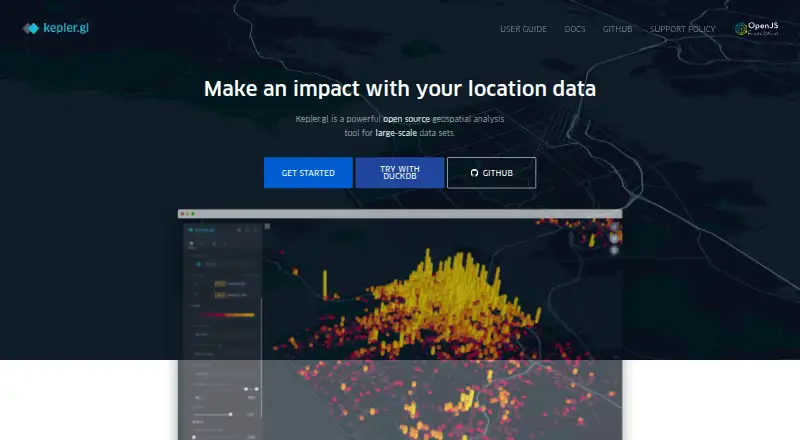
What kepler.gl is
kepler.gl is a free, MIT-licensed web application for exploring and analyzing large-scale geolocation data. Built on MapLibre GL and deck.gl, it can render millions of points and perform spatial aggregations in a browser. Users can import CSV, GeoJSON, DataFrame, GeoDataFrame, or WKT data, or start with samples. Documented layers include points, arcs, lines, grids, polygons, clusters, icons, hexbins, heatmaps, H3, S2, trips, and vector or raster tiles. Analysis tools cover filters, time playback, SQL Data Explorer, an AI Assistant, 3D maps, and split maps. The demo runs client-side, keeping uploaded data in the browser rather than sending or storing it on backends. Maps can be exported as images, CSV, or JSON and shared through a public Dropbox URL. As a React component using Redux, it can be embedded in React-Redux applications. Mapbox and MapLibre base maps are supported, and API setup requires a Mapbox account and access token.
Good
- Free MIT-licensed software
- Renders millions of points in-browser
- Many map layer and analysis options
- Client-side demo keeps uploads in browser
- Embeddable React-Redux component
Watch out
- API setup requires a Mapbox account and token
- Demo has no backend storage
- JupyterLab requires an extension
Who it suits
It suits developers, analysts, and teams exploring location data in browsers or embedding maps in React-Redux applications. Users wanting self-hosted or notebook workflows can also use its documented Jupyter integration.
Verdict
kepler.gl offers extensive geospatial visualization and analysis without paid plans. Its client-side handling, React embedding, and broad import formats make it flexible, while Mapbox setup requirements matter for API users.
Plans and prices
From kepler.gl's own pricing page, checked 9 Oct 2026.
| Plan | Price | What it gives you |
|---|---|---|
| Open-source software | Free | MIT-licensed software · no paid plans or pricing stated on the pages reviewed |
The facts
Each one read from kepler.gl's own pages, with the date it was checked.
What it does
- Analysis tools
- The user guide describes filters, time playback, SQL Data Explorer, an AI Assistant, 3D maps, and split maps.checked 9 Oct 2026
- Data formats
- The Jupyter guide lists CSV, GeoJSON, DataFrame, GeoDataFrame, and WKT as supported data formats.checked 9 Oct 2026
- Data handling
- The save-and-export guide says the demo app is client-side only, keeps uploaded data in the browser, and does not send or store user data on backends.checked 9 Oct 2026
- Data import
- The getting-started guide says users can upload CSV or GeoJSON files or use sample data.checked 9 Oct 2026
- Embeddable
- Kepler.gl is a React component that uses Redux and can be embedded and customized in other React-Redux applications.checked 9 Oct 2026
- Exports and sharing
- The demo app guide describes exporting maps as images, CSV data, and JSON, and sharing a public URL through Dropbox.checked 9 Oct 2026
- Jupyter integration
- The documentation provides a kepler.gl Jupyter Notebook guide and says JupyterLab users need to install the JupyterLab extension.checked 9 Oct 2026
- License
- The project license is MIT.checked 9 Oct 2026
- Map providers
- The release notes state that both Mapbox and MapLibre base maps are supported.checked 9 Oct 2026
- Notable requirement
- The API setup guide says an application using kepler.gl needs a Mapbox account and access token.checked 9 Oct 2026
- Purpose
- Kepler.gl is a web-based application for visual exploration and analysis of large-scale geolocation data.checked 9 Oct 2026
- Rendering
- Built on MapLibre GL and deck.gl, it can render millions of points and perform spatial aggregations in the browser.checked 9 Oct 2026
- Storage integrations
- The cloud-provider documentation says the application has no backend but provides integration points for optional commercial backends.checked 9 Oct 2026
- Visualization layers
- Documented layer types include point, arc, line, grid, polygon, cluster, icon, hexbin, heatmap, H3, S2, trip, vector tile, and raster tile layers.checked 9 Oct 2026
Alternatives to kepler.gl
- 1

Felt
Free planAndroidiOSWebAPI8.2From $199 a month - 2
NASA WorldWind
Free planOpen sourceAndroidWebAPILinux7.9Free plan - 3

Maptitude
AndroidiOSWebAPI7.8From $795 a year - 4
Mapbox Studio
Free planAndroidiOSWebAPI7.7Free plan - 5
StatSilk
Free planAndroidiOSWebAPI7.7From $495 a year - 6

GIS Cloud
Free planAndroidiOSWebAPI7.5From $5 a month