Kargo
Kargo is an open-source continuous promotion orchestration layer for moving applications through deployment stages in Kubernetes environments.
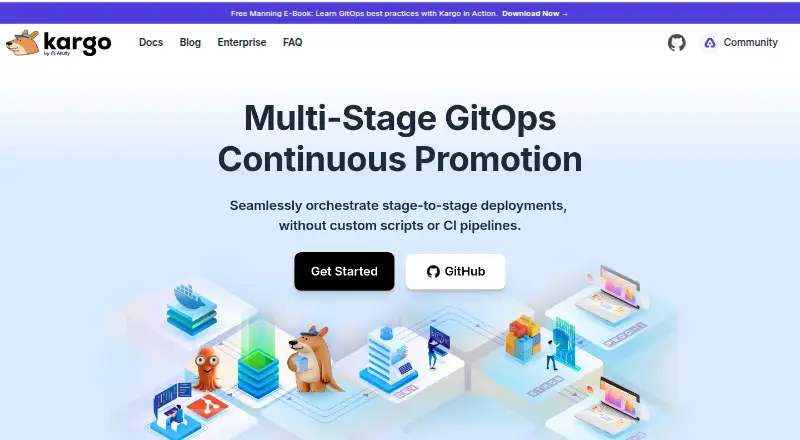
What Kargo is
Kargo is an open-source continuous promotion orchestration layer for moving applications through deployment stages in Kubernetes environments. It complements Argo CD and lets teams build customizable pipelines for advancing changes between environments. A cross-environment view and tracking for Git artifacts, container images, and Helm charts help make changes visible as they move. Verification checks can run at stages before an artifact proceeds downstream. Documented promotion steps cover Git operations, Helm, Kustomize, Argo CD, and HTTP requests to external services. Kargo Enterprise additionally lists Jira, ServiceNow, JFrog Evidence, GitHub Actions, and Slack or email notifications, along with automatic return to a stage’s last stable artifact when verification fails. The open-source distribution uses the Apache 2.0 license. A basic installation needs a Kubernetes cluster, and the documentation says Kargo works best with Argo CD. Its default configuration is intended only for trials in a local cluster that is not internet-facing. Akuity Pro, which includes one Kargo instance, is listed at $495 a month; Enterprise pricing requires contacting sales.
Good
- Builds customizable promotion pipelines
- Tracks Git artifacts, container images, and Helm charts
- Runs verification checks before downstream promotion
- Documents Git, Helm, Kustomize, Argo CD, and HTTP steps
- Open-source distribution is Apache 2.0 licensed
Watch out
- A basic installation requires a Kubernetes cluster
- Documentation says it works best paired with Argo CD
- Default configuration is only for non-internet-facing local trials
- Open-source version has no time- or severity-bound security backport guarantee
Who it suits
Kargo is aimed at platform teams and DevOps engineers coordinating software delivery across Kubernetes environments. It may suit teams already using Argo CD and looking for staged promotion workflows with verification.
Verdict
Kargo focuses on controlled promotion between Kubernetes deployment stages, with artifact visibility and verification checks. Teams should account for the Kubernetes requirement and the open-source distribution’s stated security-fix backport limit.
Plans and prices
From Kargo's own pricing page, checked 30 Sep 2026.
| Plan | Price | What it gives you |
|---|---|---|
| Akuity Pro (includes 1 Kargo instance) | $495 a month | 1 Kargo instance · 50 Kargo stages included · unlimited target clusters and users · Starts at $ 495/month |
| Akuity Enterprise (includes Kargo) | Priced on request | Custom number of instances and applications · custom number of Kargo stages · self-hosted and on-prem · premium support and dedicated account manager · Contact sales for pricing |
The facts
Each one read from Kargo's own pages, with the date it was checked.
What it does
- Additional integrations
- The guide lists Jira, ServiceNow, JFrog Evidence, GitHub Actions, and Slack or email notifications as Kargo Enterprise integrations.checked 30 Sep 2026
- Artifacts
- Kargo tracks updates from Git artifacts, container images, and Helm charts.checked 30 Sep 2026
- Artifact tracking
- Kargo tracks updates from Git artifacts, container images, Helm charts, and other artifacts.checked 30 Sep 2026
- Change visibility
- Kargo provides a view of changes across environments.checked 30 Sep 2026
- Compliance
- Akuity states that its platform maintains SOC 2 Type II, ISO 27001:2022, PCI DSS 4.0.1, and HIPAA-aligned controls.checked 30 Sep 2026
- Deployment requirements
- The basic installation requires a Kubernetes cluster, and the documentation says Kargo works best paired with Argo CD.checked 30 Sep 2026
- Developer workflow
- Kargo supports promotion and rollback of container images, Kubernetes manifests, and Helm charts.checked 30 Sep 2026
- Guardrails
- Kargo describes built-in processes and guardrails for transitions between environments.checked 30 Sep 2026
- Installation
- The official quickstart offers installation for local Kubernetes setups including Docker Desktop, OrbStack, kind, k3d, and custom environments.checked 30 Sep 2026
- Installation caution
- Kargo’s default configuration is documented as suitable only for trying it in a local cluster that is not internet-facing.checked 30 Sep 2026
- Integrations
- Documented promotion steps include Git operations, Helm, Kustomize, Argo CD, and HTTP requests to external services.checked 30 Sep 2026
- Kubernetes focus
- Kargo is designed for Kubernetes environments and complements Argo CD by orchestrating application promotion between stages.checked 30 Sep 2026
- Licensing
- The open-source Kargo distribution is published under the Apache 2.0 license.checked 30 Sep 2026
- Managed service security
- Akuity says its platform maintains SOC 2 Type II, ISO 27001:2022, and PCI DSS 4.0.1 validation, and HIPAA-aligned controls.checked 30 Sep 2026
- Managed support
- Akuity Enterprise lists premium support and a dedicated account manager among its included features.checked 30 Sep 2026
- Promotion pipelines
- Kargo supports customizable promotion pipelines for multi-stage deployments.checked 30 Sep 2026
- Promotion workflows
- Kargo supports customizable promotion pipelines for moving changes from one environment to another.checked 30 Sep 2026
- Purpose
- Kargo is a continuous promotion orchestration layer for moving applications through deployment stages, and it complements Argo CD for Kubernetes.checked 30 Sep 2026
- Rollback
- Kargo Enterprise can automatically return a stage to its last stable artifact when verification fails.checked 30 Sep 2026
- Security
- Kargo’s operator security documentation covers secure configuration, OpenID Connect, access controls, API tokens, and secrets management.checked 30 Sep 2026
- Support limits
- The open-source distribution has no time- or severity-bound backport guarantee for security fixes.checked 30 Sep 2026
The company
- Company origin
- Akuity says it was founded by Argo co-creators Hong Wang, Jesse Suen, and Alexander Matyushentsev.checked 30 Sep 2026
- Founded
- 2021checked 28 Sep 2026
- Headquarters
- Sunnyvale, California, United Stateschecked 28 Sep 2026
The full review of Kargo
Overview
Kargo is an open-source orchestration layer for promoting Kubernetes applications through deployment stages, particularly for teams already using Argo CD. It suits platform and DevOps teams that need controlled, visible transitions between environments; teams seeking a general-purpose deployment tool or a Kubernetes-free workflow should look elsewhere.
Its value is in coordinating promotions and checks across stages, not replacing the systems that build and deploy applications. Kargo is Apache 2.0 licensed, but its basic installation requires a Kubernetes cluster and works best paired with Argo CD.
Key features
Promotion workflows and artifact visibility
Teams can customize pipelines to move changes from one environment to another, with a view of changes across environments. Kargo tracks updates from Git artifacts, container images, Helm charts, and other artifacts, helping operators follow what is advancing rather than treating each stage change as an isolated action.
Verification and integrations
Stage verification checks can gate an artifact before it advances downstream. Documented steps include Git operations, Helm, Kustomize, Argo CD, and HTTP requests to external services. That combination is useful for teams building Kubernetes promotion workflows around those tools, though it does not imply traffic splitting; Kargo does not provide that capability.
Enterprise capabilities and security
Kargo Enterprise adds integrations with Jira, ServiceNow, JFrog Evidence, GitHub Actions, and Slack or email notifications. It can automatically return a stage to its last stable artifact when verification fails. The operator security guidance covers secure configuration, OpenID Connect, access controls, API tokens, and secrets management. Akuity's managed platform states that it maintains SOC 2 Type II, ISO 27001:2022, and PCI DSS 4.0.1 validation, with HIPAA-aligned controls.
The default configuration is intended only for trying Kargo in a local cluster that is not internet-facing, so it is not a production-ready shortcut. The open-source distribution also has no time- or severity-bound guarantee for backporting security fixes, a meaningful consideration for teams with strict patch obligations.
Pricing
Kargo's open-source distribution is free under the Apache 2.0 license. There is also an Akuity Pro plan at $495 a month, including 1 Kargo instance, 50 Kargo stages, and unlimited target clusters and users. The included instance and stage allowance make Pro a defined option for teams that can work within those limits; teams needing more instances or stages should consider Enterprise.
Akuity Enterprise uses custom pricing and includes a custom number of instances and applications, a custom number of Kargo stages, self-hosted and on-premises options, premium support, and a dedicated account manager. It is the better fit for organizations needing tailored scale or managed support, but pricing requires a sales conversation. The open-source option avoids a subscription while leaving teams without a guaranteed security-fix backport window.
Platforms
Kargo is available for API, Linux, macOS, self-hosted, web, and Windows environments, with Kubernetes as its deployment focus. The basic installation requires a Kubernetes cluster. The quickstart supports local Kubernetes setups including Docker Desktop, OrbStack, kind, k3d, and custom environments. Its deployment model supports both self-hosted and managed use, but the default setup should stay confined to a non-internet-facing local cluster.
Who it's for
Kargo is a strong fit for platform teams and DevOps engineers managing application delivery across multiple Kubernetes environments, especially where Argo CD is already part of the workflow. It is less suitable for teams without Kubernetes, teams looking for traffic-splitting controls, or organizations that need a firm open-source security-fix backport commitment.
Pros and cons
- Pros: Customizable pipelines, cross-environment change visibility, and verification gates give teams explicit control over stage transitions.
- Pros: Tracking Git artifacts, images, and Helm charts plus documented Git, Helm, Kustomize, Argo CD, and HTTP steps supports varied Kubernetes promotion workflows.
- Pros: Enterprise adds automated return to a last stable artifact after failed verification, alongside integrations and premium support.
- Cons: A Kubernetes cluster is required, and Kargo works best alongside Argo CD, limiting its appeal outside that ecosystem.
- Cons: Default configuration is only suitable for a non-internet-facing local trial, so operators must address production security configuration.
- Cons: Open source carries no time- or severity-bound security-fix backport guarantee, and traffic splitting is not supported.
Alternatives
Argo Rollouts is worth considering for a free, self-hosted Kubernetes controller and CRDs when the priority is that controller model rather than Kargo's cross-stage promotion orchestration. Choose KubeVela for a free Apache-2.0 self-hosted Kubernetes control plane instead. PipeCD is another free Apache 2.0 open-source option for teams comparing Kubernetes delivery tools.
Northflank may suit readers looking for a freemium option with a free Sandbox that includes two services, one database, two cron jobs, and always-on compute. HashiCorp Nomad is an alternative for readers evaluating a freemium deployment platform with self-managed enterprise plans. Octopus Deploy is another freemium option with a free plan and trial. Weave GitOps offers an open-source option that requires Kubernetes and Flux. Devtron Release Orchestration has a freemium plan capped at 50 vCPUs, 10 users, and one cluster, plus a self-hosted OSS Plus plan at $499 a month.
For broader category comparisons, browse Progressive Delivery Software and Kubernetes Deployment Tools.
Verdict
Choose Kargo if your platform or DevOps team needs to coordinate verified promotions across Kubernetes stages, particularly alongside Argo CD. Its mix of artifact visibility, configurable transitions, and stage checks addresses a focused delivery problem well. Look elsewhere if you do not run Kubernetes, need traffic splitting, or require a dependable security-fix backport commitment from the open-source distribution.
Alternatives to Kargo
- 1

Garden
Free planOpen sourceWebAPILinuxmacOS8.3From $50 a month - 2
Plural
Free planOpen sourceWebAPILinuxmacOS8.2From $450 a month - 3

PipeCD
Free planOpen sourceWebAPILinuxmacOS7.5Free plan - 4

Octopus Deploy
Free planWebAPILinuxSelf-hosted7.3From $4,330 a year - 5

Qovery
WebAPILinuxmacOS7.1From $299 a month - 6
Argo Rollouts
Free planLinuxmacOSSelf-hostedWindows6.9Free plan