K3s
K3s is a free, certified Kubernetes distribution designed for IoT and edge computing.
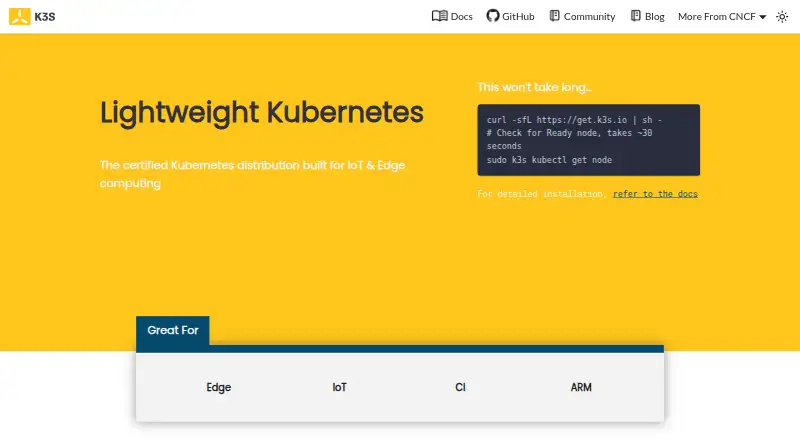
What K3s is
K3s is a free, certified Kubernetes distribution designed for IoT and edge computing. It is self-hosted and comes as a single binary or minimal container image. The site describes the binary as under 70 MB, while the documentation gives a figure under 100 MB. SQLite is the default lightweight datastore, with etcd, MySQL, and Postgres also available. K3s packages components including containerd or cri-dockerd, Flannel, CoreDNS, Traefik, ServiceLB, Kube-router, local-path-provisioner, and Spegel. Documented uses include edge deployments, homelabs, IoT, continuous integration, development, ARM single-board computers, air-gapped environments, and embedded Kubernetes. High availability can use an embedded datastore or external MySQL, PostgreSQL, or etcd. Air-gapped installation guidance covers private registries, manually deployed images, and the embedded registry mirror. Security materials include hardening guidance and CIS benchmark self-assessment guides that assume embedded etcd. Upgrade documentation describes Kubernetes-native automated upgrades through Rancher's system-upgrade-controller. Releases are listed for x86_64, ARMv7, and ARM64. K3s does not natively support Windows.
Good
- Free, certified Kubernetes distribution.
- Available as a single binary or minimal container image.
- Multiple datastore options.
- Supports high-availability setups.
- Documents air-gapped installation options.
Watch out
- Does not natively support Windows.
- Binary size is described differently across site and documentation.
- CIS self-assessment guides assume embedded etcd.
Who it suits
K3s suits users deploying Kubernetes in edge, IoT, homelab, development, or air-gapped settings. It is intended for self-hosted Linux environments and has releases for x86_64, ARMv7, and ARM64.
Verdict
K3s offers a lightweight, self-hosted Kubernetes distribution with documented options for datastores, high availability, and air-gapped installation. Windows users should note that it has no native support for that platform.
Plans and prices
From K3s's own pricing page, checked 7 Oct 2026.
| Plan | Price | What it gives you |
|---|---|---|
| K3s | Free | No price or usage limits stated on the opened official pages |
The facts
Each one read from K3s's own pages, with the date it was checked.
Where it runs
- Air-gapped installs
- The installation guide documents air-gapped setups using a private registry, manually deployed images, or the embedded registry mirror.checked 7 Oct 2026
- Windows support
- The FAQ states K3s does not natively support Windows.checked 7 Oct 2026
What it does
- Community support
- The FAQ directs users to known issues, GitHub issues and discussions, and the K3s channel in Rancher Slack for help.checked 7 Oct 2026
- Datastores
- SQLite is the default lightweight datastore, and etcd, MySQL, and Postgres are also available.checked 7 Oct 2026
- Footprint
- The site describes K3s as a single binary under 70 MB, while the documentation says under 100 MB.checked 7 Oct 2026
- High availability
- K3s supports high-availability setups with an embedded datastore or external MySQL, PostgreSQL, or etcd datastore.checked 7 Oct 2026
- Included components
- K3s packages containerd or cri-dockerd, Flannel, CoreDNS, Traefik, ServiceLB, Kube-router, local-path-provisioner, and Spegel.checked 7 Oct 2026
- Integrations
- The upgrade documentation describes Kubernetes-native automated upgrades using Rancher's system-upgrade-controller.checked 7 Oct 2026
- Packaging
- K3s is distributed as a single binary or minimal container image.checked 7 Oct 2026
- Product
- K3s is a certified, lightweight Kubernetes distribution designed for IoT and edge computing.checked 7 Oct 2026
- Security
- The security documentation provides hardening guidance and CIS benchmark self-assessment guides, which assume K3s runs with embedded etcd.checked 7 Oct 2026
- Supported architectures
- The site lists x86_64, ARMv7, and ARM64 releases.checked 7 Oct 2026
- Use cases
- The documentation lists edge, homelab, IoT, continuous integration, development, ARM single-board computers, air-gapped environments, and embedded Kubernetes as use cases.checked 7 Oct 2026
Alternatives to K3s
- 1

KubeSphere
Free planOpen sourceWebAPILinuxSelf-hosted8.1From $65 a month - 2

Google Kubernetes Engine
Free planWebAPILinuxSelf-hosted7.6Free plan - 3

HashiCorp Nomad
Free planWebAPILinuxmacOS7.3Free plan - 4

Oracle Cloud Infrastructure Container Registry
Free planWebAPILinux7.0Free plan - 5
MicroK8s
Free planLinuxmacOSSelf-hostedWindows6.9From $25 a year - 6

Kubermatic Kubernetes Platform
Free planWebAPILinuxmacOS6.8Free plan