
Javadoc
Javadoc generates HTML API documentation from Java source files and is installed with the Java Development Kit (JDK).
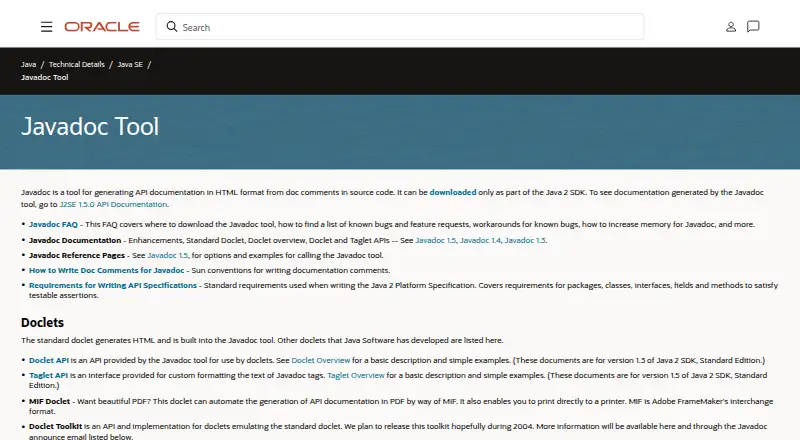
What Javadoc is
Javadoc generates HTML API documentation from Java source files and is installed with the Java Development Kit (JDK). Its standard doclet produces pages for public and protected Java types and members, including classes, interfaces, constructors, methods, and fields. It can process packages, individual source files, or both, and include subpackages recursively. Developers can use alternate doclets to shape the content and format of generated documentation, and taglets to support custom tags in comments. The standard doclet includes DocLint, which can flag common documentation-comment problems but does not check conformance or repair errors. Oracle cautions users to consider issues with output that does not conform or contains executable content such as JavaScript. Oracle lists JDK 25 downloads for Linux, macOS, and Windows. JDK 25 binaries are free under Oracle No-Fee Terms and Conditions through September 2028; later updates use the Java SE OTN License, which may require a production-use fee beyond its limited free grants. Customers with active support contracts can take technical questions to My Oracle Support.
Good
- Included with the Java Development Kit.
- Documents packages, source files, and subpackages.
- Alternate doclets can define output content and format.
- Taglets support custom documentation-comment tags.
- JDK 25 binaries are free through September 2028.
Watch out
- DocLint does not verify conformance or fix errors.
- Oracle warns about non-conformant or executable output.
- Later JDK updates may require production-use fees.
Who it suits
Javadoc suits Java developers who need to generate API documentation from source files and want control over the output format or documentation tags.
Verdict
Javadoc creates structured HTML API pages from Java source, with options for customized output. Its comment checks are limited, and the stated free terms for JDK 25 binaries run through September 2028.
Plans and prices
From Javadoc's own pricing page, checked 4 Oct 2026.
| Plan | Price | What it gives you |
|---|---|---|
| Javadoc (included with JDK 25) | Free | Included with the JDK · JDK 25 binaries are free under Oracle No-Fee Terms and Conditions through September 2028 |
The facts
Each one read from Javadoc's own pages, with the date it was checked.
What it does
- Custom output
- Javadoc supports alternate doclets that define the content and format of generated output.checked 4 Oct 2026
- Custom tags
- Custom tags in documentation comments are supported through taglets.checked 4 Oct 2026
- Inputs
- Javadoc can document whole packages, individual Java source files, or both, and can recursively include subpackages.checked 4 Oct 2026
- JDK inclusion
- The Javadoc tool is installed with the Java Development Kit (JDK).checked 4 Oct 2026
- License limit
- Oracle says JDK 25 updates are free under NFTC through September 2028; subsequent updates use the Java SE OTN License, which may require a fee for production use beyond its limited free grants.checked 4 Oct 2026
- Operating systems
- Oracle lists JDK 25 downloads for Linux, macOS, and Windows.checked 4 Oct 2026
- Output safety
- Oracle advises users to be aware of problems that may arise from non-conformant output or output containing executable content such as JavaScript.checked 4 Oct 2026
- Purpose
- Javadoc generates HTML API documentation pages from Java source files.checked 4 Oct 2026
- Standard output
- The standard doclet generates HTML pages describing public and protected types and members, including classes, interfaces, constructors, methods, and fields.checked 4 Oct 2026
- Support
- Oracle directs customers with active support contracts to My Oracle Support for technical questions and service requests.checked 4 Oct 2026
- Validation
- The standard doclet provides DocLint to help detect common problems in documentation comments, but does not validate their conformance or correct errors.checked 4 Oct 2026
The company
- Founded
- 1977checked 28 Sep 2026
- Headquarters
- Austin, Texas, USAchecked 28 Sep 2026
- Maker founding
- Oracle says it was founded in 1977.checked 4 Oct 2026
The full review of Javadoc
Javadoc is a Java API documentation generator for developers who want reference pages built from source. It is strongest when a team already works with the JDK and wants control over the generated HTML; it is a weaker fit for teams seeking an interactive, hosted API reference.
Overview
Installed with the Java Development Kit, Javadoc turns Java source into HTML documentation. The standard doclet covers public and protected types and members, while alternate doclets let teams change what the output contains and how it is formatted. That makes it a practical choice for Java projects that want documentation generated alongside their code, rather than a separate API publishing service.
Key features
The standard doclet documents classes, interfaces, constructors, methods, and fields. Inputs can be whole packages, individual Java source files, or both, with recursive inclusion of subpackages. This range supports either a focused documentation run or broader coverage of a package tree.
Alternate doclets provide control over output content and format, and taglets allow custom tags in documentation comments. Code samples are supported. Javadoc does not import OpenAPI definitions or provide an interactive API reference, so it is not the right tool when readers need to explore or try API operations in a browser.
DocLint can catch common problems in comments, but it does not establish full conformance or correct mistakes. A review and repair step remains necessary. Oracle also warns that non-conformant output or output containing executable content such as JavaScript can pose problems, so generated pages should be treated with care.
Pricing
The Javadoc tool is included with JDK 25, and the JDK 25 binaries cost nothing under Oracle's No-Fee Terms and Conditions through September 2028. The stated free terms apply to updates only through that date. Later updates use the Java SE OTN License, which may require a fee for production use beyond its limited free grants.
The entry also gives a 30-day trial and identifies a paid pricing model, but the named Javadoc plan is the included-with-JDK option. For technical questions and service requests, Oracle directs customers with active support contracts to My Oracle Support.
Platforms
Oracle lists JDK 25 downloads for Linux, macOS, and Windows. Javadoc is a self-hosted tool installed with the JDK, rather than a hosted documentation service. It also supports deployment models described as both, clustering, an admin console, and containers; supported operating systems include Linux, UNIX, and Windows.
Who it's for
Javadoc suits Java developers and teams that maintain libraries or applications and want API pages generated from source, especially when custom output or project-specific comment tags matter. Look elsewhere if the priority is interactive browsing, OpenAPI import, or a hosted reference portal; its comment checks also leave conformance and correction to the team.
Pros and cons
- Pro: It comes with the JDK, so Java teams can generate reference pages from their existing source and package structure.
- Pro: Alternate doclets and taglets allow customization of output and documentation-comment conventions.
- Con: DocLint only flags common comment problems; it does not validate conformance fully or fix errors.
- Con: There is no OpenAPI import or interactive API reference, limiting its fit for browser-based API exploration.
- Con: Free JDK 25 updates under NFTC end in September 2028, after which production-use terms may involve fees.
Alternatives
For a broader directory of documentation options, see API Documentation Tools. The listed alternatives are profiling products, not direct substitutes for generating Java API reference pages. VisualVM is a free standalone Java troubleshooting tool for Windows, Linux, and macOS, so it is the more relevant choice if Java troubleshooting, rather than documentation, is the need. Grafana Cloud Application Observability offers a freemium observability service with a free allowance of 2,232 host hours, better suited to readers seeking application monitoring. The remaining alternatives are profilers: Scalene is an open-source Python profiler; Parca is an Apache 2-licensed open-source option; py-spy is a sampling profiler for Python programs; Pyroscope offers a free tier with 50 GB ingestion per month and 14-day retention; async-profiler provides Linux and macOS binaries under Apache License 2.0; and Intel VTune Profiler permits commercial and non-commercial use with community support.
Profiling Software is the relevant category if profiling, rather than documentation generation, is the goal.
Verdict
Choose Javadoc if you maintain Java code and want source-based API pages that can be customized through doclets and taglets, with the tool already included in the JDK. Its main limitation is that comment checks are advisory and it lacks interactive and OpenAPI features; teams that need a richer API portal should choose a documentation tool built for that purpose.
Getting started
- Visit Oracle’s Javadoc page
- Obtain a Java Development Kit for your operating system
- Install the JDK, which includes Javadoc
- Provide packages, source files, or both as documentation inputs
- Use the standard doclet or select alternate doclets and taglets
Limits worth knowing
JDK 25 binaries are free under Oracle No-Fee Terms and Conditions through September 2028. Later updates use the Java SE OTN License, which may require a production-use fee beyond its limited free grants; DocLint only detects common problems and does not correct them.
Questions
What does Javadoc generate?
It generates HTML API documentation pages from Java source files.
Is Javadoc included with Java?
Yes. The Javadoc tool is installed with the Java Development Kit.
Which operating systems have JDK 25 downloads?
Oracle lists downloads for Linux, macOS, and Windows.
Can Javadoc process individual files and packages?
Yes. It can document whole packages, individual Java source files, or both, including subpackages recursively.
Does Javadoc support custom documentation formats?
Yes. Alternate doclets can define output content and format, and taglets support custom tags.
How long are JDK 25 binaries free?
They are free under Oracle No-Fee Terms and Conditions through September 2028.
Alternatives to Javadoc
- 1
Grafana Cloud Application Observability
Free planAndroidiOSWebAPI8.4From $0.03 a month - 2
Grafana Alerting
Free planWebLinuxmacOSWindows6.8$0.03 usage-based - 3
YourKit .NET Profiler
Free planAPILinuxmacOSWindows6.8From $99 a year - 4

Amazon CodeGuru Profiler
Free planWebAPILinuxSelf-hosted6.7From $0.01 a month - 5
Pyroscope
Free planWebLinuxmacOSWindows6.7From $19 a month - 6

Parca
Free planWebAPILinuxSelf-hosted6.6Free plan