Jaeger
Jaeger is a free, open-source platform for distributed tracing in complex systems.
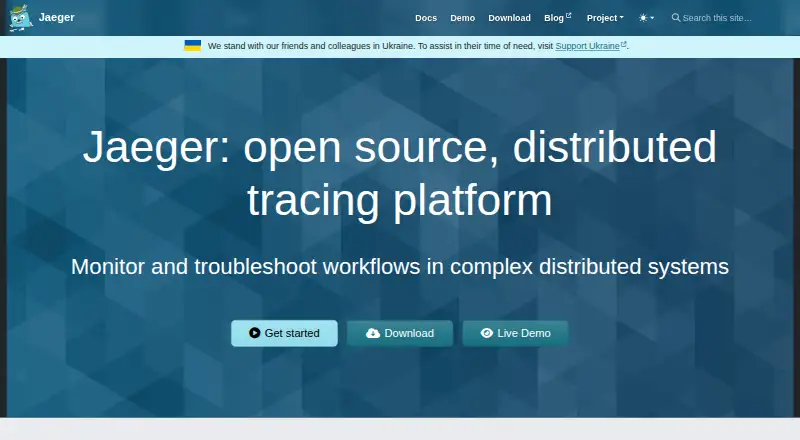
What Jaeger is
Jaeger is a free, open-source platform for distributed tracing in complex systems. Teams can use it to locate performance bottlenecks, investigate root causes, and examine dependencies among services. It accepts trace data through OpenTelemetry Protocol (OTLP) and can ingest Zipkin spans over HTTP in Thrift, JSON v1/v2, and Protobuf formats. Its interface provides System Architecture and Deep Dependency Graph service views, while Service Performance Monitoring derives aggregate metrics from traces and presents them as time-series charts. Sampling options include head-based sampling with centralized static or adaptive configuration, as well as tail-based sampling. Supported distributed storage backends include Cassandra, Elasticsearch, and OpenSearch; ClickHouse is experimental behind a feature gate. Jaeger v2 is available as executable binaries and container images, and the all-in-one setup runs collector and query components together with transient in-memory storage. It is self-hosted, so storage capacity and scale depend on the selected infrastructure. Jaeger v1 reached end of life on December 31, 2025 and no longer receives updates.
Good
- Free and open source.
- Accepts OpenTelemetry and Zipkin trace data.
- Includes service architecture and dependency graph views.
- Offers head-based and tail-based sampling.
- v2 binaries and container images are available.
Watch out
- Self-hosted storage capacity and scale depend on infrastructure.
- ClickHouse support is experimental.
- Jaeger v1 no longer receives updates.
Who it suits
Jaeger suits teams that need to trace and troubleshoot complex distributed systems using a self-hosted tool. Users should distinguish current v2 availability from the discontinued v1 lifecycle.
Verdict
Jaeger offers distributed tracing, service views, and sampling options without a software price, but users provide the infrastructure. Jaeger v1 is end of life; the project makes v2 available in binaries and container images.
Plans and prices
From Jaeger's own pricing page, checked 3 Oct 2026.
| Plan | Price | What it gives you |
|---|---|---|
| Jaeger | Free | 100% open source · self-hosted deployment · storage capacity and scale depend on chosen infrastructure |
The facts
Each one read from Jaeger's own pages, with the date it was checked.
What it does
- Artifact verification
- The download page says binary releases include SHA-256 checksum files and cryptographic signatures.checked 3 Oct 2026
- Community support
- The project directs users to CNCF Slack, GitHub issues and discussions, and Stack Overflow for contact and help.checked 3 Oct 2026
- Deployment
- Jaeger v2 is available as executable binaries and container images, and the all-in-one setup runs collector and query components in one process with transient in-memory storage.checked 3 Oct 2026
- Notable lifecycle limit
- Jaeger v1 reached end of life on December 31, 2025 and no longer receives updates.checked 3 Oct 2026
- Open source
- The project describes Jaeger as 100% open source and cloud native.checked 3 Oct 2026
- Performance monitoring
- Service Performance Monitoring computes aggregate metrics from traces and visualizes them as time-series charts.checked 3 Oct 2026
- Purpose
- Jaeger is an open-source distributed tracing platform for monitoring and troubleshooting workflows in complex distributed systems.checked 3 Oct 2026
- Sampling
- Jaeger supports head-based sampling with centralized remote configuration, including static or adaptive configuration, and tail-based sampling.checked 3 Oct 2026
- Security
- Jaeger documents TLS and mutual TLS support for several component connections, plus bearer-token authentication between browser and UI.checked 3 Oct 2026
- Service graphs
- The UI supports System Architecture and Deep Dependency Graph service graphs.checked 3 Oct 2026
- Storage integrations
- Primary supported distributed storage backends are Cassandra, Elasticsearch, and OpenSearch; ClickHouse is experimental behind a feature gate.checked 3 Oct 2026
- Tracing protocol
- Jaeger can receive trace data using the OpenTelemetry Protocol (OTLP).checked 3 Oct 2026
- Troubleshooting
- Jaeger helps identify performance bottlenecks, track root causes, and analyze service dependencies.checked 3 Oct 2026
- Zipkin compatibility
- Jaeger accepts Zipkin spans over HTTP in Thrift, JSON v1/v2, and Protobuf formats.checked 3 Oct 2026
The company
- Founded
- 2016checked 23 Sep 2026
Where it runs
- Supported desktop platforms
- The download page lists binaries for macOS, Linux, and Windows.checked 3 Oct 2026
The full review of Jaeger
Overview
Jaeger is an open-source platform for tracing requests across complex distributed systems. It suits teams that can operate their own observability infrastructure and need to investigate bottlenecks, root causes, and service dependencies.
Its tracing and service-graph capabilities make it a focused option for diagnosing distributed workflows, but storage, capacity, and scale are yours to manage. New deployments should use Jaeger v2: v1 reached end of life on December 31, 2025, and no longer receives updates.
Key features
Jaeger accepts trace data through OpenTelemetry Protocol (OTLP) and can ingest Zipkin spans over HTTP in Thrift, JSON v1/v2, and Protobuf formats. That gives teams using either protocol a way to feed traces into Jaeger without making its own instrumentation format the only option.
For investigation, the UI provides System Architecture and Deep Dependency Graph views. Service Performance Monitoring also turns trace data into aggregate metrics and time-series charts. These tools help teams move from an individual request to broader service relationships and performance patterns; they do not replace the work of running the storage and collection infrastructure.
Sampling includes head-based options with centralized remote configuration, which can be static or adaptive, as well as tail-based sampling. This gives operators choices about which traces to retain, though deciding how to configure sampling remains an operational responsibility.
Primary distributed storage integrations are Cassandra, Elasticsearch, and OpenSearch. ClickHouse support is experimental and behind a feature gate, so it is not on the same footing as the primary backends. Security documentation covers TLS and mutual TLS for several component connections, plus bearer-token authentication between the browser and UI.
Jaeger v2 is distributed as executable binaries and container images. Its all-in-one setup runs collector and query components together, but uses transient in-memory storage; it is suitable for a lightweight start, not durable trace retention. Binary releases include SHA-256 checksums and cryptographic signatures. The project has been active since 2016 and describes itself as cloud native and fully open source; community help is available through CNCF Slack, GitHub issues and discussions, and Stack Overflow.
Pricing
Jaeger — free. The plan is 100% open source and self-hosted. There is no software price, but storage capacity and scale depend on the infrastructure you choose and operate. Jaeger has no free trial because its plan is free.
This fits teams that want control over deployment and can provide the supporting infrastructure. It is less suitable for readers seeking a managed service or a predictable, bundled storage allowance: the plan leaves those costs and operational decisions to the user.
Platforms
Jaeger supports API, Linux, macOS, self-hosted, web, and Windows. Downloadable desktop binaries are available for Linux, macOS, and Windows, while the deployment model is self-hosted.
Who it's for
Jaeger is a strong fit for engineering teams tracing distributed services that want open-source tooling, protocol flexibility, service graphs, and control over where trace data is stored. It is especially practical when the team already operates compatible storage such as Cassandra, Elasticsearch, or OpenSearch.
Look elsewhere if you need real user monitoring: Jaeger does not provide it. Also consider another option if your priority is managed hosting, built-in storage quotas, or a supported v1 installation; v1 no longer receives updates.
Pros and cons
- Pros: No software charge and a fully open-source, self-hosted deployment let teams control their tracing stack.
- Pros: OTLP and several Zipkin span formats support integration with more than one tracing protocol.
- Pros: Service graphs, trace-derived performance charts, and multiple sampling approaches support both request-level and service-level investigation.
- Cons: Storage capacity and scale rely on infrastructure the user provides and operates.
- Cons: The all-in-one setup stores data only in transient memory, limiting its role to non-durable use.
- Cons: Jaeger v1 is end of life and receives no updates, making v2 the relevant choice for new deployments.
- Cons: ClickHouse is experimental behind a feature gate, unlike the primary supported storage backends.
Alternatives
For another free, self-hosted open-source observability platform, consider Apache SkyWalking. SigNoz offers a self-hosted community plan as well as a cloud option; its community plan puts infrastructure, storage, scaling, upgrades, and backups on the user.
If managed pricing with a stated ingestion allowance matters, Uptrace has a cloud plan with 50 GB free per month, then $0.075/GB, and unlimited users, services, and hosts. OpenZipkin is another open-source project centered on Zipkin code, documentation, specifications, and support.
For a hosted free tier with explicit trace and retention limits, Tracekit offers 200K traces per month, seven-day retention, and one team member on its free plan. Grafana Tempo is another free option.
Honeycomb has a free plan capped at 20M events per month, 100M metrics data points per month, and two triggers. Grafana Cloud Traces offers an always-free plan with 50 GB ingested per month and 14-day retention.
Compare more options in Distributed Tracing Tools and Application Performance Monitoring.
Verdict
Choose Jaeger if your team needs open-source distributed tracing and can run the storage and deployment infrastructure itself. Its protocol support, service views, and sampling options make it a capable choice for troubleshooting complex systems without a software fee. Look elsewhere for managed operations, bundled retention, or real user monitoring.
Alternatives to Jaeger
- 1

TiDB Cloud
Free planOpen sourceWebAPILinuxSelf-hosted8.1Free plan - 2

Aerospike Database
Free planOpen sourceWebAPILinuxmacOS7.8Free plan - 3

RabbitMQ
Free planOpen sourceWebAPILinuxmacOS7.8Free plan - 4

Apache Cassandra
Free planOpen sourceWebAPILinuxmacOS7.7Free plan - 5
Apache RocketMQ
Free planOpen sourceAPILinuxmacOSSelf-hosted7.5Free plan - 6

Honeycomb
Free planAndroidiOSWebAPI7.5From $150 a month