Invisible Hand Technologies
Invisible Hand Technologies turns store-level retail data into recommendations for consumer brands and CPG manufacturers.
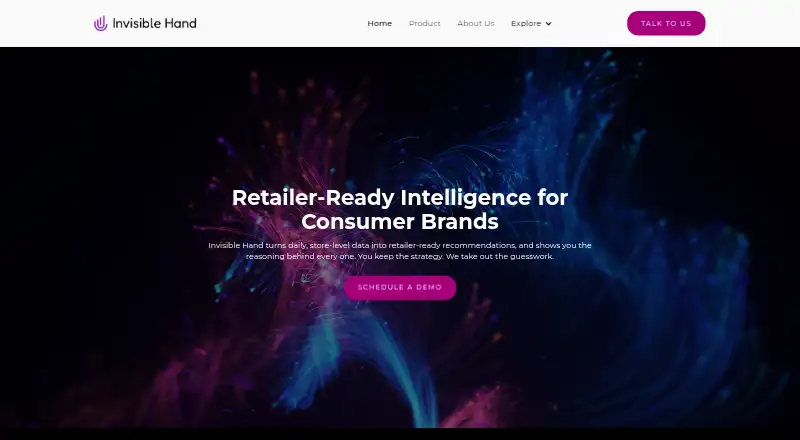
What Invisible Hand Technologies is
Invisible Hand Technologies turns store-level retail data into recommendations for consumer brands and CPG manufacturers. Its price models estimate demand by SKU, retailer, and market to guide price changes intended to benefit both the brand and retailer. Promotion analysis helps distinguish added sales from volume that would have occurred anyway, so teams can assess promotions and rollbacks for their effect on value and margin. The platform traces shifts in sales, margin, or share to factors such as pricing, distribution, availability, and competition, down to individual stores. It also tracks competitor price and promotion trends and provides visibility into out-of-stocks at retailers carrying a customer’s products. Invisible Hand combines store-level data collected up to daily with internal, market, and third-party information. Its models simulate local-market outcomes, while recommendations arrive through dashboards, alerts, and an AI assistant. Users can inspect and challenge the reasoning. The product is web-based, and pricing is available on request; prospective customers can schedule a demo.
Good
- Models demand by SKU, retailer, and market
- Traces sales and margin changes to store-level factors
- Provides competitor pricing and promotion trends
- Recommendations include inspectable reasoning
Watch out
- Web platform only
- Pricing is available on request
Who it suits
It suits consumer brands and CPG manufacturers looking to guide pricing, promotions, and retail decisions with store-level data. Teams wanting to inspect recommendations and monitor availability or competitors may also find its tools relevant.
Verdict
Invisible Hand brings pricing, promotion, and retail diagnostics together for consumer brands and CPG manufacturers. Buyers should contact the company for pricing and assess whether its data-driven recommendations fit their workflows.
The facts
Each one read from Invisible Hand Technologies's own pages, with the date it was checked.
What it does
- AI assistant
- Its AI chat answers questions about what is happening, why, and what to do next using customer data and optimization models.checked 8 Oct 2026
- AI data assistant
- Users can ask questions about what is happening, why, or what to do next, with answers powered by their data and the company’s optimization models.checked 7 Oct 2026
- Availability
- The product provides out-of-stock visibility across retailers that stock a customer’s products.checked 8 Oct 2026
- Competitive intelligence
- The product provides real-time insight into competitors’ pricing and promotion trends.checked 8 Oct 2026
- Customers
- The product provides AI-powered price optimization for consumer brands and CPG manufacturers.checked 8 Oct 2026
- Data inputs
- The company says it collects store-by-store price, promotion, and availability data across retail fleets, up to daily, and combines it with internal, market, and third-party data.checked 8 Oct 2026
- Intended users
- The product page describes the platform as serving consumer brands and CPG manufacturers.checked 7 Oct 2026
- Modeling
- The company says its machine-learning engine models volume, price, and elasticity for each local market and simulates outcomes before users act.checked 8 Oct 2026
- Out-of-stock visibility
- The platform provides out-of-stock visibility across retailers that stock a customer’s products.checked 7 Oct 2026
- Pricing
- The opened maker pages provide no plan prices or trial terms; the homepage directs visitors to schedule a demo.checked 7 Oct 2026
- Pricing availability
- The maker’s opened homepage and product page direct prospective customers to schedule a demo and do not state plan prices.checked 8 Oct 2026
- Promotion optimization
- It separates incremental sales from subsidized volume to help identify promotions and rollbacks that create value or destroy margin.checked 8 Oct 2026
- Purpose
- Invisible Hand turns daily, store-level data into retailer-ready recommendations and shows the reasoning behind them.checked 8 Oct 2026
- Recommendations
- Recommendations are delivered through dashboards, real-time alerts, and plain-language answers.checked 8 Oct 2026
- Root cause analysis
- It traces changes in sales, margin, or share to drivers including price, promotion, distribution, availability, or competition, down to store level.checked 8 Oct 2026
- Support and sales
- The homepage invites prospective customers to schedule a demo.checked 7 Oct 2026
- Transparency
- The company says users can inspect the data behind recommendations, challenge answers, and stay in control.checked 8 Oct 2026
The company
- Company leadership
- The maker identifies Max Pedró as CEO, Fuchang Yin as CTO, and Mitch Freeman as CPO.checked 8 Oct 2026
- Headquarters and founding
- The company’s LinkedIn profile lists Boston, Massachusetts as its headquarters and 2024 as its founding year.checked 7 Oct 2026
Money
- Price optimization
- It models demand response by SKU, retailer, and market to identify price moves intended to create value for brands and retailers.checked 8 Oct 2026
The full review of Invisible Hand Technologies
Invisible Hand Technologies is a web platform for consumer brands and CPG manufacturers that need store-level guidance on pricing, promotions, availability, and competition. It suits teams managing decisions across multiple retailers and local markets, while smaller businesses looking for a self-serve repricing tool will find the sales-led buying process less convenient. The central advantage is a connected view of causes and likely outcomes rather than isolated price reports.
Overview
The platform combines store-by-store price, promotion, and availability data collected up to daily with internal, market, and third-party data. Its machine-learning engine models volume, price, and elasticity for each local market, then simulates possible outcomes before a user acts. That local modeling can make recommendations more relevant than a single national assumption, particularly when retailer conditions differ materially.
Invisible Hand links changes in sales, margin, or share to price, promotion, distribution, availability, and competition, with analysis down to individual stores. Recommendations are delivered in dashboards and real-time alerts, while an AI data assistant answers what is happening, why it is happening, and what to do next. Users can inspect the data behind an answer and challenge the recommendation, keeping commercial judgment with the team.
Key features
Price and promotion optimization
Price optimization works at SKU, retailer, and market level and uses elasticity analysis to suggest price moves intended to create value for both brand and retailer. Promotion analysis separates incremental sales from subsidized volume, making it useful for deciding whether a discount creates demand or simply gives away margin. This is a better fit for CPG organizations balancing retailer relationships than for merchants wanting a basic automated repricer.
Root-cause and competitive analysis
When performance changes, the root-cause analysis traces the effect to factors such as distribution, availability, competition, price, or promotion. Store-level diagnosis can turn a broad share decline into a more actionable investigation. Competitive intelligence supplies real-time views of rivals’ pricing and promotion trends across a category, supporting continuous rather than occasional monitoring.
Availability and AI guidance
Out-of-stock visibility spans retailers carrying a customer’s products, helping teams distinguish lost demand from weak pricing or promotion. The AI assistant puts the same customer data and optimization models into plain-language questions, while inspectable reasoning provides a check against accepting an unexplained recommendation.
Pricing
Invisible Hand uses paid, custom pricing. The company’s homepage and product page direct prospective customers to schedule a demo, and no subscription prices, plan tiers, free plan, or trial terms are published. Buyers therefore need a sales conversation to establish cost, scope, and commercial fit. That approach may suit enterprise CPG teams needing a tailored deployment, but it offers no low-cost way for a small team to evaluate the product independently.
Platforms
Invisible Hand is delivered through the web. The web format suits distributed brand and revenue-management teams, although the supplied platform coverage does not include a native mobile or desktop application.
Who it's for
This is aimed at consumer brands and CPG manufacturers making pricing, promotion, distribution, and availability decisions across retailers. It is particularly well matched to organizations with enough store-level data to benefit from local elasticity modeling, simulations, competitor monitoring, and continuous alerts. A business that only needs a handful of product prices checked or a simple rule-based repricing workflow should look for a more transparent, self-serve alternative.
Pros and cons
- Pros: SKU-, retailer-, and market-level price recommendations; promotion analysis that distinguishes incremental sales from subsidized volume; root-cause analysis down to individual stores; real-time competitor pricing and promotion insight; retailer-wide out-of-stock visibility; inspectable and challengeable AI recommendations.
- Cons: Custom pricing means there is no published cost for budgeting or comparison; no free plan or trial terms are stated; the sales-demo process may be excessive for smaller teams; web is the only stated platform.
Alternatives
DynamicPricing.ai is the better starting point when a team wants a freemium web product with a free tier covering one price test, one pricing rule, and up to 50 products per rule, plus unlimited monthly orders; its Starter plan is $75 a month for up to 500 orders.
Pricefy fits teams seeking a free or trial-based API and web tool for up to 50 SKUs, five competitors, daily price updates, AI Automatch, competitor discovery, and one feed channel.
Retailgrid is preferable when a freemium API and web workflow with manual imports and seven-day retention is sufficient; its Freemium plan allows up to 500 grid rows, while Starter costs €349 a month.
NIQ is a paid alternative available on Android, iOS, Windows, web, and API.
Peak is a paid API and web option with an Essentials tier that includes five data feeds, two small workspaces, ten workflows, 500 API calls per day per API, one deployed API, one Peak application, one power user, and ten commercial users.
RELEX Demand Planning is a paid web alternative focused on demand planning.
7Learnings is a paid API and web alternative priced through a demo request.
Oracle Retail Assortment Planning Cloud Service is a paid web alternative.
Verdict
Choose Invisible Hand if you are a consumer brand or CPG manufacturer that needs continuous, local-market pricing and promotion recommendations tied to store-level causes, competitor movement, and out-of-stocks. Its strongest differentiator is the combination of simulation, diagnostics, and inspectable AI guidance. Look elsewhere if transparent pricing, a free evaluation, or a lightweight self-serve repricing workflow is more important than enterprise-oriented analysis.
Alternatives to Invisible Hand Technologies
- 1

Beyond
Free planAndroidiOSWebAPI8.0Free plan - 2
Minderest
WebAPIExtension7.0From €500 a month - 3

PriceLabs
AndroidiOSWebAPI6.9From $14.49 a month - 4

Wheelhouse
Free planWebAPI6.6From $12.99 a month - 5
PriceBeam
WebAPI6.5From $995 a month - 6
Omnia Retail
Web6.2From €399 a month