
Retailgrid
Retailgrid is an agentic AI pricing platform for mid-market retailers.
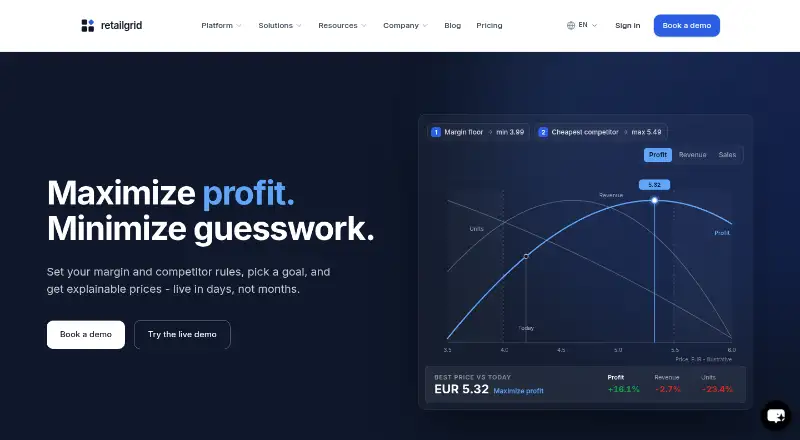
What Retailgrid is
Retailgrid is an agentic AI pricing platform for mid-market retailers. Its workspace brings sales, costs, inventory, competitor prices, and external signals into a spreadsheet-style grid. The Price Optimization agent identifies prices intended to maximize margin or sales volume within configured constraints. Rules-Based Pricing applies margin, competitor, and MAP rules across a catalog. Competitor price monitoring is a separate paid layer; direct competitor domains are listed at €100-€300 per month each, depending on site complexity.
Retailgrid lists native connections for Shopify and Magento, as well as BigCommerce and WooCommerce. Retailers can also import catalog, cost, and sales data by CSV or API for systems without a listed integration. The Freemium plan is free and includes up to 500 grid rows, manual data import, no Agents, and seven-day data retention. Starter costs €349 a month and Growth costs €1,999 a month. Retailgrid says customer data is hosted in European regions on Google Cloud and Microsoft Azure, and encrypted in transit and at rest. It says GDPR governs its personal-data processing; ISO 27001 and SOC 2 certification work is underway, and neither certification is held yet.
Good
- Workspace combines sales, cost, inventory, and competitor data.
- Pricing rules can apply across a catalog.
- CSV and API imports support unlisted systems.
- Paid plans include onboarding and support.
Watch out
- Freemium has no Agents.
- Freemium data retention is seven days.
- Competitor monitoring is separately priced.
- ISO 27001 and SOC 2 certifications are not held.
Who it suits
Retailgrid is aimed at mid-market retailers, including businesses in fashion, food and beverage, electronics, home and living, and other listed sectors. It may suit teams seeking to combine pricing rules, data imports, and price optimization in one workspace.
Verdict
Retailgrid combines retail data review with rule-based pricing and price optimization. Review the row limits, retention periods, and separate competitor-monitoring fees when comparing plans.
Plans and prices
From Retailgrid's own pricing page, checked 14 Oct 2026.
| Plan | Price | What it gives you |
|---|---|---|
| Freemium | Free | Up to 500 grid rows · no Agents · manual data import · 7-day retention · €0/ month |
| Starter | €349 a month | Up to 10,000 grid rows · no Agents · Retailgrid API · AI Chat · 30-day retention · €349/ month |
| Growth | €1,999 a month | Up to 50,000 grid rows · Core Agents · Retail Analytics · Retailgrid API · human chat and video calls · 365-day retention · €1,999/ month |
| Enterprise | Priced on request | Up to 1,000,000 grid rows · all Agents · API plus custom integration · advanced security · dedicated customer-success manager · 730-day retention · Custom |
The facts
Each one read from Retailgrid's own pages, with the date it was checked.
What it does
- AI workspace
- The product provides a structured grid with AI enrichment, elasticity and optimization models, and export-ready pricing decisions.checked 14 Oct 2026
- API
- Retailgrid advertises a public REST API for catalog, cost, sales and price data, with API access beginning on Starter.checked 14 Oct 2026
- Chrome extension
- Retailgrid Price Check can find up to 12 competitor prices, keep daily history and export CSV files; the listing shows version 1.1.0 updated October 3, 2026.checked 14 Oct 2026
- Cloud deployment
- Retailgrid describes itself as cloud-based and says customer data runs on Google Cloud in EU and US regions.checked 14 Oct 2026
- Competitor monitoring
- Competitor prices are collected from crawlers, marketplace APIs and data partners, with standard refreshes every four hours.checked 14 Oct 2026
- Compliance
- Retailgrid says it processes personal data in line with GDPR, while ISO 27001 and SOC 2 certification work is underway and neither certification is held yet.checked 30 Sep 2026
- Data import
- Retailgrid accepts catalog, cost and sales data via CSV upload and API for systems not listed as integrations.checked 30 Sep 2026
- Data sources
- Listed marketplace and price sources include Amazon (SP-API), eBay, bol., Google Shopping, Idealo and PriceRunner.checked 30 Sep 2026
- Documentation
- Public Mintlify documentation covers grids, formulas, agents, pricing runs, dashboards, monitoring, Shopify, AI connections, security sessions and help.checked 14 Oct 2026
- Elasticity analysis
- Retailgrid includes price-elasticity analysis by SKU and segment as a core pricing capability.checked 14 Oct 2026
- Funding
- Retailgrid announced a €358,000 pre-seed round on May 19, 2026, led by Finnish angels with Innovestor Angel CoFund participation.checked 14 Oct 2026
- GMROI
- Enterprise includes an agent intended to optimize price against gross-margin return on inventory.checked 14 Oct 2026
- Integrations
- Listed connections include Shopify, Magento, BigCommerce, WooCommerce, Amazon SP-API, eBay, bol., ManoMano, eMag, Google Shopping, Idealo, PriceRunner, PCA, GetRealPrice, BigQuery, Snowflake, Google Cloud, Azure, Slack and email.checked 14 Oct 2026
- Limit: early-access modules
- The platform footer marks Promotions and Assortment as early-access capabilities.checked 14 Oct 2026
- Limit: MCP scope
- The initial MCP connector could read data but could not create, update or delete rows.checked 14 Oct 2026
- MCP connector
- The public MCP connector supports AI assistants and initially exposed five read-only tools for products, grids and job status.checked 14 Oct 2026
- MCP expansion
- A later announcement says the Claude directory connector expanded from five read-only tools to 41 and can approve proposals and publish prices with guardrails.checked 14 Oct 2026
- Notable news
- On October 12, 2026, Retailgrid announced inclusion in Anthropic’s Claude Connectors Directory.checked 14 Oct 2026
The company
- Company
- The maker identifies itself as Retailgrid Oy and gives a Helsinki, Finland address.checked 30 Sep 2026
- Company legal name
- The company identifies itself as Retailgrid Oy, Business ID 3600291-3, at Maria01 in Helsinki, Finland.checked 14 Oct 2026
- Company size
- LinkedIn lists Retailgrid in the 11–50 employee range and gives Helsinki as headquarters.checked 14 Oct 2026
- Headquarters
- Helsinki, Finlandchecked 28 Sep 2026
Money
- Limit: free tier
- The free tier has no agents, manual-only imports, a 500-row cap and seven-day retention, so it is mainly for small evaluations.checked 14 Oct 2026
- Limit: monitoring cost
- Competitor monitoring is an add-on priced separately, with direct competitor domains listed at €100–€300 per domain per month.checked 14 Oct 2026
The full review of Retailgrid
Retailgrid is a retail pricing platform for mid-market merchants that brings sales, costs, stock and competitor prices into a spreadsheet-style workspace. It is best suited to retailers with substantial catalogs and a need for rule-based pricing or optimization; very small shops may find its paid tiers and separately priced competitor monitoring hard to justify.
Overview
Retailgrid brings retail data together for pricing and assortment decisions, with explainable recommendations as its focus. Its grid combines sales, costs, inventory, competitor prices and external signals, giving teams a shared place to review inputs before acting. The approach suits businesses whose pricing decisions depend on several moving parts, but the row caps and short retention on lower tiers matter if a retailer wants to keep a longer operating history.
Key features
Pricing decisions and controls
The Price Optimization agent proposes prices aimed at maximizing margin or sales volume within configured constraints. Retailgrid also supports promotion and markdown optimization, price-elasticity analysis and continuous optimization. These capabilities make the platform more than a monitoring dashboard, though the agents begin with Growth rather than the free or Starter plans.
Rules-Based Pricing applies margin, competitor and minimum advertised price (MAP) rules across a catalog. That is a practical fit for retailers that need consistent guardrails at scale; those seeking optimization agents on a lower-cost plan will not find them in Freemium or Starter.
Data and connections
Shopify and Magento are native connections, alongside BigCommerce and WooCommerce. Retailgrid also names Amazon SP-API, eBay, bol., Google Shopping, Idealo and PriceRunner among its marketplace and price sources. Catalog, cost and sales data can be imported by CSV or API when a system is not among its integrations, offering a fallback at the cost of manual data work.
Competitor monitoring is a separately priced layer. Direct competitor domains cost €100-€300 per month each, depending on site complexity, so merchants should add that expense when estimating a usable monitoring setup rather than treating it as part of the base subscription.
Pricing
Retailgrid uses a freemium model, with paid plans starting at €349 per month. The tiers scale sharply in row capacity, agent access, support and retention:
| Plan | Price | What it includes |
|---|---|---|
| Freemium | €0.00 per month | Up to 500 grid rows, no Agents, manual import and 7-day retention |
| Starter | €349.00 per month | Up to 10,000 rows, no Agents, Retailgrid API, AI Chat support and 30-day retention |
| Growth | €1,999.00 per month | Up to 50,000 rows, Core Agents, Retailgrid API, human chat and video calls, and 365-day retention |
| Enterprise | Custom pricing | Up to 1,000,000 rows, all Agents, API plus custom integration, a dedicated customer success manager and 730-day retention |
Freemium is useful for a small catalog or initial evaluation, but 500 rows, manual imports and a week of retention make it a narrow ongoing option. Starter substantially raises the row ceiling and adds API access, yet still has no agents and only 30 days of history. Growth is the first listed tier with Core Agents and a full year of retention, making it the meaningful step for teams pursuing automated pricing decisions. Enterprise suits larger catalogs or custom integration needs, with custom pricing. No seat limit is stated for these tiers. Competitor-domain fees are additional.
Paid plans include onboarding and support without a separate implementation fee. Retailgrid says data is hosted on Google Cloud and Microsoft Azure in European regions, encrypted in transit and at rest, with role-based access. It says personal data is processed in line with GDPR; ISO 27001 and SOC 2 certification work is underway, and neither certification is held yet.
Platforms
Retailgrid is available on web and through an API. Retailers relying on systems beyond its native connections can use CSV or API imports, although Freemium is limited to manual imports and Starter is the first tier that includes the Retailgrid API.
Who it's for
Retailgrid is aimed at mid-market retailers, including businesses in fashion, home and living, food and beverage, electronics, hardware and DIY, auto parts, and health and beauty. It is most compelling for teams that need to combine multiple retail data sources with catalog-wide pricing rules or optimization. A smaller shop with only a few products and basic competitor checks is less likely to need its higher row capacities or agent-led workflow.
Pros and cons
- Pros: The grid combines sales, cost, inventory, competitor and external inputs, supporting decisions based on more than price feeds alone.
- Pros: Rules-based pricing and optimization cover margin, competitor and MAP controls, plus promotion, markdown and elasticity use cases.
- Pros: CSV and API imports provide a route for data from systems outside the native connections.
- Cons: Agents are absent from both Freemium and Starter, pushing users who need optimization toward the €1,999-per-month Growth plan.
- Cons: Competitor monitoring adds €100-€300 per month for each direct competitor domain.
- Cons: The free tier retains data for only seven days, while Starter retains it for 30 days; neither is suited to long-term analysis.
- Cons: Retailgrid does not yet hold ISO 27001 or SOC 2 certification.
Alternatives
For a narrower competitor-price monitoring need, consider Pricefy: its free plan covers up to 50 SKUs, five competitors, daily updates and one feed channel, and it also has a $37-per-month Starter plan. It is a more approachable starting point for limited monitoring, while Retailgrid offers the broader retail-data workspace and pricing-agent focus.
Minderest is a paid alternative with API, extension and web platforms; its pricing experts provide pricing information and a demo is requested to see the platform.
Competera is another paid option, with competitive data offering SLA-controlled price monitoring, AI product matching and pay-per-use billing, alongside a Contextual AI plan.
Omnia Retail may suit smaller teams seeking a packaged pricing tier: its SMB Pricing Solutions plan is €399.00 per month for a single shop and up to five users, with AI monitoring, dynamic pricing, plug-and-play integrations, an Omnia Agent and online support.
Priceva has a free Starter plan with up to 6,200 price checks per month, 20 competitors or sites, one region, 20 products and one user, with no overage pricing—useful for tightly bounded monitoring needs.
Dealavo is a paid alternative with a free trial.
Import.io Aperture is a paid web-based alternative.
Competitors offers a free plan and a $49-per-month Starter tier covering 500 SKUs, three competitors, daily checks and email alerts.
For category-wide comparisons, browse Competitor Price Monitoring Software or Retail Pricing Software.
Verdict
Retailgrid is a strong fit for mid-market retailers that want one workspace for retail data, catalog rules and agent-led price optimization, and can support the Growth plan and extra monitoring fees. Look elsewhere if you need only low-cost competitor checks, or if certification status is a deciding requirement.
Getting started
- Open the Retailgrid website
- Choose Freemium, Starter, Growth or an Enterprise custom plan
- Connect Shopify, Magento, BigCommerce or WooCommerce
- Upload catalog, cost and sales data by CSV or API
- Configure pricing rules and optimization constraints
Limits worth knowing
Freemium allows up to 500 grid rows, manual data import, no Agents and seven-day retention. Starter allows up to 10,000 rows but still has no Agents; Growth allows 50,000 rows with Core Agents and 365-day retention.
Questions
Is Retailgrid free?
Yes. The Freemium plan costs nothing and includes up to 500 grid rows.
What does Retailgrid Starter cost?
Starter costs €349 a month.
Which commerce platforms connect natively?
Retailgrid lists Shopify, Magento, BigCommerce and WooCommerce as native connections.
Can data be imported without a listed integration?
Yes. Catalog, cost and sales data can be brought in through CSV upload or API.
How much does competitor price monitoring cost?
Direct competitor domains are listed at €100-€300 per month each, depending on site complexity.
Who makes Retailgrid?
The maker is Retailgrid Oy, based in Helsinki, Finland.
Alternatives to Retailgrid
- 1
Pricefy
Free planWebAPIExtension7.5From $49 a month - 2
EDITED Pricing
AndroidiOSWebAPI7.1 - 3

Shopify
Web7.1From $29 a month - 4
Minderest
WebAPIExtension7.0From €500 a month - 5

DynamicPricing.ai
Free planWeb6.8From $75 a month - 6

NIQ
AndroidiOSWebAPI6.8