Pricefy
Pricefy monitors competitor prices, matches products, supports repricing, and publishes product feeds to shopping channels.
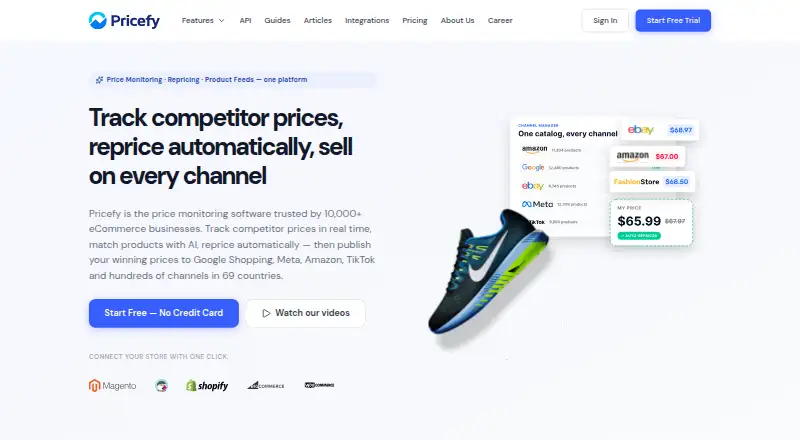
What Pricefy is
Pricefy monitors competitor prices, matches products, supports repricing, and publishes product feeds to shopping channels. It tracks prices across countries, currencies, and marketplaces including Amazon and eBay, with daily automated monitoring and change alerts. Matching can use EAN, GTIN, or UPC codes, or AI/ML visual comparison when barcodes are missing. Dynamic repricing supports rules and price floors, and users can approve suggested prices before applying them. Alerts can arrive by email, Slack, or webhook, while custom reports can be created in Excel, CSV, or XML. Native store integrations include Shopify, WooCommerce, Magento, BigCommerce, PrestaShop, and Wix; connected stores sync every 24 hours, with manual sync also available. Product feeds can be generated for Google Shopping, Meta, Amazon, TikTok, and hundreds of channels across 69 countries. Listed plan caps range from 50 SKUs on Free to 25,000 on Enterprise. All plans include free onboarding and setup.
Good
- Monitors competitor prices daily.
- Matches by product codes or visual comparison.
- Supports rules, price floors, and approval of suggested prices.
- Alerts via email, Slack, or webhook.
- Integrates with six named store platforms.
Watch out
- Free plan is limited to 50 SKUs.
- Starter plan supports up to 100 SKUs.
- Paid pricing shown is billed annually.
Who it suits
Pricefy suits eCommerce businesses, retailers, and brands that need competitor pricing information, repricing tools, or product feeds for shopping channels.
Verdict
Pricefy brings competitor monitoring, product matching, repricing, and channel feeds together. Check SKU limits and the annual billing term when choosing a plan.
Plans and prices
From Pricefy's own pricing page, checked 15 Oct 2026.
| Plan | Price | What it gives you |
|---|---|---|
| Free | Free | 50 SKUs · 5 competitors · 45 monitored URLs · 1 channel · daily updates · AI Automatch · forever |
| Starter | $49 a month | 100 SKUs · unlimited competitors · 500 monitored URLs · 3 channels · twice-daily updates · alerts · Excel/email reports · $49 monthly or $37/mo billed annually |
| Pro | $99 a month | 2,000 SKUs · unlimited competitors · 3,000 monitored URLs · unlimited channels · dynamic repricing · daily reports · $99 monthly or $74/mo billed annually |
| Business | $189 a month | 15,000 SKUs · unlimited competitors · 15,000 monitored URLs · autopilot repricing · instant alerts · MAP/MSRP monitoring · $189 monthly or $142/mo billed annually |
| Enterprise | $499 a month | 25,000 SKUs · unlimited competitors · 85,000 monitored URLs · 50 linked accounts · dedicated support · $499 monthly or $374/mo billed annually |
The facts
Each one read from Pricefy's own pages, with the date it was checked.
What it does
- AI competitor discovery
- AI Competitor Discovery searches for additional competitor products and stores for a merchant catalog.checked 15 Oct 2026
- AI product matching
- AI Automatch matches a merchant catalog with competitor products, while Google-result matches do not consume the rolling Automatch allowance.checked 15 Oct 2026
- Alerts and reports
- Paid plans provide price-change alerts, scheduled reports and exports, with instant alerts and hourly reports on higher tiers.checked 15 Oct 2026
- API limits
- Bulk API operations are capped at 50 products or monitored URLs, repricing applies to 30 SKUs, and page size is 25 by default with a 100 maximum.checked 15 Oct 2026
- Autopilot repricing
- Autopilot repricing is enabled on Business and Enterprise plans, above the Pro dynamic-repricing tier.checked 15 Oct 2026
- Catalog synchronization
- Connected stores synchronize automatically every 24 hours, with manual synchronization available from the dashboard.checked 15 Oct 2026
- Catalog syncing
- Connected stores sync automatically every 24 hours, and users can trigger a manual sync from the dashboard.checked 30 Sep 2026
- Chrome extension
- The Chrome extension runs scraping tasks in a pinned browser tab using the user's existing browser session.checked 15 Oct 2026
- Competitor monitoring
- Users add competitor product URLs and Pricefy collects product details such as price, stock, image and currency.checked 15 Oct 2026
- Documentation
- The help center contains guides for onboarding, imports, competitors, features, errors, report templates and MAP workflows.checked 15 Oct 2026
- Dynamic repricing
- Dynamic repricing applies merchant-defined rules with price floors and ceilings to protect target margins.checked 15 Oct 2026
- Infrastructure claims
- The company states its scraping infrastructure has 99.9% uptime and real-time validation of collected data.checked 30 Sep 2026
- Integrations
- Native catalog connections are offered for Shopify, WooCommerce, Magento, BigCommerce, PrestaShop and Wix.checked 15 Oct 2026
- Intended customers
- Pricefy describes its platform as serving eCommerce businesses, retailers, and brands seeking competitive pricing intelligence.checked 30 Sep 2026
- Licence
- Pricefy grants a limited, personal, non-transferable internal-use licence and prohibits copying, modification, reverse engineering and sublicensing.checked 15 Oct 2026
- Limit: setup and usability
- G2 reviewers mention a difficult CSV format, a UI/UX needing improvement and insufficient explanation of product functions.checked 15 Oct 2026
- Limit: Shopify reliability
- A Shopify reviewer reports inaccurate product matching, unreliable tracking and unhelpful support, saying the app was not worth the cost.checked 15 Oct 2026
- Limit: speed and B2B coverage
- G2 feedback reports occasional slowness and weaker usefulness when B2B competitors do not publish prices.checked 15 Oct 2026
- Magento integration
- Magento 2 support includes configurable products, custom attributes, multi-store setups and REST API repricing pushback.checked 15 Oct 2026
The company
- Company history
- Pricefy's own history page says it was founded in 2008 to provide competitive pricing intelligence to ecommerce businesses.checked 15 Oct 2026
- Company legal name
- The UK company is Pricefy Ltd, company number 11256046, incorporated on 15 March 2018.checked 15 Oct 2026
- Company size and headquarters
- LinkedIn lists Pricefy as an 11–50 employee public company headquartered in London, England, founded in 2016.checked 15 Oct 2026
- Founded
- 2008checked 28 Sep 2026
- Headquarters
- London, United Kingdomchecked 28 Sep 2026
The full review of Pricefy
Overview
Pricefy brings competitor-price tracking, product matching, repricing, and shopping-channel feeds into one service for online retailers and brands. It suits teams that want those workflows together and can make decisions on a daily update schedule. Its appeal is breadth; its constraints are catalog caps and annual billing on paid plans.
Key features
Pricefy tracks competitor prices across countries, currencies, and marketplaces such as Amazon and eBay, with daily monitoring and price-change alerts. Product matching can use EAN, GTIN, or UPC codes, or AI/ML visual comparison when barcodes are missing. That flexibility is useful for catalogs with incomplete identifiers, but daily updates will not suit sellers who need to react to intraday price moves.
Repricing combines rules and price floors with semi-automated approval of suggested prices. Pro adds dynamic repricing; Business and Enterprise add Autopilot repricing and MAP/MSRP monitoring. The tier progression makes sense for teams that want to retain approval before automating, though the stronger automation capabilities start well above the free and Starter plans.
Alerts can be sent by email, Slack, or webhook, and custom reports can be created in Excel, CSV, or XML. Native store integrations cover Shopify, WooCommerce, Magento, BigCommerce, PrestaShop, and Wix. Connected stores sync every 24 hours, with manual syncing available from the dashboard, so teams needing fresher catalog data must trigger it themselves.
Pricefy generates product feeds for Google Shopping, Meta, Amazon, TikTok, and hundreds of channels across 69 countries. That reach is a practical advantage for retailers selling across multiple destinations. The company also says its anti-detection scraping keeps monitoring anonymous to competitor websites, and claims 99.9% infrastructure uptime with real-time validation of collected data.
Pricing
The free plan costs nothing and caps usage at 50 SKUs, five competitors, one daily price update, AI Automatch, competitor discovery, and one feed channel. It is a sensible trial ground for a small catalog, but not a broad monitoring setup: competitor count, update frequency, and channel reach are all constrained.
Starter costs $37 a month billed annually; the page also shows $49. It raises the cap to 100 SKUs, allows unlimited competitors, offers two daily price updates, price-change notifications, Excel/email reports, and three feed channels. This is the entry paid tier for a small store that wants more coverage, but it does not include dynamic repricing.
Pro costs $74 a month billed annually, with $99 also shown. It supports up to 2,000 SKUs, unlimited competitors, two daily price updates, reports, unlimited feed channels, and dynamic repricing. For a retailer that needs repricing and broader distribution, this is the clearest step up from Starter.
Business costs $142 a month billed annually, with $189 also shown. Its 15,000-SKU ceiling comes with dynamic and Autopilot repricing plus MAP/MSRP monitoring. Enterprise costs $374 a month billed annually, with $499 also shown; it raises the cap to 25,000 SKUs and adds dedicated support while retaining the Business feature set. These tiers target larger catalogs and more automated pricing operations. All plans include free onboarding and setup, and users are notified as they approach their SKU limit.
Platforms
Pricefy is available on web and through an API. Store integrations cover six named platforms, from Shopify and WooCommerce to Wix, while the feed service extends to shopping channels across 69 countries.
Who it's for
Pricefy is best suited to eCommerce businesses, retailers, and brands that want competitor monitoring, repricing, and channel feeds in one platform. Small sellers can start on Free or Starter; teams with larger catalogs or a need for dynamic repricing should consider Pro or above. It is a weaker fit for businesses that require continuous price updates or cannot commit to annual billing for paid plans.
Pros and cons
- Pros: Product matching can fall back on visual AI/ML comparison when barcodes are absent, reducing dependence on complete identifiers.
- Pros: Multiple alert routes, report formats, store integrations, and channel feeds support varied commerce workflows.
- Pros: Plans scale from 50 to 25,000 SKUs, with notifications as a catalog approaches its cap.
- Cons: Monitoring and connected-store syncing follow daily schedules, limiting responsiveness without manual syncs.
- Cons: The free plan is restricted to 50 SKUs, five competitors, one update per day, and one feed channel.
- Cons: Paid plans are billed annually, and dynamic repricing begins at Pro rather than Starter.
Alternatives
Consider DynamicPricing.ai if a free web-based option for pricing tests and rules is the priority; its free plan allows one price test, one pricing rule, up to 50 products each, and unlimited monthly orders. Choose Retailgrid for a free API/web tier centered on grid data, with up to 500 grid rows, manual import, no agents, and seven-day retention.
NIQ is another paid option. RELEX Demand Planning is a paid web alternative. For custom pricing, consider 7Learnings, Oracle Retail Assortment Planning Cloud Service, or SAS Visual Statistics, which also offers a free trial and enterprise-scale statistical modeling on SAS Viya. Competera offers custom-priced competitive monitoring with SLA-controlled data and AI-powered product matching, plus contextual AI pricing across more than 20 markets.
Browse the Retail Pricing Software or Competitor Price Monitoring Software lists to compare more options.
Verdict
Choose Pricefy if your retail team wants competitor tracking, product matching, repricing, and feed management in one service, and daily updates fit your operating pace. Its strongest case is that joined-up workflow across a wide range of channels; look elsewhere if you need faster-than-daily monitoring, a larger free allowance, or paid pricing without an annual term.
Getting started
- Open the Pricefy website or API
- Choose the Free plan or a paid plan
- Connect a Shopify, WooCommerce, Magento, BigCommerce, PrestaShop, or Wix store
- Import or synchronize your catalog
- Add competitors and match products by codes or visual comparison
- Set monitoring, alert, report, or repricing rules
- Generate feeds for selected shopping channels
Limits worth knowing
The Free plan allows up to 50 SKUs, five competitors, one daily price update, and one feed channel. The $37/mo Starter plan billed annually supports up to 100 SKUs, two daily updates, and three feed channels.
Questions
Does Pricefy have a free plan?
Yes. Free includes up to 50 SKUs, five competitors, one daily price update, AI Automatch, competitor discovery, and one feed channel.
How much does Pricefy cost?
The listed annual prices are $37 for Starter, $74 for Pro, $142 for Business, and $374 for Enterprise.
Which platforms does Pricefy support?
Pricefy is available through web and API access. Native store integrations include Shopify, WooCommerce, Magento, BigCommerce, PrestaShop, and Wix.
How often do connected stores synchronize?
Connected stores sync automatically every 24 hours, and a manual sync can be triggered from the dashboard.
Can Pricefy change prices automatically?
Dynamic repricing uses rules and price floors. Users can choose semi-automated approval of suggested prices, while Business and Enterprise list Autopilot repricing.
Which shopping channels can receive feeds?
Pricefy generates feeds for Google Shopping, Meta, Amazon, TikTok, and hundreds of channels across 69 countries.
Alternatives to Pricefy
- 1

Retailgrid
Free planWebAPIExtension7.5From €349 a month - 2
EDITED Pricing
AndroidiOSWebAPI7.1 - 3

Shopify
Web7.1From $29 a month - 4
Minderest
WebAPIExtension7.0From €500 a month - 5

DynamicPricing.ai
Free planWeb6.8From $75 a month - 6

NIQ
AndroidiOSWebAPI6.8