Imagga Visual Search
Imagga Visual Search is an API and deployment platform for adding image-based search to software and applications.
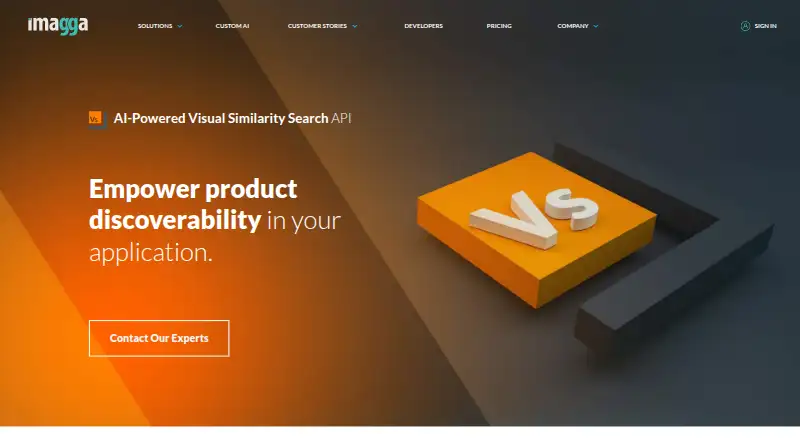
What Imagga Visual Search is
Imagga Visual Search is an API and deployment platform for adding image-based search to software and applications. It analyzes images with visual and semantic features, then finds matches by meaning, color, category, or functional similarity. A user can upload an image from the web or a personal device to locate similar items in an indexed collection. Custom criteria can be defined for a particular image database to improve relevance. Retailers can show related products as alternatives or provide additional choices when a product is unavailable; Imagga highlights fashion, home décor, and furniture retailers, while describing the technology as applicable to visual datasets in any industry. The service runs as a cloud platform or as an on-premise installation on private servers. On-premise files remain inside the customer’s data center, with a Docker image usually run on Linux and connected through a REST API. The infrastructure is designed for large request volumes, and the enterprise on-premise option supports billions of data with flexible licensing. Plans include a free tier and paid options beginning at $79 a month.
Good
- Searches by semantics, color, category, or functional similarity
- Accepts JPG, PNG, GIF, and WebP images
- Custom image-database criteria improve relevance
- Cloud and private-server deployment options
- Scalable infrastructure for large request volumes
Watch out
- Free plan requires Powered by Imagga attribution and a website link
- Free tier is limited to 100 API requests
- On-premise deployment is offered in the Enterprise plan
Who it suits
It suits companies building visual or semantic search into software, especially online retailers in fashion, home décor, and furniture. Teams needing private-server deployment can use the on-premise Docker and REST API setup.
Verdict
Choose Imagga Visual Search when your product needs image similarity or visual discovery through an API. It is also a fit for organizations requiring private-server processing. Look elsewhere if 100 free requests or attribution requirements do not suit your rollout.
Plans and prices
From Imagga Visual Search's own pricing page, checked 1 Oct 2026.
| Plan | Price | What it gives you |
|---|---|---|
| Indie | $79 a month | 70,000 API requests · Visual Search API · Background Removal API · Barcode Recognition API · OCR/Text recognition API · Email support · monthly |
| Pro | $349 a month | 300,000 API requests · Visual Search API · Background Removal API · OCR/Text recognition API · Face Recognition API · Priority support · monthly |
| Enterprise | Priced on request | Above 1,000,000 API requests · Custom models · Pay per use · Dedicated Support Engineer · On-Premise deployment |
| Free | — | 100 API requests · Basic Solutions · Online documentation |
The facts
Each one read from Imagga Visual Search's own pages, with the date it was checked.
What it does
- Core function
- Imagga enables companies to implement image-based search in software systems and applications using visual and semantic features extracted during categorization.checked 1 Oct 2026
- Customization
- Features relevant to an image database can be custom defined for higher accuracy results.checked 1 Oct 2026
- Deployment
- Imagga offers a cloud platform and an on-premise solution deployed on private servers for privacy-regulation compliance.checked 1 Oct 2026
- Enterprise scale
- The on-premise solution is designed to process billions of data with no ceiling limits and offers flexible licensing.checked 1 Oct 2026
- On-premise integration
- Imagga supplies a Docker image typically run on a Linux machine, and the stack is integrated through a RESTful API.checked 1 Oct 2026
- On-premise privacy
- On-premise files never leave the customer's data center.checked 1 Oct 2026
- Product recommendations
- The service can display similar products as alternatives or to offer more choice when products are out of stock.checked 1 Oct 2026
- Scalability
- The Visual Similarity Search API has scalable infrastructure capable of serving large amounts of requests within large search pools.checked 1 Oct 2026
- Search by image
- Users can search for similar items within an index by uploading an image from the web or one they took themselves.checked 1 Oct 2026
- Search criteria
- The API retrieves results based on semantics, color, category or functional similarity.checked 1 Oct 2026
- Security and compliance
- Imagga states that it is a GDPR and Bulgarian Personal Data Protection Act controller and that its privacy policy meets GDPR processing and protection requirements.checked 1 Oct 2026
- Support
- The pricing page lists email support for Indie, priority support for Pro, and a dedicated Support Engineer for Enterprise.checked 1 Oct 2026
- Target users
- Imagga identifies fashion, home décor and furniture online retailers as opportunities and says the technology can apply to any visual dataset regardless of industry or use case.checked 1 Oct 2026
Money
- Free-plan condition
- The free plan requires users to mention “Powered by Imagga” and link back to Imagga's website.checked 1 Oct 2026
The company
- Headquarters
- Sofia, Bulgariachecked 28 Sep 2026
The full review of Imagga Visual Search
Imagga Visual Search is an API for adding image similarity and visual discovery to applications that manage an indexed image collection. It is most suitable for retailers and other teams building search into a catalog, recommendation flow, or specialized visual dataset. Its configurable matching and private-server option are compelling, but request quotas, attribution on the free tier, and monthly cost should shape the buying decision.
Overview
Imagga extracts visual and semantic features during categorization, then returns matches according to meaning, color, category, or functional similarity. A user can submit an image from the web or a device and search for comparable items in the vendor-managed index. This is a product-integration service rather than a standalone consumer reverse-image website, so its value depends on having an application and a meaningful image pool behind it.
Search criteria can be tailored with custom-defined features for a particular image database. That is useful when a fashion, home décor, or furniture catalog needs relevance beyond generic visual resemblance. Imagga also positions the technology for any industry with a visual dataset, although teams still need to define which characteristics should drive matching.
Key features
Similarity results can power product recommendations, alternative suggestions, and “more like this” discovery. Retailers can show comparable products when an item is out of stock, turning image search into a merchandising tool rather than a single lookup. The API supports JPG, PNG, GIF, and WebP uploads.
Imagga describes scalable infrastructure for large request volumes and large search pools. That makes it a plausible foundation for an integrated catalog experience, while the plan quota remains the practical limit for predictable budgeting. The source index is vendor-only, so organizations wanting a completely self-managed search index should consider the on-premise offering or another product.
Cloud hosting is available alongside private-server deployment. The on-premise stack is supplied as a Docker image, typically run on Linux, and connects through a RESTful API. Files stay inside the customer’s data center, an important distinction for regulated or privacy-sensitive workloads. Imagga says its processing and privacy policy address GDPR and the Bulgarian Personal Data Protection Act. Enterprise on-premise deployments are intended for billions of data items without a stated ceiling and use flexible licensing.
Pricing
The free plan includes 100 API requests, Basic Solutions, and online documentation. It requires the user to display “Powered by Imagga” and link to Imagga’s website, which can rule it out for white-label launches or customer-facing products where attribution is unacceptable.
Indie — $79 a month, billed monthly: 70,000 API requests, Visual Search, Background Removal, Barcode Recognition, and OCR/Text recognition APIs, plus email support. This is the sensible entry point for a small production integration that needs several image services, but the monthly allowance is finite and support is not prioritized.
Pro — $349 a month, billed monthly: 300,000 API requests, Visual Search, Background Removal, OCR/Text recognition, Face Recognition, and priority support. It suits a busier application that needs more throughput and face recognition; the price is difficult to justify for prototypes or low-volume catalogs.
Enterprise — custom pricing: Above 1,000,000 API requests, custom models, pay-per-use billing, a dedicated Support Engineer, and on-premise deployment. This is the plan for high-volume or compliance-led deployments that need bespoke models and private infrastructure rather than a fixed self-serve quota.
Platforms
Imagga is offered as an API for web applications and runs on Linux, with self-hosted deployment supported through Docker. Cloud and on-premise choices let teams balance operational simplicity against data-residency requirements.
Who it's for
Online fashion, home décor, and furniture retailers are natural users because visual similarity can improve catalog discovery and substitute recommendations. It also fits organizations building search over any substantial visual dataset, especially where custom criteria or private-server processing are requirements.
It is less suitable for a simple personal reverse-image lookup, a project that cannot display attribution on a free tier, or a workload small enough that paid monthly quotas would be wasteful.
Pros and cons
- Pros: Matching by semantics, color, category, and function supports more precise catalog search than a single visual signal.
- Pros: Custom-defined features can align results with the needs of a specialized image database.
- Pros: On-premise Docker deployment keeps files inside the customer’s data center and supports privacy-regulated use.
- Pros: Enterprise licensing, custom models, and pay-per-use billing address very large or bespoke workloads.
- Cons: The free tier allows only 100 requests and requires Imagga attribution and a backlink.
- Cons: Indie and Pro are fixed monthly quotas, so growing traffic can force a plan upgrade.
- Cons: The vendor-only source index limits teams seeking a wholly self-managed indexing stack.
Alternatives
For a broader directory of comparable products, see Reverse Image Search Software and AI Reverse Image Search Tools.
Lenso.ai is a better fit when you need Android, iOS, desktop, browser-extension, and API access, with unlimited searches on its Starter plan. Choose LocalLens when open-source, self-hosted software with no stated usage limits matters more than a managed commercial API. SearchReverseImage suits free consumer searches with no signup or watermarks and support for files up to 4 MB. ImageRights Discovery is aimed at trying image-rights discovery on the first 100 images. Pixsy is preferable for monitoring up to 500 images and submitting unlimited cases, although its free tier includes no takedown notices. Reverse Image Search Anywhere is a free, open-source extension project. RIMG provides free reverse-image searches with no stated usage limit. SerpApi is the alternative when you need a general search API with a 250-search monthly free tier and 50-throughput-per-hour limit.
Verdict
Choose Imagga Visual Search for a retail or enterprise application that needs configurable image similarity, recommendation workflows, and an API that can be kept on private servers. Its strongest differentiator is the combination of custom visual criteria and on-premise privacy. Look elsewhere if your rollout cannot carry free-tier attribution, needs an unmetered low-cost service, or is simply a consumer reverse-image search.
Getting started
- Open the Imagga Visual Search website
- Choose the Free, Indie, Pro, or Enterprise plan
- Use the API with a supported image format
- For on-premise use, deploy the supplied Docker image on Linux
- Integrate the stack through its RESTful API
Limits worth knowing
The Free plan allows 100 API requests and requires a “Powered by Imagga” mention with a link to Imagga. The lowest paid Indie plan provides 70,000 API requests per month for 79.00 USD, billed monthly.
Questions
Is there a free plan?
Yes. The Free plan includes 100 API requests, basic solutions, and online documentation, with required Imagga attribution and a website link.
What does the Indie plan cost?
Indie costs $79 a month, billed monthly, and includes 70,000 API requests plus Visual Search, Background Removal, Barcode Recognition, OCR/Text recognition, and email support.
Can Imagga run on private servers?
Yes. Enterprise includes on-premise deployment; files stay in the customer’s data center, using a Docker image typically run on Linux and integrated through REST.
Which image formats are supported?
Supported formats are JPG, PNG, GIF, and WebP.
Does it provide API access?
Yes. Imagga Visual Search is delivered through an API and supports RESTful integration for on-premise deployments.
Alternatives to Imagga Visual Search
- 1
Berify
Free planAndroidiOSWebAPI8.0From $5.95 a month - 2
Ximilar Visual Search
Free planAndroidiOSWebAPI7.9From $69 a month - 3

Pixsy
Free planWebAPI7.4From $209 a year - 4

ViSenze
AndroidiOSWebAPI7.3 - 5
Cloudinary
Free planWebAPIExtension7.2Free plan - 6

ImageRights Discovery
Free planWebAPImacOSWindows7.0Free plan