Hypothesis
Hypothesis is a collaborative annotation tool for digital course materials.
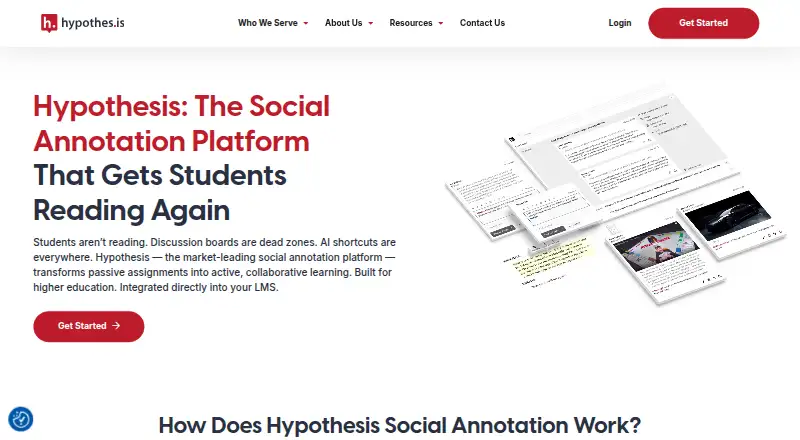
What Hypothesis is
Hypothesis is a collaborative annotation tool for digital course materials. Learners can highlight passages, ask questions, and reply to peers alongside the material they are discussing. Annotations can include private highlights, page notes, tags, and threaded replies. It supports web pages, PDFs, EPUB files, YouTube videos, and content from VitalSource and JSTOR. Colleges and universities can connect it to Canvas, Blackboard, Moodle, D2L Brightspace, and Sakai through LTI 1.3; annotations can also sync with LMS gradebooks, including Canvas SpeedGrader.
A free account is available for personal use and collaboration. The Free plan costs nothing, billed per student/yearly, and includes core annotation, private groups, and self-service support. Browser access includes a Chrome extension for Chrome and other Chromium browsers, or a bookmarklet for Firefox and Safari. Hypothesis also offers API access and exports in JSON, plain text, CSV, and HTML, with JSON import. It was founded as an open-source project in 2011.
Good
- Annotates web pages, PDFs, EPUBs, and videos.
- Supports threaded replies, private highlights, and tags.
- Integrates with five named LMS platforms.
- Free personal account and collaboration are available.
- Exports JSON, plain text, CSV, and HTML.
Watch out
- Bronze seats are capped at 1,000.
- Silver seats are capped at 2,000.
- Gold seats are capped at 3,000.
Who it suits
Hypothesis suits students and instructors who want to discuss course materials in context, as well as institutions seeking LMS integrations. Personal users and collaborators can start with the free account.
Verdict
Hypothesis brings discussion and notes directly alongside digital learning content, with options for individual use and institutional LMS integration. Check plan seat limits and support provisions against your needs.
Plans and prices
From Hypothesis's own pricing page, checked 15 Oct 2026.
| Plan | Price | What it gives you |
|---|---|---|
| Free | Free | Core annotation · Private groups · Self-service support · Per student/yearly |
| Bronze | — | Core annotation · LMS integration · Up to 1,000 user seats · Partner workshops · One annual training session · Standard email support · Per student/yearly |
| Custom solution | Priced on request | Custom solution; page does not specify features or price · Contact sales for a custom solution |
| Gold | — | Silver features · Up to 3,000 seats · Unlimited training · Dedicated customer success manager · Premium support · Hypothesis Academy · Quarterly check-ins · Per student/yearly |
| Silver | — | Core annotation · LMS integration · Up to 2,000 user seats · Advanced analytics · Auto-grading · Bronze support features · Hypothesis Academy · Per student/yearly |
The facts
Each one read from Hypothesis's own pages, with the date it was checked.
What it does
- Additional integrations
- Hypothesis says its annotations sync with LMS gradebooks, including Canvas SpeedGrader.checked 30 Sep 2026
- Analytics
- The LMS reporting dashboard provides annotation counts and engagement information across assignments and courses.checked 15 Oct 2026
- Annotation features
- Users can create annotations, private highlights, page notes, and threaded replies, and add tags to annotations.checked 30 Sep 2026
- Annotation types
- The service supports highlights, anchored annotations, page notes, threaded replies, tags and private, public or group visibility.checked 15 Oct 2026
- API
- The public API supports authentication plus creating, updating, deleting, searching and moderating annotations and managing users and groups.checked 15 Oct 2026
- Auto-grading
- The paid package descriptions include automatic grading based on student annotation activity and LMS gradebook synchronization.checked 15 Oct 2026
- Chrome distribution
- The Chrome Web Store listing reports approximately 300,000 users and identifies Annotation Unlimited PBC as publisher.checked 15 Oct 2026
- Compliance
- Hypothesis says it has completed a Cloud Security Alliance CAIQ assessment and documents SOC compliance, and it provides a HECVAT response for higher education customers.checked 30 Sep 2026
- Developer authentication
- Users can create an API token at the developer account page, while OAuth authorization and token endpoints support integrated clients.checked 15 Oct 2026
- Developer repositories
- Hypothesis publishes public repositories for the annotation service, client, browser extension, PDF viewer, proxy, LMS app and WordPress plugin.checked 15 Oct 2026
- Documentation depth
- The help center lists 37 annotation articles, 47 public-web articles and 124 LMS articles, plus installation and troubleshooting guides.checked 15 Oct 2026
- Education focus
- Hypothesis describes its institutional audience as colleges and universities, faculty and instructors, and students.checked 30 Sep 2026
- Gradebook workflow
- Canvas users can access student annotations through SpeedGrader, and the LMS app can synchronize annotation grades.checked 15 Oct 2026
- Image annotation
- Image annotations let users place pins or area selections on visual material such as diagrams, charts and scanned PDFs.checked 15 Oct 2026
- Independent finding: LMS workflow
- The University of Colorado assessment found Hypothesis operates as an LTI integration with an annotation sidebar and Canvas SpeedGrader access.checked 15 Oct 2026
- Independent praise: collaboration
- The University of North Texas guide reports that annotations can support collaborative discussion, peer review and inclusion of links, images and GIFs.checked 15 Oct 2026
- Independent praise: learning outcomes
- Washington University’s teaching center cites research linking social annotation with better critical thinking, metacognition, reading comprehension and reading motivation.checked 15 Oct 2026
Where it runs
- Browser access
- The free web app can be used with a Chrome extension on Chrome and other Chromium browsers, or a bookmarklet in Firefox and Safari.checked 30 Sep 2026
The company
- Company
- The site footer identifies the company as Annotation Unlimited, PBC, and the About page says the project was founded as an open-source project in 2011.checked 30 Sep 2026
- Company location and founding
- LinkedIn lists headquarters in San Francisco, California and a 2011 founding year.checked 15 Oct 2026
- Company scale
- LinkedIn lists Hypothesis as a privately held education company with 11–50 employees.checked 15 Oct 2026
- Founded
- 2011checked 23 Sep 2026
- Legal maker
- The service terms identify the contracting company as Annotation Unlimited, PBC.checked 15 Oct 2026
Money
- Free personal use
- Hypothesis says a free account is available for personal use and collaboration.checked 30 Sep 2026
The full review of Hypothesis
Overview
Hypothesis is an annotation tool for reading and discussing digital course materials, from web pages and PDFs to EPUBs and videos. It is best suited to learners and educators who want conversation attached to the text, especially in college courses using an LMS. Its strongest case is the combination of personal use and course-scale integrations; institutional buyers should weigh the per-student plans against their seat caps and support levels.
Key features
Readers can highlight passages, keep private highlights and page notes, add tags, and reply in threaded discussions. That mix makes Hypothesis useful both for private study and for collaborative reading, with questions and responses anchored to the material rather than separated into a discussion space.
Its content range is broad for an education-focused tool: annotations work on web pages, PDFs, EPUB files, YouTube videos, and content from VitalSource and JSTOR. Canvas, Blackboard, Moodle, D2L Brightspace, and Sakai connect through LTI 1.3, and annotations can sync with LMS gradebooks, including Canvas SpeedGrader. That makes it a stronger fit for courses already built around these systems than for teams seeking a general-purpose website feedback tool.
Hypothesis also offers export to JSON, plain text, CSV, and HTML, plus JSON import. The security program includes code analysis, dependency monitoring, assessments, and third-party penetration testing; it has completed a Cloud Security Alliance CAIQ assessment, documents SOC compliance, and provides a HECVAT response for higher education customers.
Pricing
The Free plan costs nothing, billed Per student/yearly. It includes core annotation, private groups, and self-service support, making it the practical starting point for personal use and collaboration without an institutional package. It does not include the LMS integration, analytics, or grading features named in the paid plans.
Bronze has custom pricing and is billed Per student/yearly. It includes core annotation and LMS integration, up to 1,000 user seats, partner workshops, one annual training session, and standard email support. It suits smaller institutions that need course integration and some onboarding, but the seat ceiling and limited training may constrain larger rollouts.
Silver has custom pricing, billed Per student/yearly. It raises the cap to 2,000 seats and adds advanced analytics, auto-grading, and Hypothesis Academy alongside core annotation and LMS integration. It is the more capable option for institutions needing grading and broader insight, though its higher seat ceiling still sets a boundary.
Gold has custom pricing, billed Per student/yearly. It includes all Silver features, up to 3,000 seats, unlimited training, a dedicated customer success manager, premium support, Hypothesis Academy, and quarterly check-ins. That service level is most relevant to institutions that need sustained implementation support; buyers should compare the cap with expected enrollment.
Custom solution pricing is available by contacting sales; the package’s features are not defined. Plan seat caps are 1,000 for Bronze, 2,000 for Silver, and 3,000 for Gold, so institutions beyond those limits should discuss fit before choosing a tier.
Platforms
Hypothesis supports web access, browser extension, and API use. The free web app works with a Chrome extension on Chrome and other Chromium browsers, or with a bookmarklet in Firefox and Safari. The platform list does not identify native mobile apps, so readers looking specifically for one should consider that before committing.
Who it's for
Hypothesis is a natural fit for college and university instructors, students, and institutions that want shared annotation in course materials and an LMS workflow. Individual readers and small collaborative groups can start with the free account. Organizations outside education may find the course-oriented integrations and per-student pricing less aligned with general review or feedback work.
Pros and cons
- Pros: Annotations cover a varied range of reading and learning content, including PDFs, EPUBs, YouTube, VitalSource, and JSTOR.
- Pros: LTI 1.3 connections and gradebook syncing can place annotation work inside established LMS courses.
- Pros: Private notes and threaded replies support both individual study and shared discussion.
- Cons: Paid tiers have seat caps, from 1,000 to 3,000 users, which may limit large deployments.
- Cons: Bronze and Silver offer narrower support and training than Gold, while Gold’s dedicated service comes with the highest listed seat cap rather than unlimited seats.
- Cons: Paid plans use custom pricing, so institutions cannot compare published per-student costs before contacting sales.
Alternatives
For a broader set of web annotation options, browse Web Annotation Tools. Choose Pastel instead if its Android and iOS platforms are important alongside web access. Annot8 is worth considering for web-based project feedback with a free tier capped at 2 projects, 3 team seats, and 50 feedback threads per month. AnnotationBase offers a free web plan with up to 5 active projects and 5 collaborators. dotts has a free web plan allowing up to 3 projects and unlimited reviewers. SiteDots is another free option with extension and web platforms. WebPinch offers extension and web access with a free plan for personal projects and one organization project. Markify provides free web canvases for comment-based feedback. PinPoint is a free web option while in early access, with limits of 100 projects, 20 members, and 20 guests.
Verdict
Choose Hypothesis if your priority is collaborative reading tied to course materials, particularly when an LMS and gradebook workflow matter. Its content support, threaded annotations, and education integrations make that case convincingly. Look elsewhere if you need a published institutional price, uncapped seats, or a general-purpose feedback tool rather than annotation built around learning content.
Getting started
- Open https://web.hypothes.is/.
- Create a free account for personal use and collaboration, or review institutional plans.
- Use the web app, install the Chrome extension for Chrome or another Chromium browser, or use the bookmarklet in Firefox or Safari.
- For institutional use, review the listed LTI 1.3 integrations with Canvas, Blackboard, Moodle, D2L Brightspace, and Sakai.
Limits worth knowing
The Free plan includes core annotation, private groups, and self-service support. Bronze, Silver, and Gold cap user seats at 1,000, 2,000, and 3,000 respectively.
Questions
Is Hypothesis free?
Yes. It offers a free account for personal use and collaboration, and the Free plan costs nothing, billed per student/yearly.
Which platforms and browsers does it support?
Its listed platforms are API, extension, and web. The web app can be used with a Chrome extension on Chrome and other Chromium browsers, or a bookmarklet in Firefox and Safari.
Which materials can be annotated?
Hypothesis supports web pages, PDFs, EPUB files, YouTube videos, and content from VitalSource and JSTOR.
Which LMS integrations are available?
It lists Canvas, Blackboard, Moodle, D2L Brightspace, and Sakai integrations via LTI 1.3. Annotations can sync with LMS gradebooks, including Canvas SpeedGrader.
Is Hypothesis open source?
The project was founded as an open-source project in 2011.
What are the paid plan seat caps?
Bronze supports up to 1,000 seats, Silver up to 2,000, and Gold up to 3,000. Prices for those packages are not provided here.