Horolog
Horolog is a free, open-source calendar that you host yourself.
What Horolog is
Horolog is a free, open-source calendar that you host yourself. It schedules focus time, habits, and deadline-aware tasks around meetings, accepting natural-language planning input. Its task scheduler places work in available sittings and assigns P1–P4 priorities when tasks compete for a slot. Habit routines can recur, use time-of-day windows and daily caps, and move automatically when schedules change. Horolog connects to Google and Outlook calendars, ICS feeds, and CalDAV servers, and can export a subscribable ICS plan. Smart Meetings identify times that fit every attendee’s availability. Native task sync modules are listed for Linear, Todoist, GitHub Issues, Notion, ClickUp, and Jira. Analytics include deep-work hours, meeting load, schedule fragmentation, the longest daily free period, after-hours load, and unmet demand. Users can select local or hosted language models, including Ollama, vLLM, SGLang, llama.cpp, Anthropic, and OpenAI. The project describes this build as single-user and unauthenticated; it recommends an SSO proxy for team use.
Good
- Schedules deadline-aware tasks around meetings
- Supports Google, Outlook, ICS, and CalDAV
- Exports a subscribable ICS plan
- Includes native sync modules for six task services
- Offers local and hosted model choices
Watch out
- Single-user and unauthenticated by design
- Booking links have no authentication
- Internet-facing booking routes need a reverse proxy
Who it suits
Horolog may suit people who want to host their own calendar and schedule tasks and habits around meetings. Its integrations and model choices may be useful for users coordinating across several calendars or task services.
Verdict
Horolog combines self-hosted calendar planning with task scheduling, habit routines, meeting coordination, and productivity analytics. Its unauthenticated design is an important limit for team use or internet-exposed booking links; the project recommends protective proxies for those cases.
The facts
Each one read from Horolog's own pages, with the date it was checked.
What it does
- AI models
- Users can choose local or hosted language models, including Ollama, vLLM, SGLang, llama.cpp, Anthropic, and OpenAI.checked 8 Oct 2026
- Analytics
- Productivity analytics include deep-work hours, meeting load, fragmentation, longest free run per day, after-hours load, and unmet demand.checked 8 Oct 2026
- Authentication limit
- The project describes this build as single-user and unauthenticated by design, and recommends an SSO proxy for team use.checked 8 Oct 2026
- Booking link limit
- Booking links have no authentication, and the README recommends putting the route behind a reverse proxy before internet exposure.checked 8 Oct 2026
- Booking links
- Booking links have no authentication, and the maker advises placing the route behind a reverse proxy before exposing it to the internet.checked 8 Oct 2026
- Calendar connections
- It supports Google and Outlook calendars, ICS feeds, and CalDAV servers, and can export the plan as a subscribable ICS feed.checked 8 Oct 2026
- Calendar support
- Horolog supports Google and Outlook calendars, ICS feeds and CalDAV servers, and can export a subscribable ICS plan feed.checked 8 Oct 2026
- Data handling
- The README says Horolog runs on the user's machine with no account or telemetry and that nothing leaves the machine.checked 8 Oct 2026
- Deployment
- The README provides Docker Compose deployment and says SQLite can be used instead of the default Postgres service.checked 8 Oct 2026
- Habits
- Habit routines support recurrence, time-of-day windows, daily caps, and automatic relocation.checked 8 Oct 2026
- Habits and focus
- The Habit & Routine Manager supports recurrence, time-of-day windows, per-day caps and automatic relocation.checked 8 Oct 2026
- License
- Horolog is licensed AGPL-3.0-or-later, and the README says modified network-service versions must publish their changes.checked 8 Oct 2026
- Meeting scheduling
- Smart Meetings find times that intersect every attendee’s availability.checked 8 Oct 2026
- Model providers
- Users can choose local or hosted models, including Ollama, vLLM, SGLang, llama.cpp, Anthropic and OpenAI-compatible providers.checked 8 Oct 2026
- Privacy
- The README says Horolog runs on the user's machine with no account, no telemetry and nothing leaving the machine; hosted model or calendar connections may require their own external services.checked 8 Oct 2026
- Product
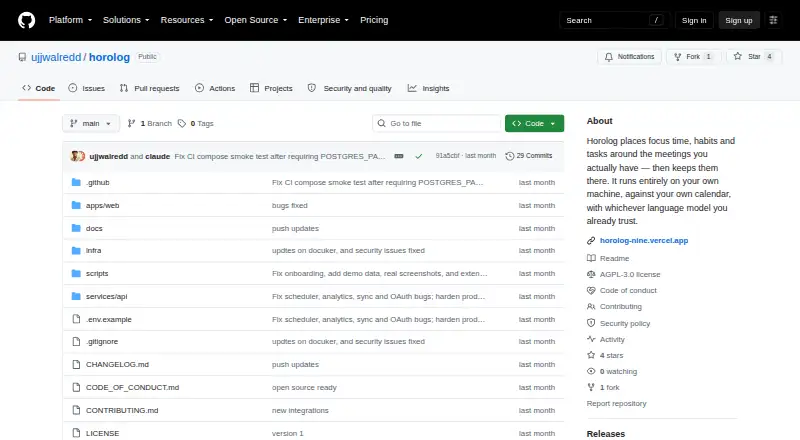
- Horolog is an open-source, self-hosted AI calendar that schedules focus time, habits and tasks around meetings.checked 8 Oct 2026
- Purpose
- Horolog is an open-source, self-hosted AI calendar that schedules focus time, habits, and tasks around meetings.checked 8 Oct 2026
- Security limitation
- The app is single-user and unauthenticated by design, and the maker advises putting it behind an SSO proxy for team use.checked 8 Oct 2026
- Support
- The repository links to a security policy for vulnerability reporting and welcomes contributions through its contributing guide.checked 8 Oct 2026
- Support and reporting
- The repository links to a security policy for reporting vulnerabilities and welcomes contributions through its contributing guide.checked 8 Oct 2026
- Task integrations
- Native sync modules are listed for Linear, Todoist, GitHub Issues, Notion, ClickUp, and Jira.checked 8 Oct 2026
- Task scheduling
- Its task scheduler places deadline-aware tasks in sittings around meetings, with P1–P4 priorities for contested slots.checked 8 Oct 2026